Arya News - As far back as 1867, White House officials have viewed Greenland, and Iceland, as having immense strategic value
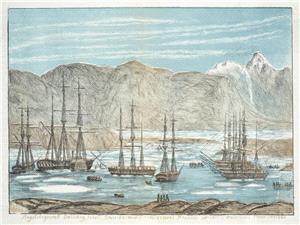
Shortly before the United States descended into civil war and senior administration officials made a forceful case to purchase Greenland for its natural resources, an American ship appeared in Nuuk’s harbour. Its arrival at Greenland’s largest outpost was newsworthy enough to merit a large picture in the local newspaper.
The clipping, published in 1861, comes from the pages of the Atuagagdliutt, a Kalaallisut-language weekly that was the first in the world to use colour illustrations.
The image of early US interest in Greenland forms part of a newly opened exhibition on 19th-century Arctic exploration at the University of Toronto’s Thomas Fisher rare book library.
Arctic Fever, which draws together lithographs, books, maps and ephemera, offers some uncanny parallels to today’s scramble for the north, showcasing the ambition, hubris and hunger for territory and resources that still drive much interest in the region.
“A lot of people see the news and are confused by president Donald Trump’s desires for Greenland. He’d said it in his first term. He voiced it last year,” said Isabelle Gapp, an art historian at the University of Aberdeen, and co-curator of the exhibition. “But people often don’t quite understand just how long a history the US has with Greenland.”
The view held by senior officials in the current White House was also held in 1867, when secretary of state William Seward formalized a desire to acquire Greenland and Iceland, citing the two islands’ immense strategic value.
Donald Trump has said he would not take Greenland by force, but the White House suggests that it remains keen to control the island. Jeff Landry, the US special envoy to Greenland, called it“one of the world’s most strategically consequential regions” in a recent New York Times op-ed, and called American dominance in the Arctic a “non-negotiable” reality.
“It’s lucky for us – in a kind of nasty way – that politics would make this collection so resonant. But I’m hopeful it gives us a chance to think more about just politics,” said the exhibition’s other curator, Mark Cheetham, an art historian at the University of Toronto. “It’s also the place where the themes of environment and migration and resource extraction are so dominant. We’re hoping though to be able to give the public a fuller view of a place that has long been the source of obsessions.”
Few regions of the world have captured the public imagination as the Arctic, buoyed in part by accounts of successful expeditions – and the horrors associated with failure . The exhibition’s title comes from the 19th-century US adventurer Walter Wellman, who wrote: “The arctic fever is in our blood, and there is no cure for such patients but to put them on ice.”
By focusing their collection during the zenith of exploration in the region, the team at the library are hoping to reshape how people understand the human presence in a vast, culturally and geographically diverse region of the planet.
“We tried to push against the narrative that this was a barren, inhospitable wasteland. Wilderness implies a space in which there is kind of nothingness, that one is travelling to a place where no one has been before. But this is obviously untrue when you look at the people who have long lived there,” Gapp said. “But even today, there’s a narrative that is a place where this man overcomes nature. And this idea very much comes from the 19th century.”
Grant Hurley, a librarian who helped acquire many of the works, said the collection showed the evolution of how nations slowly changed their views of the north.
“For European and American explorers, the Arctic was once thought of as a place to be transited successfully. It was simply a place to pass through,” he said. “Once that was accomplished, it then became a place to colonize and claim as your own territory.”
But for Indigenous peoples, the lands and waters were long a place to live, hunt, travel and explore. Threaded through the exhibit is a recognition that they understood how to thrive on the region’s land and waters – and attempted to share that knowledge with outsiders.
The British explorer William Parry spent a winter learning from Inuit in the 1820s when his search for the fabled Northwest Passage was foiled by ice. Parry grew enamoured with an Inuk woman called Iligliuk, who displayed a “superiority of understanding for which she was so remarkably distinguished”.
Early attempts to have locals sketch maps of the region “did not produce any very satisfactory information”, Parry wrote in his journal. But soon the British began to “appreciate the geographical knowledge which they possessed”.
Iligliuk’s ability to translate her knowledge of the land into something sailors could use was both accurate and detailed. Her skills were called “astounding” by the English geographer John Barrow, who was serving as the second secretary of the admiralty.
Iligliuk’s maps reflected generations of interaction with the environment. Instead of a compass, she was guided by winds, the movement of ice and the contours of the land. She identified spots where caribou were plentiful and where one could rest, displaying a very different relationship with the region than the one envisioned by European and American explorers.
“What strikes me over and over again is how militarized the Arctic has been [since] the first excursions in the 1500s. Parry wanted to find the Northwest Passage. Why? Because it was an economic and military advantage,” Cheetham said. “Iligliuk’s views reflected a wholly different measure of time and space.”
While none of his items are present, the curators admit that Sir John Franklin, the famed explorer, is the “ghost” of the exhibition. His 1845 expedition in search of the Northwest Passage ended in disaster, with all 129 crew members succumbing to the hostile elements.
From 1847 to 1859, at least 36 expeditions set out in search of Franklin’s lost ships. All ended in failure, but produced both an unprecedented stream of detailed studies of the region. The collection also includes other, more human artefacts from the search, including elaborate playbills printed on silk commemorating the theatrical showcases put on as entertainment during the long winter nights. One such performance, aboard the HMS Assistance in 1851, promised a “grand farcical, tragical, melo-dramatical, serio-comic” play, with a “lady … engaged at an enormous sacrifice, it being her first appearance on any stage” – a nod to the extensive catalogue of costumes brought along for the voyage.
Related: Inuit oral historian who pointed way to Franklin shipwrecks dies aged 58
It wasn’t until researchers turned to Inuit oral history that they were able to locate the final resting place of the Erebus and the Terror in the past decade.
Climate change has battered swaths of the Arctic and will inflict further damage to delicate ecosystems. As permafrost thaws and ice melts, the rush to extract immense resource wealth is only beginning. Nations and Indigenous peoples are bracing once more for a feverish push into the region.
“As the focus intensifies once more on the Arctic, it’s important to remember there isn’t one history, there are many histories. People have long moved in all directions, from all places. They have traveled and they have lived there,” Gapp said. “The history of the Arctic is long, rich, varied, and so too is its future. Where we are today is just another brief moment in its history.”