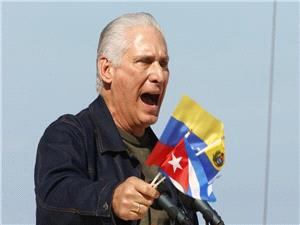
Arya News - Cuban President Miguel Díaz-Canel said Thursday he is willing to begin negotiations with the U.S.
Feb. 5 (UPI) -- Cuban President Miguel Díaz-Canel said Thursday he is willing to begin negotiations with the United States "without pressure" as the Caribbean island faces mounting economic challenges.
He made the remarks during a press conference with local media that was streamed on the Cuban presidency"s YouTube channel. Díaz-Canel acknowledged Cuba has not received Venezuelan oil since December, which he said has worsened an acute fuel shortage.
The president said the loss of Venezuelan oil supplies has placed the country in a "complex" energy situation that affects electricity generation, as well as basic economic activities across the island. Venezuela has been Cuba"s main oil partner for years under cooperation agreements between the two governments.
Díaz-Canel said his government is prepared to talk with Washington "on any issue of mutual interest," provided discussions occur "without pressure," "without conditions" and "on equal footing."
He described dialogue as a "historic" position of the Cuban state, but one shaped by what he called an "asymmetrical" relationship marked by decades of the U.S. economic embargo on Cuba.
"Cuba is willing to engage in dialogue with the United States, to talk about any issue that may be discussed," he said, adding that "under pressure, dialogue is not possible."
Any negotiations, he said, must include "respect for our sovereignty, our independence and our self-determination," and should avoid issues that could be interpreted as "interference in our internal affairs."
Díaz-Canel outlined potential areas for cooperation including migration, regional security, efforts to combat drug trafficking and terrorism, as well as scientific, academic and cultural exchanges.
"We do not hate the American people," he said, adding that past contacts between the two countries have revealed "many things we can work on together without prejudice."
The Cuban leader also addressed what he described as growing external threats, including warnings of a possible military attack and tighter U.S. sanctions. He said Cuba is "a country of peace" and rejected the idea that it poses a threat to the United States.
"Our military doctrine is the concept of the war of the entire people, which is a defense of sovereignty and independence," Díaz-Canel said, stressing the strategy "does not contemplate aggression against another country."
He said the government has implemented a nationwide defense preparedness plan after assessing regional developments and their implications for Latin America and the Caribbean.
Cuban authorities linked the move to regional tensions following U.S. actions against Venezuela, which Havana describes as including the detention of Venezuelan President Nicolás Maduro.
The plan covers preparations across the territorial defense structure "from municipal defense zones to the National Defense Council," as well as regular armed forces units, territorial militias and civil defense brigades.
Díaz-Canel said the measures are "legitimate" under Cuba"s constitution. He added the country has designated Saturdays as "National Defense Days" and recently updated plans to respond to a potential attack, including preparations for a possible wartime transition, "if necessary."
"We are not saying that we have entered a state of war," he said. "We are saying we are preparing in case we have to enter a state of war at some point."
The president also outlined the government"s strategy to address the energy emergency, which he said has worsened due to fuel access restrictions imposed by the administration of President Donald Trump.
He referred to a policy known in Cuba as "Zero Option," originally designed during the economic crisis of the 1990s under former leader Fidel Castro. The approach emphasizes austerity and domestic self-sufficiency as short-term responses to shortages.
Díaz-Canel said the full plan has been approved by the Council of Ministers and will be presented soon. At the same time, Cuba is moving ahead with an energy transition aimed at reducing reliance on fossil fuels and expanding renewable generation, he said.
Díaz-Canel said the country installed more than 1,000 megawatts of solar capacity in 2025 through about 49 photovoltaic parks. That expansion increased the share of renewable energy in Cuba"s electricity mix from 3% to 10% in a single year.
He said the strategy includes continued solar expansion, energy storage systems to support nighttime supply, maintenance of thermoelectric plants and electrification of remote communities.
"This situation reinforces the importance of the energy transition and the need for the country to sustain itself with the energy sources it has," Díaz-Canel said.