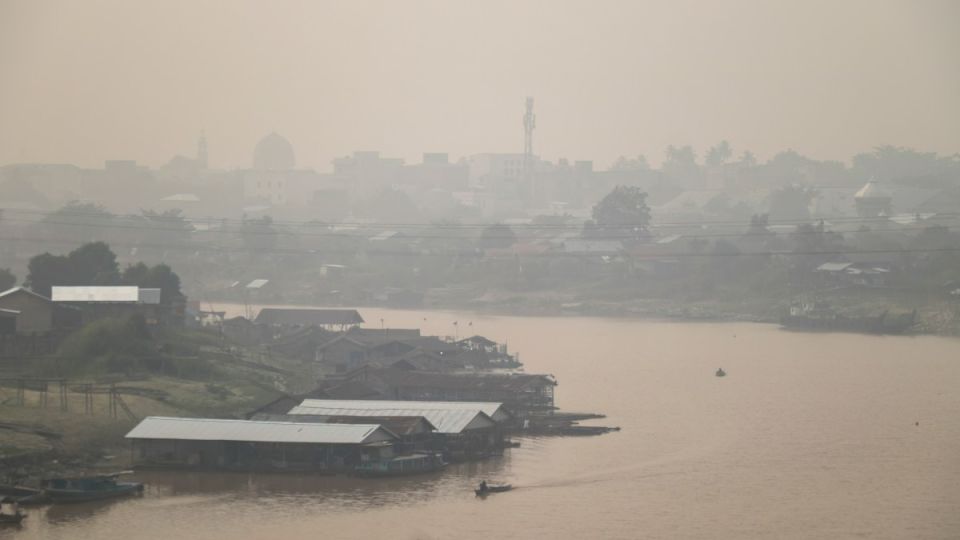
Arya News - Japan is set to deploy three helicopters to help Indonesia battle forest and peatland fires in Kalimantan at Jakarta’s request – as smoke from the blazes spread across Southeast Asia and pressure mounts on the government to accept more international assistance.
JAKARTA – Japan is set to deploy three helicopters to help Indonesia battle forest and peatland fires in Kalimantan at Jakarta’s request as smoke from the blazes spreads across Southeast Asia and pressure mounts on the government to accept more international assistance.
The Japanese CH-47 Chinook helicopters, each capable of carrying up to 5,000 liters of water, are expected to begin water-bombing operations next Thursday, the National Disaster Mitigation Agency (BNPB) said.
Defense Minister Sjafrie Sjamsoeddin told House of Representatives Commission I, which oversees foreign affairs and defense, earlier on Monday that the assistance was being provided under the Humanitarian Assistance and Disaster Relief (HADR) framework of the Defense Cooperation Agreement (DCA) signed by Indonesia and Japan in May.
The agreement provides for closer coordination during disasters, including logistical support and the deployment of transport assets.
“In defense cooperation, when a friend is in need, the other steps in to help,” said Sjafrie during the meeting.
An advance team from Japan has arrived in Indonesia to coordinate with the Indonesian Military (TNI) and the forest and land fire task force ahead of the helicopters’ deployment.
Meanwhile, BNPB acting spokesperson Berton Panjaitan said a preparatory meeting and site survey had been completed Friday at Supadio Air Force Base in West Kalimantan. The team identified several locations across Kalimantan for water bombing operations.
Japan’s Defense Ministry had as well confirmed the deployment previously, saying its Self-Defense Forces helicopters for international disaster relief would be sent “at the request of the Government of Indonesia,” according to a post on the ministry’s official X account.
The assistance comes as fires continue to spread across Kalimantan, with hotspots concentrated in West, Central and South Kalimantan.
As of Aug. 30, the Forestry Ministry had detected 946 fire hotspots nationwide, including 455 in West Kalimantan and 308 in Central Kalimantan, as dry conditions and thick smoke hamper firefighting efforts.
Nearly 13,000 personnel and dozens of aircraft had been deployed to fight the blaze, but the response has struggled to keep pace with the scale of the fires, combined with the ongoing El Niño weather phenomenon.
Forestry Minister Raja Juli Antoni acknowledged that reducing the wildfires would be challenging as El Niño, which intensifies severe drought conditions, would only peak this month.
The fires have also sent smoke across the region, with the Philippines reporting that haze had blanketed the capital, Manila, pushing air quality to “very unhealthy” and “acutely unhealthy” levels in some areas.
In neighboring Malaysia, air quality in six areas of Sarawak reached hazardous levels on Tuesday, according to data from the country’s Department of Environment, Reuters reported.
Malaysian authorities have considered cloud seeding to address the deteriorating conditions and have offered to help Indonesia fight the fires, including through firefighting and cloud-seeding operations. Jakarta, however, has yet to say whether it will accept the offer.
“Regarding assistance from Malaysia, we have not yet received further instructions on how to proceed. We are currently focused on optimizing existing resources and conducting forest and land fire response operations in the field,” Berton of BNPB told The Jakarta Post, Monday.
Calls have mounted for Indonesia to broaden its response and formally declare the fires a national disaster, which observers say would strengthen coordination and facilitate international assistance, particularly as the dry season intensifies.
Although the government has maintained that a national disaster declaration is not necessary to receive foreign assistance, experts argue that the scale of the fires and the resulting transboundary haze warrant such a designation.
“The wildfires have created massive spillover effects not only to public health and the economy at home but also to our neighbors. The government must quickly declare it as a national disaster and open to cross-border cooperation to tackle the crisis,” said Trubus Hardiansyah, a public policy professor at Trisakti University.
The authority to declare a disaster as a national disaster rests with the President under the 2007 Disaster Management Law. The designation allows greater central government intervention and facilitates the flow of foreign assistance under the supervision of BNPB.
On the other hand, under BNPB Regulation No.6/2018, international assistance can be accepted during a disaster emergency based on an official statement from the Indonesian government. The regulation does not require a national disaster declaration, but the government must formally accept the assistance.
Daniel Johan, a member of House Commission IV overseeing forestry, said the territorial coverage and public health impacts of the ongoing fires were “extraordinary,” urging the government to declare a national disaster to strengthen its financial capacity to combat the fires.
A BNPB official told the Post on Tuesday that, regardless of the absence of a national disaster declaration, the central government remained committed to deploying “its set of national-scale resources” to contain the fires.
Read More:
Health department advises public to mask up as haze from Indonesia forest fires reach the Philippines
Malaysia’s Sarawak in haze, water crisis