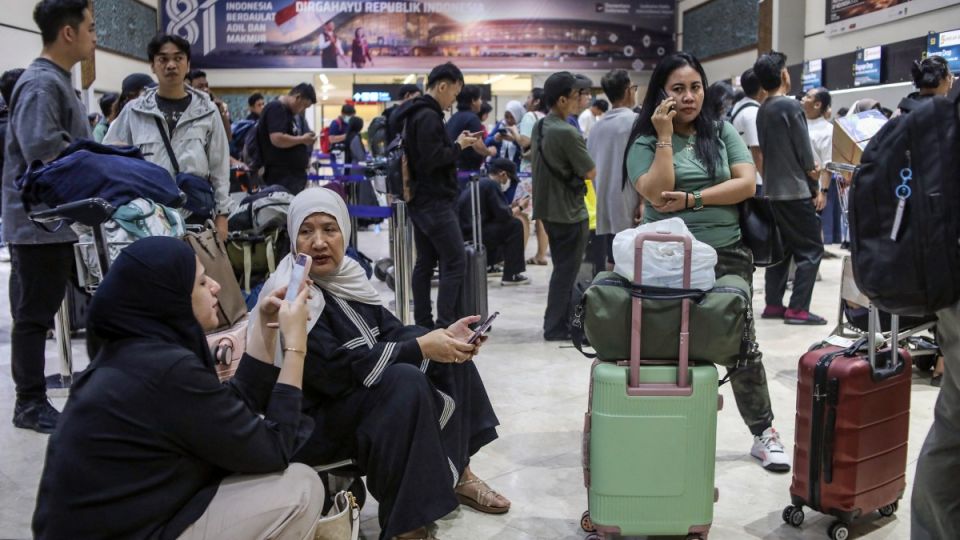
Arya News - Indonesia`s Transportation Ministry data showed that more than 2,300 flights had been disrupted since Sunday, affecting 270,337 passengers – marking a sharp increase from a day earlier, when more than 450 flights affecting 170,000 passengers had been disrupted.
JAKARTA – Local and international travelers scrambled for alternatives and faced mounting uncertainty on Monday as Mount Anak Krakatau’s volcanic ash kept eight Indonesian airports closed, disrupting thousands of flights as critics questioned the government’s contingency plans and communication.
The travel chaos stretched into its second day after the volcano, located in the Sunda Strait between Java and Sumatra, erupted continuously for about 25 hours from late Friday to early Sunday, sending ash plumes as high as 50,000 feet into the atmosphere.
The volcano erupted again on Sunday evening, although the event lasted less than a minute.
The lingering ash forced eight airports to remain closed on Monday, including Jakarta’s Soekarno-Hatta International Airport and Halim Perdanakusuma Airport, after ashfall was detected around their airfields.
Transportation Ministry data showed that nearly 3,000 flights had been disrupted since Sunday, affecting 341,000 passengers. That was a sharp increase from a day earlier, when more than 450 flights affecting 170,000 passengers were disrupted.
With airport closures extended in increments of several hours, travelers were left uncertain about when they could resume their journeys, particularly those facing tight connections or other time-sensitive plans.
Pascale Iskandar, a 39-year-old inventory worker, was supposed to return from Bali to Jakarta on Sunday before flying to Canada on Tuesday. After her original flight was canceled, she booked another for Monday night, only to receive another cancellation around noon.
“Everything is unclear. Soekarno-Hatta’s closure is not announced for a full day, and developments come by the hour,” Pascale told The Jakarta Post on Monday.
Farida, a 24-year-old finance analyst from North Sumatra, faced a similar predicament after being unable to return to Jakarta for work.
While she praised her airline for offering refunds and free rescheduling, Farida said she remained unaware of any contingency plan for affected travelers.
“I think the government is still lacking when it comes to providing information about the disaster’s contingency plan and what steps we travelers should take next,” Farida told the Post.
The government has sought to ease the bottleneck by directing traffic to five alternative airports across Java: Kertajati, Yogyakarta International, Juanda, Adi Soemarmo and Ahmad Yani.
“We continue to encourage airlines, especially foreign airlines, to use larger aircraft and the alternative airports we have provided,” Transportation Minister Dudy Purwagandhi said on Monday, adding that passengers on canceled flights were entitled to full refunds.
Dudy also said that authorities provided free buses and trains for passengers traveling to and from Yogyakarta, Surakarta, Semarang and Surabaya.
The minister said the Volcanic Ash Advisory Center had forecast ash dispersion to persist until at least Tuesday morning. The ministry would continue testing for ash at affected airports to determine whether limited operations could resume.
The disruption comes amid renewed unrest at Anak Krakatau, which has remained at Level III, or the second-highest level of alert, since July following several years of relative calm. Geological authorities have warned that further eruptions remain possible.
Anak Krakatau was not the country’s only active volcano disrupting aviation. The Meteorology, Climatology and Geophysics Agency (BMKG) website announced that Wunopito Airport in East Nusa Tenggara (NTT) was also closed on Monday because of volcanic ash from Mount Ili Lewotolok.
Four other volcanoes have also erupted over the past two weeks, namely Sinabung in North Sumatra, Semeru in East Java, Lewotobi Laki-laki in NTT, and Ibu in North Maluku.
Health concerns
Ash drifting across Banten, Jakarta and West Java has also raised health concerns, particularly for children, older people and those with chronic respiratory or cardiovascular conditions.
The Health Ministry estimated that about 3.3 million older people could be at risk from exposure, warning that volcanic ash can cause acute respiratory infections and irritation to the eyes and skin.
Pulmonologist Tjandra Yoga Aditama said the danger comes from ash entering the respiratory tract, where it can irritate the throat and trigger bronchitis-like illnesses while worsening conditions such as asthma and chronic obstructive pulmonary disease.
“In extreme circumstances, when very large amounts of ash are inhaled, especially by those very close to the eruption, asphyxia can occur, creating a sensation of choking,” Tjandra said on Monday.
Anak Krakatau’s eruption has added another emergency to a string of recent disasters across the archipelago, including other volcanic eruptions, forest and land fires in Sumatra and Kalimantan, and a powerful earthquake in NTT.
The overlapping emergencies prompted President Prabowo Subianto to convene ministers and disaster officials virtually on Monday, where he called for continued monitoring of eruptions occurring in several regions.
“From the reports, I see that we have done our utmost so far. All of this will serve as material for us to plan our next steps,” Prabowo said. “Since we are on the Ring of Fire, we have to be prepared.”
Read More:
Indonesia volcano eruption: Schools shift online, offices largely remain open in ash-hit Jakarta