Arya News - As the search continues, lawmakers and transportation experts call for a thorough investigation into the incident, highlighting longstanding concerns over the adequacy of Indonesia’s sea vessel inspections.
JAKARTA – Indonesia’s vessel safety standards are under renewed scrutiny after the Virgo Transport 8 ferry capsized in the Java Sea, leaving at least six people dead and 129 missing while raising questions over whether authorities’ seaworthiness checks are rigorous enough to prevent maritime disasters.
Search and rescue teams on Monday stepped up efforts to find the missing passengers, deploying 22 sea and air assets across six sectors covering about 1,600 square nautical miles.
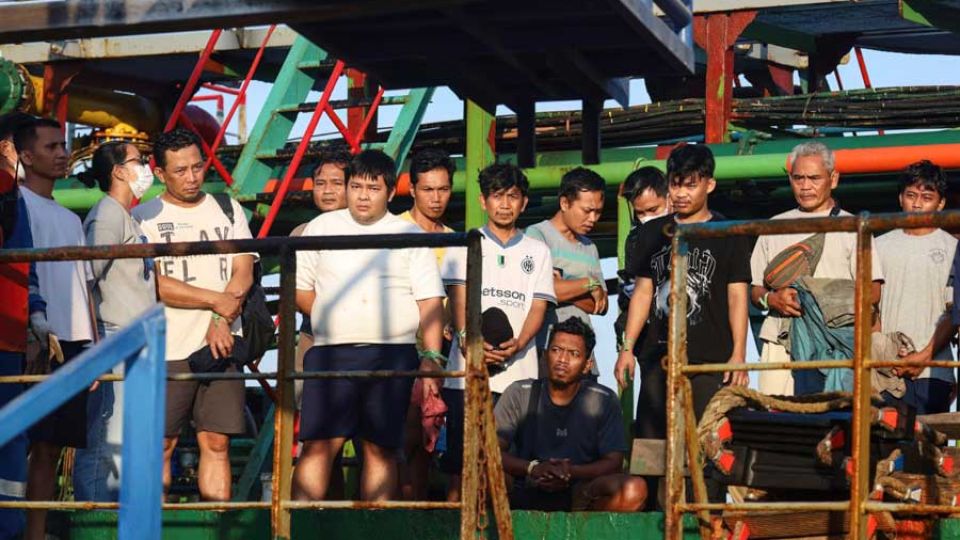
As of Monday, the National Search and Rescue Agency (Basarnas), along with the Indonesian Navy and the National Disaster Mitigation Agency (BNPB) had located 114 of the vessel’s 243 passengers, including 108 survivor and six fatalities.
Several fishing boats have rescued survivors, with one reportedly carrying about 22 people.
“Regarding the status of the 243 passengers: 108 have been found alive, six have died, and 129 are still being sought. These figures are not yet final and may change as the situation develops,” said Nanang Sigit, head of the Surabaya Search and Rescue Office.
The ferry departed Tanjung Perak Port in Surabaya, East Java, for Banjarmasin, South Kalimantan, early on Sunday before reporting bad weather and subsequently losing contact with its shipping company.
Its final Automatic Identification System (AIS) signal was recorded at 10:33 p.m. local time at about 12.8 knots, down from its previous speed of 13 knots, according to data collected by a remote base station operated by the Sepuluh Nopember Institute of Technology (ITS) in Surabaya.
Dhimas Widhi Handani, a shipping systems expert at ITS, said the drop in speed could have been caused by stronger currents, although further investigation was needed.
The AIS data, stored on an ITS server, is expected to help the National Transportation Safety Committee (KNKT) reconstruct the vessel’s movements.
High waves continued to hamper the search and the transfer of survivors to shore, while authorities urged fishermen to report any survivors they found.
Safety checks
As the search continues, lawmakers and transportation experts called for a thorough investigation into the incident, highlighting longstanding concerns over the adequacy of Indonesia’s sea vessel inspections.
The Virgo Transport 8, which was 39 years old when it last sailed, was carrying 213 passengers and 30 crew members when it lost contact on Sunday. The incident has prompted questions over whether the vessel underwent sufficiently rigorous safety and seaworthiness checks before departure.
Several House of Representatives Commission V members, which oversees transportation, questioned whether the issuance of the vessel’s Port Clearance Letter (SPB) had involved adequate scrutiny of its seaworthiness.
In Indonesia, the SPB is a mandatory clearance issued by a harbor master after verifying a vessel’s required documents, including its passenger or cargo manifest, crew list, master’s sailing declaration and other ship documents.
Commission V member Danang W. Sulistya said authorities should examine the seaworthiness documents issued by the Indonesian Classification Bureau (BKI), as well as the process through which harbor masters issue SPBs.
“All seaworthiness documents must also undergo thorough evaluation to ensure that operating vessels genuinely meet safety standards,” Danang said in a Monday statement.
Another Commission V member, Sudjatmiko, similarly called for all safety aspects to be thoroughly checked, saying authorities “should not wait for an accident before conducting an evaluation”.
The Virgo Transport 8 incident was the latest in a long line of maritime accidents in Indonesia.
According to Basarnas data, 601 maritime accidents requiring search-and-rescue operations were recorded between January and Aug. 15 this year. Most involved people falling overboard, engine failures or vessels losing contact.
Transportation expert Djoko Setijowarno said that weaknesses in the SPB issuance system could have contributed to the accident, saying the process relied heavily on document verification while physical inspections were generally conducted only when a vessel had already been flagged as potentially unseaworthy.
“The regulation suffers from several weaknesses, [including] that the SPB process still relies heavily on the master’s declaration, while there are no clear requirements for random inspections before departure or regular safety audits of the fleet,” Djoko said on Monday.
He said the problem had persisted for years but had been further aggravated by the government’s efforts in recent years to reduce transportation spending as part of its efficiency drive.
Beyond the regulatory system, disaster expert Daryono, a former director of the Meteorology, Climatology and Geophysics Agency’s (BMKG) earthquake and tsunami center, said shipmasters needed stronger training to assess weather, currents and wave conditions.
Such training would allow masters to make better decisions on routes and whether to continue sailing under deteriorating conditions, he said.
“Safety at sea must not be left to luck alone. It must be grounded in an understanding of oceanography, meteorology and established maritime safety regulations,” Daryono said.
Read More:
Rescuers battle turbulent seas in search for 129 people after ferry sinks off Indonesia’s Java