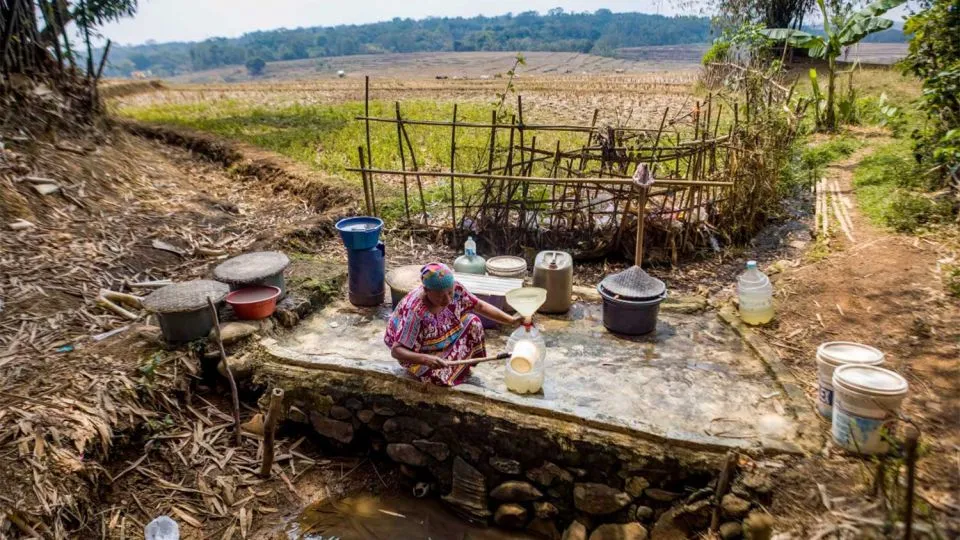
Arya News - The planned data centre site, owned by Singapore-based firm BDx Data Centers, is located roughly 5 kilometres from the Jatiluhur Dam – the main source of clean water for the Greater Jakarta area and irrigation for farms in western parts of West Java.
JAKARTA – The West Java administration has suspended the construction of a data center in Jatiluhur, Purwakarta regency, West Java amid concerns over its environmental impact and pressure on local water reserves.
The company behind the project, Singapore-based digital infrastructure firm BDx Data Centers, reportedly had yet to secure its environmental impact assessment (Amdal) and building approval (PBG).
“If the permits are still being processed, then construction should not start yet,” West Java Governor Dedi Mulyadi was seen telling a project consultant in a video uploaded to his Instagram account on Wednesday.
He also called for the permit process to be expedited, so the project would not be considered “problematic” and to provide certainty for the investing company.
Dedi attended the groundbreaking ceremony for the project on July 28, while the construction started last week.
The artificial intelligence data center, located roughly 5 kilometers from Jatiluhur Dam, has a total IT capacity of 640 megawatts (MW). The first 120 MW facility is expected to enter service in early 2027.
It had secured 845 megavolt-amperes (MVA) of grid capacity from state-owned electricity company PLN, as part of more than 1.2 gigavolt-amperes (GVA) in total power capacity the firm secured across its AI campuses in Indonesia.
According to a discussion posted on Dedi’s official YouTube channel, the data center will initially require 6,000 cubic meters of water every day, with the need projected to rise to a maximum of 384 liters per second over five to 10 years. The same volume of water is equivalent to the average clean water usage per day of a family of four.
The water supply for the data centers will be provided gradually through an official partnership with the local drinking water utility.
The Purwakarta Regency Environmental Agency is currently reviewing the AMDAL.
The suspension announcement came amid public concerns over the data center’s water use and its potential impact on Jatiluhur Dam, which is the main water source for Greater Jakarta and agricultural irrigation for rice fields in the western part of the province.
The area might not have sufficient environmental capacity to support the data center’s operations, according to Indonesian Forum for the Environment (Walhi) campaigner Wahyu Eka Styawan. The site consumes a lot of power and generates heat, requiring a cooling system that typically uses water.
“What we’re concerned about is that the reservoir’s water levels and supply could be affected,” Wahyu said on Wednesday. “Especially amid the current drought, water is a resource that must be protected.”
He added wastewater generated by the facility could also pollute the surrounding environment.
With Indonesia seeing rising investments in and construction of data centers, Wahyu urged the government to establish specific regulations and permitting requirements that take local environmental conditions and electricity supplies into account, while also involving public participation and transparent process.
“If those regulations are not yet in place, all such projects should be put on hold,” the Walhi activist added, urging the BDx project to be relocated should the AMDAL assessment find that an area lacks the water supply to support its operation.
According to the global data center industry directory Data Center Map, Indonesia has 204 data center sites, the fourth largest number in Asia after China, India and Japan. Most facilities are located in Jakarta and Batam, Riau Islands.
The facilities serve a range of digital infrastructure needs, including cloud services and AI data processing.
Underlining the importance of AI data centers like the one planned at Jatiluhur to allow data processing for AI to take place domestically, their operating companies must prioritize a water-efficient cooling system, said Alfons Tanujaya of the National Information and Communication Technology Entrepreneurs Association (APTIKNAS).
Data centers use two main types of liquid cooling systems: open-loop systems that require a continuous supply of fresh water and closed-loop ones that recirculate water within the facility.
He supported a thorough review on the BDx facility’s planned cooling system to determine its water use: “We can tolerate the development from the water-use perspective, but we have to make sure the data center uses a closed-loop system.”
Alfons also urged the government to create a one-stop permitting system that ensures AMDAL is completed before projects are launched.
BDx did not respond to The Jakarta Post’s request for comment by the time of publication.
The government is seeking to expand Indonesia’s data center capacity to support the country’s growing digital economy and AI development.
Coordinating Economy Minister Airlangga Hartarto previously said the industry is expected to maintain positive momentum over the next three to four years, with an aim for the country to increase data center capacity from 800 MW to 1.5 GW in the near future.