Arya News - Instead of chasing store counts, coffee companies from Starbucks China to Luckin Coffee are increasingly emphasising store productivity, premium experiences and sustainable returns – reflecting a broader shift as China`s coffee market enters a more mature stage of development.
SHANGHAI – For much of the past decade, success in China’s coffee market was measured by two numbers: how many stores a company could open and how cheaply it could sell a cup of joe.
That formula helped transform China into one of the world’s fastest-growing coffee markets. Chains rushed to blanket cities with outlets, expanded into counties and townships and conditioned consumers to expect coffee for as little as 9.9 yuan ($1.47) a cup.
Now, the industry’s biggest players are rewriting the playbook.
Rather than chasing store counts at all costs, companies from Starbucks China to Luckin Coffee are increasingly emphasizing store productivity, premium experiences and sustainable returns, reflecting a broader shift as China’s coffee market enters a more mature stage of development.
The transition marks an important inflection point for an industry that has spent years prioritizing scale over efficiency. As store networks become denser and competition intensifies, investors are paying less attention to how many outlets companies open and more attention to whether those stores generate healthy profits.
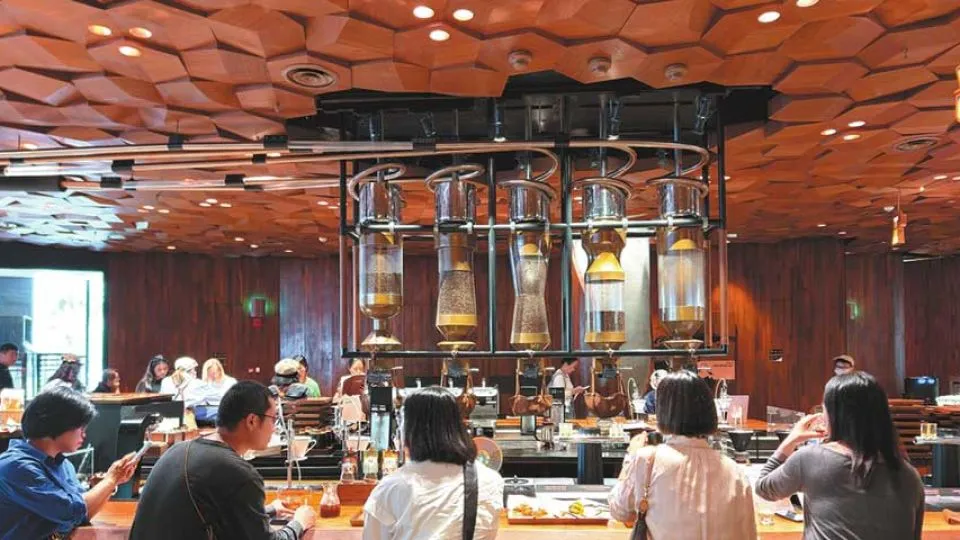
No company better illustrates the shift than Starbucks China. In September, Starbucks opened its new-generation flagship Starbucks Reserve inside Beijing SKP, one of China’s most prestigious luxury shopping malls.
Far more than another coffee shop, the location serves as a showcase for Starbucks’ evolving strategy. The store combines Reserve coffee, Italian desserts and the national debut of its “Global Inspiration” gifting collection, aiming to create a destination where coffee, luxury retail and lifestyle experiences converge.
The concept represents Starbucks’ “thousands of stores, thousands of faces” strategy. Stores are increasingly customized according to local neighborhoods, shopping districts and customer occasions, instead of following a standardized global format.
“Starbucks Reserve is an innovative practice in which we respond to customer needs and the character of the trade area, using creativity, professional capability and global resources to create a distinctive experience,” said Molly Liu, CEO of Starbucks China.
“It is also an important exploration under our ‘thousands of stores, thousands of faces’ strategy — co-creating a destination space with a landmark retail partner.”
The strategy comes just months after Starbucks Global completed its strategic partnership with Boyu Capital, which also owns SKP.
The investment has accelerated Starbucks China’s transition toward what executives describe as a “high-quality, scenario-based” expansion strategy. The company is tailoring formats to different consumption occasions, including premium commercial landmarks, lower-tier cities, cultural tourism destinations and everyday neighborhood locations.
As of Sept 15, Starbucks operated 8,238 stores across China. During fiscal 2026, it added 227 net new stores while entering 69 county-level markets. Nearly half of those openings were in third-tier cities and smaller markets, where management said new-store profitability has remained strong.
Luckin Coffee, China’s largest coffee chain by store count, is taking a different route toward the same objective. Unlike Starbucks, Luckin continues to expand aggressively. But executives are increasingly emphasizing operating quality alongside expansion.
The company reported second-quarter revenue of 15.89 billion yuan, up 28.5 percent from a year earlier, while operating profit rose 22 percent to 2.12 billion yuan. Company-run store operating margins remained above 21 percent despite continued promotional activity.
Average monthly transacting customers climbed nearly 23 percent to a record 113 million. Meanwhile, Luckin added 2,714 net new stores during the quarter, bringing its global network to 36,310 locations, including more than 35,000 across China.
CEO Guo Jinyi described the company’s approach as “high-quality scaled growth”, arguing that digital operations, continuous product innovation and customer engagement remain the company’s competitive advantages.
Investors appear convinced. Earlier this month, Abu Dhabi sovereign wealth fund Mubadala Investment Co agreed to acquire a strategic minority stake in Luckin in a transaction valued at about $1 billion.
Mohamed Albadr, Mubadala’s head of Asia, cited Luckin’s technology-enabled operating model, digital capabilities, scale and product innovation as reasons behind the investment, saying the fund expects to support the company’s next stage of domestic and overseas expansion.
The investment also reflects growing confidence that China’s coffee market remains far from saturated, provided operators can maintain healthy metrics.
Perhaps the clearest sign that the industry’s priorities are changing comes from Lucky Cup, a freshly ground coffee brand under Mixue Group. Lucky Cup built its business by combining aggressive franchising with low prices and rapid penetration into lower-tier markets. The strategy helped the chain expand from about 4,600 stores to more than 10,000 within less than a year, making it China’s third coffee chain to surpass the 10,000-store milestone.
Now the company is deliberately slowing down. In July, Lucky Cup informed franchisees it would cap new store openings at about 2,000 during this year, with fewer than half opening in the second half.
Instead of pursuing blanket nationwide expansion, the company plans to concentrate investment in roughly 20 core cities while allocating about 300 million yuan to upgrade professional coffee machines at eligible stores.
The support program targets outlets in Beijing, Shanghai, and Guangdong province’s Guangzhou and Shenzhen — along with premium commercial districts — reflecting a strategic shift from maximizing store numbers to improving store performance.
For Lucky Cup, the question is no longer how quickly it can expand, but how much each existing location can produce and how to improve efficiency and quality.
The transition is proving more difficult for weaker operators. Tims China, operator of Tim Hortons on the Chinese mainland, reported another disappointing quarter as sales continued to deteriorate. Second-quarter revenue declined 21.7 percent year-on-year to 273 million yuan, while net loss widened nearly 28 percent.
Company-operated stores remained under pressure. Revenue from such stores fell 21.6 percent, same-store sales dropped 17.3 percent and customer traffic declined more than 20 percent. The figures suggest that maintaining a large store network offers little protection when consumers visit less frequently.
As of June 30, Tims China operated 1,028 stores, adding only two net new locations during the quarter — a pace that leaves the company struggling to compete in an increasingly scale-driven market while failing to improve store productivity.
The divergence among China’s coffee chains reflects the maturation of the industry’s economics. The industry’s changing priorities also mirror broader trends across the country’s consumer economy, where investors increasingly reward profitability and operational discipline over growth at any cost. As the market matures, the winners are likely to be determined less by who can sell the cheapest latte — and more by who can generate the highest returns from every store they operate.