Arya News - With demand for matcha growing in Japan and overseas, the prefecture is making efforts to increase its production capacity of tencha, and more tea fields are shifting to this style of tea cultivation.
SHIZUOKA – Amid a global matcha boom, Shizuoka Prefecture regained its status as Japan’s top producer of first-flush green tea leaves by volume this year, for the first time in two years, according to agriculture ministry crop statistics.
Shizuoka’s reclamation of the top spot came about mainly because of a shift between two styles of green tea: sencha and tencha.
Sencha is green tea made by steeping whole leaves in hot water in a teapot. The word can also refer to the tea leaves themselves. Tencha tea leaves, grown by a different method, are used to make matcha, which is powdered green tea. Sencha has been the prefecture’s mainstay, but tencha has a higher production yield per unit of area.
With demand for matcha growing in Japan and overseas, the prefecture is making efforts to increase its production capacity of tencha, and more tea fields are shifting to this style of tea cultivation.
“Tencha is now indispensable for a stable income,” said Kiyotaka Suzuki, 73, who owns a tea field of about 2.05 hectares (20,500 square meters) in Aoi Ward, Shizuoka.
Previously, Suzuki dedicated 1.80 hectares to growing sencha and 0.25 hectares to tencha. This year, he cut the sencha area to 1.20 hectares and increased the tencha area to 0.85 hectares.
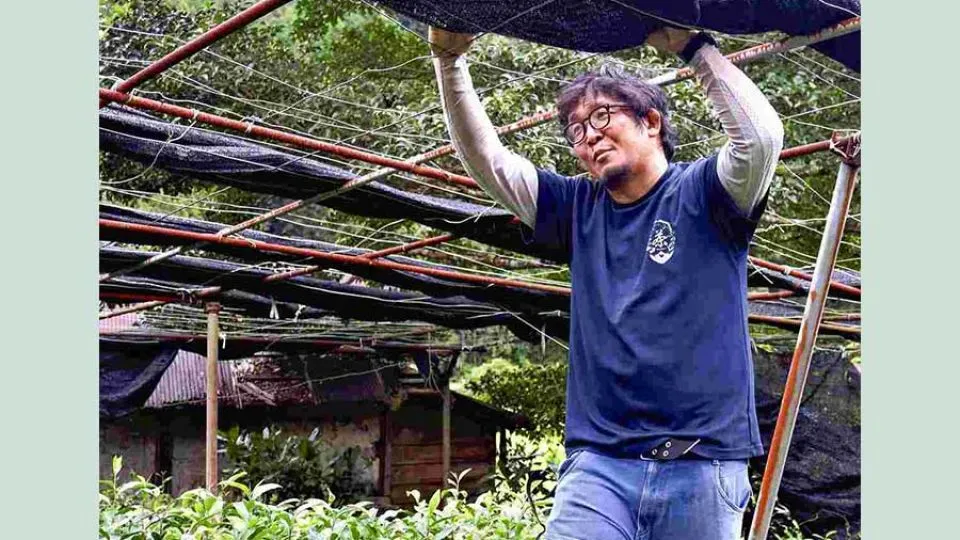
Tea leaves for tencha require about 20 days of shade and are harvested when the new shoots have grown larger than those for sencha. The total harvest from Suzuki’s field increased from about 7.5 tons during last year’s first-flush season to about 15 tons, and his income also doubled.
“I want to shift more production from sencha to tencha,” Suzuki said enthusiastically.
The prefecture’s production of first-flush crude tea made from the year’s first new shoots totaled 10,700 tons, a 32% increase from 2025. This comfortably exceeded the 9,610 tons produced in Kagoshima Prefecture, last year’s top producer.
Shizuoka Prefecture had held top spot in tea production volume since the Agriculture, Forestry and Fisheries Ministry began compiling such statistics, but it was dethroned by Kagoshima Prefecture, which had been quick to transition to matcha production, in 2024 for crude tea production and in 2025 for first-flush crude tea production.
In a bid to reclaim the top rank, Shizuoka Prefecture this spring unveiled the “Japan Tea Shizuoka” brand, which is permitted only for first-flush tea produced, processed and finished in the prefecture. The brand’s logo depicts tea fields stretching out against the backdrop of a red Mt. Fuji.
The prefecture had previously prioritized sencha tea, a stance dedicated to preserving the culture of tea brewed in a teapot. However, the focus has now shifted to tencha production with the goal of regaining the top spot.
In 2025, 71.1 hectares of tea fields were converted to tencha production with assistance from prefectural subsidies.
Noritada Miyazaki, 47, a tea farmer in Fujieda City’s Asahina area, which is known for producing gyokuro high-grade tea, said, “Tencha commands a good market price and is easier to produce because there’s little variation in quality even when it’s harvested by machine.”
The sharp rise in tea prices driven by matcha’s popularity also served as a tailwind.According to data compiled by JA Shizuoka Keizairen, an organization promoting the prefecture’s agriculture, the average price per kilogram of the year’s first-flush tea fell to a record low of ¥1,763 in 2024. However, it rose to ¥2,218 in 2025 and ¥3,365 this year, suddenly returning to the levels of about 30 years ago.
In addition to its popularity in beverages such as matcha latte and in matcha-flavored desserts, demand overseas is also rising due to health-conscious trends and the Japanese food boom. The Japan Tea Export Promotion Council said orders for matcha to be used in beverages and desserts are pouring in from about 100 countries and regions, including places in Europe, the United States, Asia and Africa. However, supply is struggling to keep up with demand.
Shizuoka Prefecture estimates overseas demand will increase to 20,000 tons by 2040. Japan’s tea exports totaled 12,612 tons in 2025.
The prefecture intends to strengthen its production system through measures such as consolidating tea fields and introducing smart agriculture.
“We view the current increase in green tea demand overseas as an opportunity,” said Hiroshi Nishikawa, manager of the prefecture’s tea promotion department. “We’ll try to establish a production system capable of meeting that demand.”