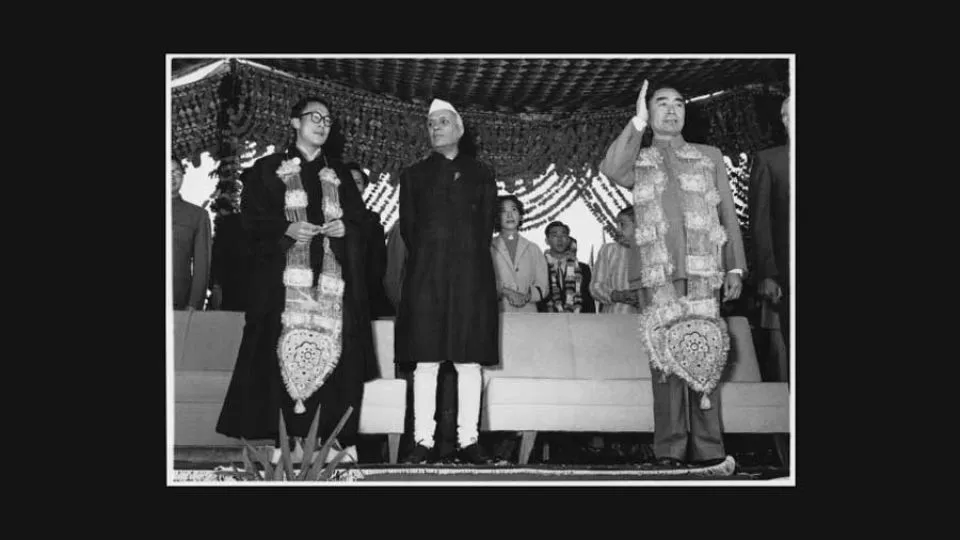
Arya News - The political relationship between India and China initially rested on the possibility of cooperation among Asian states emerging from colonial rule. However, China`s decision to establish control over Tibet in 1950 then introduced a major territorial and political question into the relationship.
DHAKA – India became independent in 1947 following the end of British rule, while the People’s Republic of China was established in 1949 following the Communist victory in the Chinese Civil War.
Both governments sought to consolidate their authority, promote economic development and establish their countries as major powers in Asia. They also regarded the Himalayan frontier as part of their respective national territories, although the boundary had never been mutually agreed upon.
Relations remained broadly cooperative during the early 1950s, supported by a shared opposition to colonialism and an interest in regional stability. The spirit of “Hindi Chini Bhai Bhai” (Indians and Chinese are brothers), a popular slogan associated with the period, reflected the optimism surrounding ties between the two countries.
But the incorporation of Tibet into the People’s Republic of China, the construction of a strategic road through Aksai Chin and competing interpretations of the frontier gradually brought those interests into conflict.
On 20 October 1962, the border dispute escalated into war, reshaping South Asian geopolitics and influencing regional alignments for decades to come.
From Asian solidarity to a contested frontier
The political relationship between the two countries initially rested on the possibility of cooperation among Asian states emerging from colonial rule.
Jawaharlal Nehru, India’s first prime minister, regarded China as an important partner in the development of a post-colonial international order. His interest in Chinese history and politics predated independence, and he believed that the two countries could contribute to a more independent Asia.
China’s leadership also had reasons to maintain stable relations with India. The new government in Beijing was consolidating its control over the mainland, rebuilding an economy devastated by years of war and seeking wider international recognition. India’s early recognition of the People’s Republic and its support for China’s representation at the United Nations offered Beijing valuable diplomatic advantages at a time when it faced growing confrontation with the United States and its allies.
The Chinese government’s decision to establish control over Tibet in 1950, however, introduced a major territorial and political question into the relationship.
Tibet had maintained substantial autonomy from China for decades, although its international status remained contested. Beijing, on the other hand, regarded the region as an integral part of Chinese territory and considered its incorporation necessary for national unification and security.
India, which had inherited British-era arrangements and privileges in Tibet, was concerned about the implications of Chinese control for its Himalayan frontier.
India’s Home Minister, Vallabhbhai Patel, warned Nehru in 1950 that China’s consolidation of Tibet could create a new strategic situation along India’s northern borders. But Nehru did not consider military confrontation a viable response.
India was still establishing its institutions and pursuing economic development, and Nehru believed that negotiations could accommodate the interests of both countries.
In 1954, India and China signed an agreement on trade and intercourse with Tibet that incorporated the principles of Panchsheel, or peaceful coexistence.
India relinquished its inherited privileges in Tibet, while the agreement established a framework for bilateral relations. The two governments presented the principles as a basis for cooperation among states with different political systems.
Nehru’s visit to China that year, and the reception he received from large crowds in Beijing, reinforced the expectation that relations could develop without a formal settlement of every territorial disagreement.
China’s leadership also benefited from the arrangement. With its control over Tibet still being consolidated, a stable relationship with India reduced the likelihood of complications along its southern frontier.
Nevertheless, the boundary question remained unresolved.
In the eastern sector, the McMahon Line had been drawn during the 1913–14 Simla Conference between British India and Tibet. China rejected the agreement, arguing that Tibet lacked the authority to conclude a separate boundary arrangement and that the line reflected British imperial interests. India inherited the frontier as part of its territorial claims and began administering areas south of the line, including Tawang, in 1951.
The western sector presented a different problem. Aksai Chin, a largely uninhabited plateau between Ladakh and Tibet, appeared within different territorial boundaries on British-era maps. Some maps placed it within Kashmir, while a British proposal in 1899 would have assigned much of the region to China.
No agreement between India and China resolved the competing claims. The area was remote, difficult to access and of limited administrative value in itself, but its strategic importance increased as China developed transport links between Tibet and Xinjiang.
The construction of a highway through Aksai Chin gave Beijing a direct route between two regions that were otherwise difficult to connect.
The road became a central source of tension. India learned of it from a Chinese press announcement in 1957 and sent reconnaissance parties in 1958, one of which was captured. India subsequently lodged a protest on 18 October 1958.
The Chinese government maintained that the route lay within its territory, while India regarded its construction as an infringement of its sovereignty. Chinese maps also showed extensive areas claimed by India as Chinese territory.
Zhou Enlai, China’s then-premier, proposed that the two countries maintain their existing positions while negotiations continued. Nehru, however, insisted that the boundary could not be treated as an unsettled question in areas India regarded as its own territory.
The disagreement reflected more than competing maps. Each government had begun to incorporate its territorial claims into domestic political expectations, making compromise increasingly difficult.
Tibet and the erosion of mutual trust
During a visit to India in 1956, the Dalai Lama expressed concern about conditions in Tibet and considered remaining in the country. Nehru advised him to return.
By 1958, however, Beijing had asked Nehru to postpone a planned visit to Tibet, telling him that it was not convenient, and relations were becoming increasingly strained.
In March 1959, an uprising against Chinese rule in Lhasa was suppressed. The Dalai Lama crossed into India on 31 March and was granted asylum.
India’s decision was consistent with its position that the Dalai Lama could not be returned to the authorities from whom he had sought refuge. China viewed his departure as a challenge to its sovereignty over Tibet and became increasingly concerned that India might provide support to Tibetan resistance.
India’s public response, meanwhile, was influenced by the Dalai Lama’s religious standing and by political opposition to China’s actions. Demonstrations and expressions of support for Tibet added further pressure to a relationship already weakened by the boundary dispute.
The political systems of the two countries also affected how the crisis was handled.
China’s one-party government could control public demonstrations and diplomatic messaging more directly. India’s parliamentary system, however, allowed opposition parties, the press and public organisations to scrutinise government policy and mobilise around the Dalai Lama’s presence.
Nehru had to consider both the diplomatic consequences of his government’s relations with Beijing and the domestic implications of any decision concerning Tibet.
China’s leadership, for its part, regarded the political activity surrounding the Dalai Lama as evidence that India was not maintaining the neutral position Beijing had expected.
Border clashes followed. In August 1959, Indian and Chinese forces confronted each other at Longju. In October, a clash at Kongka Pass in Ladakh killed nine Indian policemen.
The incidents intensified diplomatic exchanges and brought the boundary dispute to the centre of domestic political debate in India. Nehru continued to maintain that a negotiated settlement remained possible, even as relations hardened.
Zhou Enlai visited Delhi in April 1960 and floated a broad territorial exchange. China would accept India’s position in the eastern sector, including the McMahon Line, while India would recognise Chinese control in the west, including Aksai Chin. The idea reflected the strategic priorities of the two governments.
India placed greater importance on the eastern frontier, where it had established its administration, while China considered Aksai Chin essential to the road linking Tibet and Xinjiang.
Ultimately, however, the negotiations did not produce an agreement.
In India, the discovery of the Aksai Chin road and the deaths at Kongka Pass had made territorial concessions politically difficult. Parliamentary opposition questioned the government’s handling of the dispute, and members of Nehru’s own cabinet resisted compromise.
The idea also required India to recognise a territorial position that Beijing had established without India’s consent. Neither government could secure the domestic and strategic conditions necessary for a settlement.
How a border dispute escalated into war
The next phase was shaped by India’s Forward Policy, adopted in November 1961.
Indian forces established small posts in disputed territory to assert India’s claims and prevent further Chinese advances. Some were placed near or behind Chinese positions.
The policy assumed that China would avoid a major military response, even where Indian posts were difficult to supply or defend. Beijing regarded the posts as an attempt to change the situation along the frontier and increasingly concluded that force would be required to remove them.
In essence, the two governments were pursuing incompatible objectives through military deployments, while their assessments of the likelihood of war diverged.
The immediate confrontation developed around the Dhola post in the Namka Chu valley. India established the post in June 1962, north of the McMahon Line as drawn on the 1914 map. India argued that the boundary followed the Himalayan watershed along the Thag La ridge and that the map did not accurately represent the intended line.
China maintained that the area was within its territory. Chinese troops surrounded the Indian position in September, and a clash at Tsengjong on 10 October intensified the crisis.
On 12 October, Nehru told reporters that Indian forces had been instructed to clear Chinese troops from the area, although no timetable had been set.
China launched attacks in the eastern and western sectors on 20 October. Indian forces were unable to hold several positions in the eastern sector, and Tawang was evacuated.
After a lull in the fighting, China launched a second major offensive in November, forcing Indian troops to withdraw from their positions at Sela and Walong. In Ladakh, a company of the 13th Kumaon Regiment under Major Shaitan Singh held its position at Rezang La against a much larger Chinese force. Most of the company’s soldiers were killed.
The scale of the military defeat exposed weaknesses in India’s preparations for a conflict in the Himalayas. Roads and supply systems were inadequate, intelligence assessments underestimated Chinese capabilities, and the army lacked sufficient equipment for sustained operations at high altitude. Defence Minister V K Krishna Menon resigned amid mounting criticism of the government’s military policy.
Nehru sought assistance from the United States on 19 November, including fighter aircraft and bombers. China announced a unilateral ceasefire on 20–21 November and declared that its forces would withdraw from much of the territory they had occupied, while retaining control of Aksai Chin.
India’s defence ministry later reported 1,383 killed, 1,696 missing and 3,968 captured. Chinese sources have put their own losses at 722 killed and 1,697 wounded.
The causes of the war remain the subject of historical debate.
India’s Forward Policy contributed to the immediate confrontation, but it developed within a wider dispute over Tibet, the frontier and the strategic road through Aksai Chin. China’s decision to use force has been interpreted as an effort to remove Indian posts, reinforce its position in Tibet and discourage India from challenging its territorial claims.
The deteriorating relationship between China and the Soviet Union, domestic political pressures in Beijing and the desire to weaken India’s international standing may also have influenced the timing of the conflict.
The conflict cannot be explained solely by Nehru’s assessment of China or by India’s military deployments. Both governments pursued policies that narrowed the scope for negotiation, while the absence of an agreed boundary made the consequences of those policies difficult to contain.
The international context added another dimension, as the war coincided with the Cuban Missile Crisis, when the United States and the Soviet Union faced a nuclear confrontation.
Moscow’s response to the India-China conflict reflected the growing divisions within the Communist world. The Soviet Union delayed the delivery of MiG-21 aircraft to India and initially adopted a position closer to Beijing, before moving towards Delhi as the Sino-Soviet split deepened.
India’s request for Western military assistance and its subsequent relationship with Moscow illustrated the limits of non-alignment as a means of securing military support during a crisis.
The war’s enduring geopolitical consequences
For India, the war led to a major reassessment of defence policy. The army expanded, military infrastructure along the Himalayan frontier received greater attention, and the government placed greater emphasis on intelligence and military preparedness.
Nehru’s political authority weakened, and his death in May 1964 came after a period in which the assumptions underlying his China policy had been widely questioned.
The conflict also contributed to India’s longer-term debate over strategic autonomy and nuclear capability, although the 1974 nuclear test had additional causes, including regional security concerns and technological ambitions.
China’s relationship with Pakistan became one of the war’s most lasting regional consequences.
The two countries had begun negotiations over their boundary before the October 1962 fighting. On 2 March 1963, they signed an agreement under which Pakistan recognised Chinese sovereignty over the Shaksgam tract, part of the territory claimed by India as Kashmir. The agreement itself described the arrangement as provisional, pending a settlement of the Kashmir dispute.
The agreement strengthened a relationship based on shared concerns about India and China’s interest in having a strategic partner on its western flank. Military cooperation and diplomatic support subsequently made the China-Pakistan partnership a central feature of South Asian geopolitics.
India’s closer relationship with the Soviet Union developed alongside this alignment. The 1971 friendship treaty with Moscow reflected India’s need for external support during the crisis with Pakistan and the emerging Bangladesh Liberation War.
The treaty did not arise directly from the 1962 conflict, but the war had altered India’s assessment of its security environment and increased the importance of reliable strategic partners.
China’s position on Bangladesh’s emergence also reflected the regional divisions created by the conflict.
Beijing vetoed Bangladesh’s application for United Nations membership in August 1972, arguing that the question of Pakistani prisoners of war had to be resolved first. It recognised Bangladesh on 31 August 1975, after the assassination of Sheikh Mujibur Rahman.
The delay affected Dhaka’s early diplomatic choices, while the wider China-Pakistan relationship remained an important factor in Bangladesh’s foreign policy calculations.
Even today, the relationship between Bangladesh, India and China continues to be shaped by geography and development needs.
Bangladesh relies on India for extensive trade, transit and security cooperation, while China remains an important source of infrastructure investment and military equipment.
During Prime Minister Tarique Rahman’s visit to Beijing in June, China said it would support the Teesta River Comprehensive Management and Restoration Project within its capacity. Beijing emphasised that its cooperation with Dhaka “does not target any third party and should be free from third party influence”. China also agreed to support experts from both countries in expediting the project’s feasibility study and related work.
India’s concerns about the project reflect the river’s importance to water management in West Bengal and its location near the Siliguri Corridor, which connects India’s north-eastern states to the rest of the country.
The issue also illustrates how regional infrastructure projects can simultaneously carry implications for water security, connectivity and strategic relations.
The India-China frontier has experienced periods of reduced tension, but the boundary remains unsettled. The Galwan clash in June 2020 killed 20 Indian soldiers and four Chinese soldiers. An agreement in October 2024 addressed the last remaining friction points at Depsang and Demchok.
At the 25th round of Special Representatives’ talks in Beijing on 25 August this year, the two sides agreed to establish two additional military hotlines along the border in the eastern and middle sectors and to advance discussions on an “early and substantial harvest” in boundary delimitation and border management.
During Xi Jinping’s visit to Delhi in September for the BRICS summit, the leaders reiterated their commitment to a fair, reasonable and mutually acceptable settlement.
These developments indicate that the relationship is no longer governed by the immediate conditions of 1962, although the underlying territorial questions remain unresolved.
Both countries have expanded their economic and diplomatic engagement while continuing to strengthen their military positions along the frontier. Their relationship is consequently characterised by cooperation in some areas and competition in others, with the unresolved boundary continuing to influence decisions on security, infrastructure and regional partnerships.