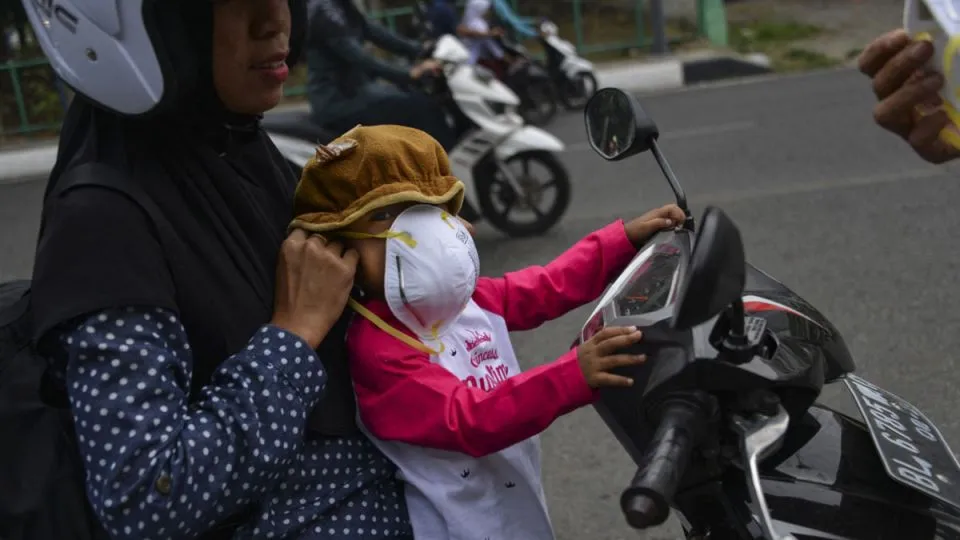
Arya News - Nearly half of acute respiratory illness cases caused by wildfire in Sumatra and Kalimantan recorded in the past two months are children who are more vulnerable to wildfire haze because of their biological conditions.
JAKARTA – Children are bearing the brunt of the escalating crises triggered by widespread wildfires in the country as wildfires disrupt many aspects of their daily lives, sparking yet another call for an urgent response from authorities.
As Indonesia struggles to contain one of its worst wildfire episodes in recent years, more than 10 million people are currently exposed to hazardous levels of air quality, according to the Health Ministry, with the haze also drifting to neighboring countries like Malaysia and Singapore.
The burning forest and peatland across Sumatra and Kalimantan have resulted in 314,124 cases of acute respiratory illness, as recorded by the ministry between Aug. 20 and Oct. 19. Around a quarter of the figure, or 77,144 cases, came from schoolchildren aged between 6 and 9 years old, followed by those younger than five with 69,335 cases.
With more children suffocating in the polluted air and limited outdoor activities that force schools in Sumatra and Kalimantan to shut down, nonprofit group Indonesian Philanthropy Association (PFI) warned of the danger of putting an entire generation at stake if no comprehensive measures are taken to tackle the recurring fires.
The report defined these children as a “lost generation”, referring to a demographic cohort whose physical or cognitive abilities are being wiped out because of early exposure to wildfire smoke.
Persistent exposure to wildfire smoke among children and unborn children may result in long-term cognitive and physical impairments, according to the group in a report published on Tuesday. The report was also produced by a research arm of the Bandung Institute of Technology (ITB).
“We are gambling with an entire generation and cannot allow this tragedy to keep repeating,” PFI chair Rizal Algamar said in a statement on Tuesday.
The group urged the government to reform its forest and peatland governance to curb uncontrolled land-clearing fires. Health authorities were also pushed to provide free and inclusive medical intervention across impacted regions.
Newborns and children under five are facing a higher risk when exposed to wildfire haze compared to their older counterparts, according to Fachrial Kautsar of the Center for Indonesia’s Strategic Development Initiatives (CISDI).
They tend to breathe faster and inhale more air relative to their body weight. Meanwhile, their lungs are still developing and, therefore, more vulnerable to microscopic pollution such as PM2.5 particulate matter.
“Children are currently becoming one of the most vulnerable groups to the wildfire smoke,” said Fachrial, who did not participate in PFI’s report, on Tuesday.
Other vulnerable groups include pregnant women and their unborn children, as wildfire smoke can creep into human placenta.
Particulate matter from wildfire smoke can also be up to 10 times more harmful than ambient air pollution, particularly among young children, according to UNICEF.
Double whammy
Fires in Indonesia have burned through over 1.9 million hectares this year as of late September, an area equivalent to 12 Londons, according to independent forest monitoring platform Nusantara Atlas. The government has not issued their number on total areas burned, with the latest data in Forestry Ministry’s platform SiPongi was from late July at 202,000 ha.
The government has been launching aerial firefighting and cloud seeding operations in six priority provinces heavily affected by the forest and peatland fires, namely South Sumatra, Riau, Jambi, West Kalimantan, Central Kalimantan and South Kalimantan.
Despite concerns about the health impacts from the blazes, Health Minister Budi Gunadi Sadikin made a controversial remark last week when suggesting the affected residents to “adapt” with the hazy conditions and remain indoors.
Budi was slammed by people on social media, criticizing the minister for shifting the responsibility to tackle the haze crisis onto the public.
Anthropologist Sofyan Ansori in the University of Indonesia (UI) called the statement “cruel but not surprising”, noting the government has failed to stop recurring fires.
Sofyan, who researched about lives of people affected by wildfires, noted people living in peatland-rich regions in Sumatra and Kalimantan have survived four different fire episodes since 2015, forcing them to “normalize” living under thick smoke.
The fires also strip away children’s their rights to education, with local education authorities canceling classes or holding remote learning once the air quality reaches hazardous levels.
However, Sofyan noted “it’s very difficult to imagine urbanized solutions [of online remote learning] being implemented in some remote regions in Kalimantan”.