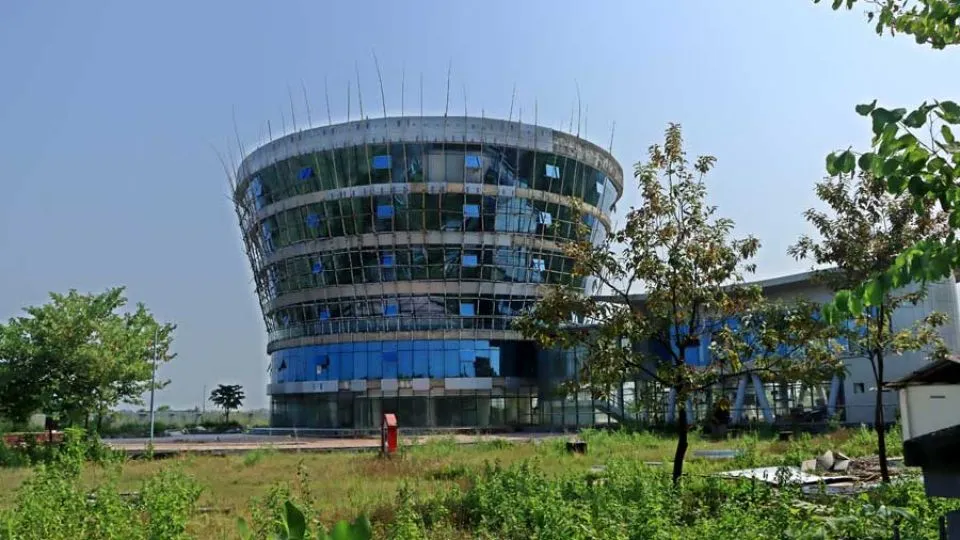
Arya News - Nearly five years after its inauguration, Bangladesh`s Sylhet Hi-Tech Park, has created just 400 jobs against its initial target of 20,000 and attracted only around US$24.25 million in investment, falling short of its initial target of US$121.38 million.
DHAKA – Nearly five years after its inauguration, Hi-Tech Park, Sylhet, has created just 400 jobs against a target of 20,000 and attracted around Tk 300 crore in investment against a target of Tk 1,500 crore.Only two of the 14 companies allotted land or space at the 171.07-acre park are operational, with gas shortages, unreliable electricity and unfulfilled commitments undermining business expansion.
Approved by the Executive Committee of the National Economic Council (Ecnec) in March 2016 at an estimated cost of Tk 336 crore, the park is located in Companiganj upazila, 22 kilometres north of Sylhet city.
It was inaugurated as Bangabandhu Sheikh Mujib Hi-Tech Park on December 12, 2021, and later renamed Hi-Tech Park, Sylhet.
The project was expected to industrialise Sylhet’s economy, create jobs for young people and capitalise on the region’s proximity to India’s seven northeastern states. The authorities promised gas connections, uninterrupted electricity, tax holidays, duty-free imports of machinery and raw materials, and the freedom to repatriate profits and capital.Several commitments, however, remain unfulfilled.
According to the Bangladesh Hi-Tech Park Authority (BHTPA), around 44 acres of land have been allotted, leaving more than 76 acres available. Of the 21,576 square feet of allocable space in the administrative building, 19,062 square feet has been allotted, but four of the five companies allocated space there are yet to become operational.
Among companies allocated land, Rangs Electronics Limited began operations on its 32-acre plot in 2025. One company is still constructing its facility, three halted construction after starting work, and four have yet to begin construction.
Rangs, the park’s flagship tenant, has struggled with infrastructure gaps for years.
The company applied for an industrial gas connection in 2022 but was denied one by the Ministry of Energy and Mineral Resources, according to Rangs. The BHTPA applied on its behalf in November 2025, but the request was rejected. The authority reapplied in April this year and is awaiting a decision.
Electricity is supplied through a 33/11 kV line operated by the Rural Electrification Board. Heavy rainfall in Sylhet frequently triggers prolonged load-shedding, according to the park authority.
Md Rafiqul Islam, senior general manager of Rangs Electronics, said the company moved to the park despite having factories on its own land, hoping to benefit from the promised facilities.
“However, commitments such as one-stop services for government documentation were not fulfilled from the outset, and we had to obtain all the required licences by approaching the relevant offices individually, just as we did for our other projects,” he said.
“The promise was that there would be no rent during the three-year construction period and that the rent would be reasonable until we reached the break-even point. However, we have been paying rent since day one. Besides, there is no backup electricity, and during maintenance work, we are forced to stop production for days,” he said.
“The biggest obstacle is the gas connection, which the ministry has continued to deny since we began construction. We had plans to launch our television, air-conditioner and other production lines, but we are now operating at only 30 percent of capacity, producing refrigerators alone. All these setbacks are causing us losses of Tk 60 crore a year, along with higher production costs,” he added.
UpSkill Bangladesh, the park’s other operational tenant, also faces connectivity and security problems.
Muminur Rahman Tamal, lead HR at the company, said the New York-based firm had expanded into Bangladesh to offer advanced IT courses.
“However, because of communication problems, we are struggling to attract students and retain employees. There are also serious security concerns in the evening,” he said.
In November 2024, a The Daily Star investigation found that 15 ICT-related projects nationwide, worth Tk 8,500 crore combined, had been undermined by faulty planning, corruption and poor execution under the previous government’s Digital Bangladesh programme.
After the Bangladesh Nationalist Party came to power in February 2026, the current administration formed a committee to develop recommendations for reviving the park.
Local lawmaker Ariful Haque Choudhury, also the minister for expatriates’ welfare and overseas employment, inspected the park in June and expressed concern.
He said the government would decide on a way forward after consultations between the ministry and the prime minister. However, no public outcome had emerged by the time of writing.
MD Fazlur Rahman, managing director of the Bangladesh Hi-Tech Park Authority, said the park’s distance from the city and lack of gas connectivity were major obstacles to attracting investors.These problems were preventing factories from becoming fully operational, he said, adding that several other issues also needed to be resolved.
The authority is working to attract new investors, he added.
“Our secretary recently visited the park with local business chamber leaders, and we will work to attract new investors. We have a high-level meeting scheduled for November 4, where we will discuss all the issues concerning the park. We are working to make the hi-tech park fully operational by overcoming all the barriers,” he said.