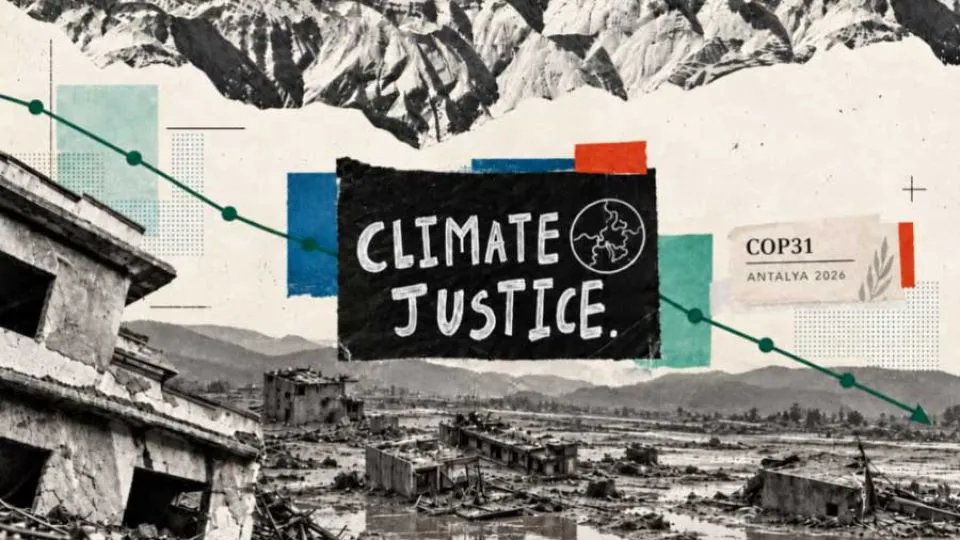
Arya News - Nepal has made an emergency appeal to the UN’s loss-and-damage fund, which has yet to disburse any money. Meanwhile, families wait for relief, and the country takes on more loans to rebuild.
KATHMANDU – When Urika Tamang last spoke to her husband, he told her he would be home on October 1. A teacher at a government school in Timure, near Nepal’s border with Tibet, he had spent the last eight years living apart from his wife and son so their child could attend a school in Kathmandu.
Tamang, 37, learned that her husband had been killed in the Rasuwa disaster when the school principal, who had been airlifted to Kathmandu for treatment, broke the news to her.
“I told our son, but he still thinks his father will come home for Dashain,” Tamang said. “He did not see his body, so it was difficult for him to believe he had died.”
Now Tamang is trying to find a way to pay for her husband’s Ghewa, a Tamang ritual to help the deceased transition to the afterlife.
“I couldn’t do anything for my husband,” she said. “All I can do now is make sure his Ghewa is done well. But the rituals are expensive.”
Tamang’s loss is part of a much larger reckoning. The Rasuwa disaster on August 26 left 1,455 people dead, nearly 7,000 injured and 5,285 unaccounted for. It swept away infrastructure, hydropower plants and entire towns, with Nepal facing an estimated $4.7 billion in recovery and reconstruction needs. Seven weeks later, as the country prepares for the Conference of the Parties (COP31), the annual meeting of countries that have joined the UN Framework Convention on Climate Change (UNFCCC), in Turkey next month, families are still grappling with the consequences. Nepal’s struggle to secure timely international support raises a wider question at the heart of climate justice: what does global solidarity mean when money pledged to vulnerable countries is slow to arrive, insufficient for their needs, or offered as loans?
Nepal has appealed to the UN’s Fund for Responding to Loss and Damage (FRLD) for an exceptional, rapid response. The appeal could test whether an international mechanism created to help countries cope with the irreversible impacts of climate change can deliver when disaster-hit communities need it most.
“Rapid response was one of the fundamental purposes for which the Fund was created,” said Maheshwar Dhakal, an alternate member of the FRLD board who also serves as the chief of Climate Change Management Division at Nepal’s Ministry of Forests and Environment. “So far, however, it has not been effective in fulfilling that purpose.”
Nepal has not requested a specific amount for its emergency appeal, Dhakal added. The $20 million cited in some media reports, he clarified, is the budget ceiling under the FRLD’s inaugural call for funding requests through the Barbados Implementation Modalities (BIM), not the amount Nepal had requested after the Rasuwa disaster.
“Even if we receive just twenty rupees, what we want to do is set a precedent for future disasters,” he said. “It would demonstrate to countries that have pledged money that the Fund is necessary and push it to become more effective and give hope to other [climate] vulnerable least developed countries (LDCs) as well.”
Any country can appeal to the Fund for disasters caused by the changing climate, as long as it is a party to the UNFCCC and the Paris Agreement. The Fund prioritises least developed countries and small island developing states. Studies linking the disaster to climate change, such as the recent World Weather Attribution analysis of Nepal’s floods, can help strengthen requests for support.
Manjeet Dhakal, an author of the study and an advisor to the Chair of the LDC group on climate change, said that right before Langtang Lirung collapsed, triggering a rock-ice avalanche that turned it into a debris flood, the region had “unusually warm conditions”. July and August 2026 were the warmest months of the year, warming faster than the entire planet.
But even a strong case for support faces a fundamental problem: the Fund itself is dependent on voluntary contributions and has far less money than developing countries need. In its inaugural funding round, 119 developing countries submitted requests worth $2.8 billion, while the Fund had only $342 million available — enough to meet just 12 percent of the requests.
Nepal also submitted three proposals under the Fund’s regular funding window. One from the Alternative Energy Promotion Center, covering projects in “Illam, Kathmandu, and Kavre”, has “reached the final stage of evaluation,” according to Maheshwar Dhakal. The Fund is yet to decide on which of the 176 proposals it will support.
Since it was set up in 2022, the Fund has not released a dollar to any country, despite provisions for rapid response.
“This is challenging because such a request had not come [to FRLD] before, but we have been making good progress,” Manjeet Dhakal said. “We will likely get a positive decision very soon.”
He added that the Fund would first allocate the money, after which Nepal would have to propose how it would be used before disbursement. The money may come too late for families such as Tamang’s. But how the Fund responds could determine whether families affected by future disasters will wait years, months, or days for support.
The urgency is especially stark right now; it took just seven minutes for the Rasuwa disaster to devastate settlements downstream, yet a Green Climate Fund project to reduce glacier-related flood risks in Nepal took more than seven years to reach implementation.
At the moment, there is no mechanism in the UN through which countries like Nepal, which contribute little to global warming, can demand compensation from the world’s largest carbon emitters whose actions have contributed to the catastrophic damage that will impact generations to come.
For families already struggling to recover, domestic relief may be the quickest source of help.
Truong Huyen-Chi (Shachi), director of the Asia Coordination Office for the Asian Mountain Academic Alliance, said in an email interview that Nepal’s own budget and disaster funds are the channels most capable of moving money within days.
Nepal’s prime minister disaster relief fund has collected over Rs. 17.75 billion ($29.75 million). Yet, as the disaster’s 49th day approached, grieving families said they had received no financial assistance from the government.
“In three days, it is the day for Ghewa. But the government has not given the grieving families any money,” said Wanju Wayba Tamang, who has been supporting affected communities.
“If you look at social media, it feels like the government is doing a great job. But on the ground, the government hasn’t returned to check if there is food or anything else that people need. We’ve been going on with the help of individuals and organisations.”
While disasters affect everyone, not everyone has the same resources to recover. Lawyer and social activist Arnab Chaudhary called on the state to acknowledge the disproportionate impact on marginalised communities.
“Even now the state does not have disaggregated data on people living in holding centres. How will it ensure their needs are met?” Chaudhary asked.
Wanju Wayba Tamang is worried about 51 children from Hakubesi, a hamlet in Rasuwa, who have been relocated to Kathmandu. If the state had supported them, they would not have been forced to seek shelter elsewhere, he said, worried about their vulnerability to human trafficking.
The disaster has also renewed questions about the risks communities face when infrastructure is built in fragile mountain environments.
“My brothers gave their lives inside the tunnels while Kathmandu lit bright. It’s not just the World Bank that killed my brothers; it’s the state of Nepal as well,” Wayba Tamang said. “Why did it approve 16 hydropower projects in one corridor? It was like an ambush for my Tamang brothers, on whose sacred lands the state built the plants.”
Civil society groups have also raised concerns about hydropower development and climate risks. In a letter calling on the World Bank Group to halt financing large hydropower projects pending independent risk assessment, over 100 organisations from Nepal and around the globe warned that international financiers had backed hydropower projects despite early warnings about extreme climate risks. They pointed to Upper Trishuli-1, financed by a consortium including the International Finance Corporation (IFC), which they said went ahead despite warnings from as early as 2017.
Severe floods in 2024 and GLOF in 2025 damaged more than 20 hydropower plants, according to the letter sent to the World Bank. Nepal’s energy sector now accounts for 54 percent of its post-disaster recovery budget.
Rebuilding infrastructure raises a further question: who should pay for the additional costs of making it resilient to climate change?
Nepal is already relying heavily on loans to finance climate-related development. A recent Himal Khabar analysis found that over the last decade, for every $1 that Nepal received in grants for climate-related projects through the government’s budget, it took on more than $6 in loans. Nepal’s public debt burden already exceeds $700 per person.
Yet, just 28 days after the Rasuwa disaster, the World Bank offered $170 million to Nepal as an additional loan.
Pakistan’s experience after the devastating floods of 2022, which caused an estimated $30 billion in damage, offers a warning. Much of the international funding offered to Pakistan came as loans rather than grants.
“The international community must ensure that what they did to Pakistan they do not do to Nepal,” Zain Moulvi, director of research at Alternative Law Collective of Pakistan that works in environmental laws, climate finance, and just transition, told Kantipur in a phone interview.
“Developing countries pay three times. First when disasters cause damage. Then because aid is decreasing, they are given loans. Then the government goes through a cycle of austerity, and as disasters recur year after year, the money that is supposed to go to health, education is cut to repay the debt,” said Sunil Acharya, global lead for just transition at the not-for-profit organisation Resource.
For Shachi, climate justice means more than international pledges.
“A widow’s claim should be settled within weeks, children should be kept in school, and recovery assistance should follow people where they now live,” she said. “It would also mean the families are asked what they need, not only counted.”
In his UN speech, Prime Minister Balendra Shah argued that vulnerable countries should not have to borrow to rebuild after disasters they have done little to cause.
“When a climate-driven disaster destroys the infrastructure of a poor country, the answer cannot simply be another mega loan or patchwork of small grants,” Shah said. “We need adequate grant-based support from the world.”
At COP31 next month, Nepal will have to press for more than financial pledges. It will need to seek accessible loss-and-damage finance, predictable support that does not add to its debt, and mechanisms capable of responding quickly when disasters strike. The US withdrawal from the Paris Agreement has added pressure on the countries that remain committed to climate action, while traditional donors are increasingly directing resources towards defence, conflict and domestic priorities.
“If COP is able to decide to decrease the use of fossil fuels and decrease the rise in global temperature, it would be the greatest achievement for Nepal,” said Manjeet Dhakal. “It would be a win if COP can address a simple way for countries like Nepal to get climate finance.”
Shachi pointed to Barbados as an example of what countries could achieve beyond financial pledges. “Barbados did not win a big number,” she said. “It won a rule: the World Bank now pauses loan repayments for small states hit by disaster. Extending such clauses to mountain countries and LDCs would do more for Nepal over time than any single pledge.”
For Urika Tamang, however, the loss is already irreversible.
“If he was here, I wouldn’t need anything, I would have dealt with any hardship in life,” she said. “But now my world is no longer with me. Even if I receive something, it feels like nothing.”