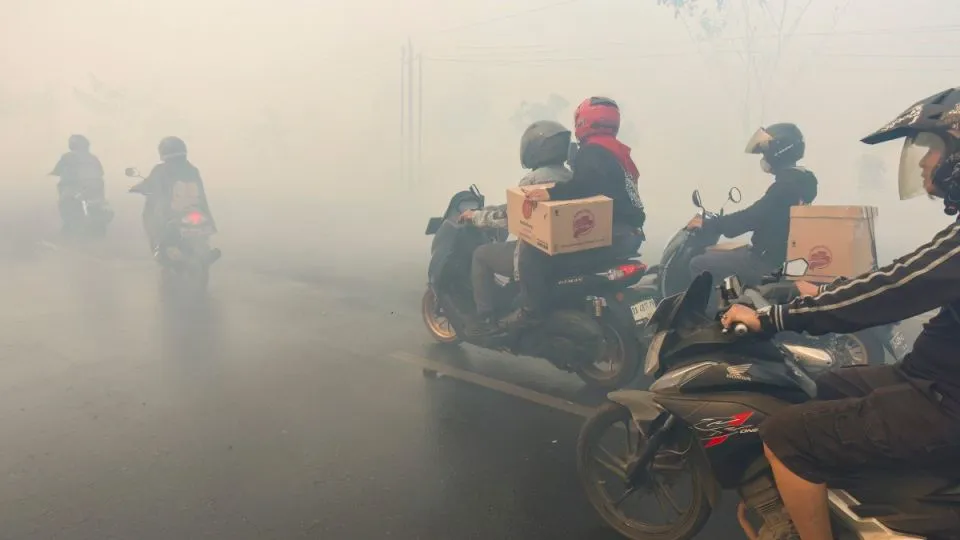
Arya News - Some Indonesians have been turning to social media to voice their frustrations and apologise about the uncontrolled wildfire that caused toxic haze to reach Malaysia, Singapore and other countries, while urging them to protest the Indonesian government over their handling of the issue.
JAKARTA – When atmospheric haze from forest and peatland fires worsened in Kalimantan in mid-October, videos showing skies turning dusty orange spread widely across social media, including one posted by homemaker Firda Ayu Wahyuni in Palangka Raya, Central Kalimantan.
Showing the view outside her house in the city, one of the hardest-hit areas by wildfire-induced haze across Kalimantan, the video she posted drew millions of views on TikTok and Threads before being reposted by national and global news outlets.
“I hope the videos gain attention and reach the regional and central governments, so they can respond quickly and name the forest fires a national disaster,” Firda told The Jakarta Post on Tuesday, complaining further about lagging disaster response she observed in her region.
Central Kalimantan is among the worst hit regions in this year’s wildfire season that is exacerbated by the El Niño-induced drought with 220,330 hectares of land in the province burned as of early September. Palangka Raya has also recorded “very unhealthy” air quality in recent weeks, according to Swiss-based air monitoring platform IQAir.
Firda and other Indonesians have been turning to social media to voice their frustration about the uncontrolled wildfire, with some are also calling on the international community to pressure Jakarta to respond more effectively, as haze reaches as far as neighboring countries of Malaysia and the Philippines.
Jakarta-based private employee Andreas Pandu called on people across the region, whom he referred to using the internet solidarity term SEAblings (Southeast Asia siblings), to speak out loudly.
He said people abroad who had also been affected by the haze have more room to criticize the government, while domestic criticism was often met with counternarrative and attempts to silence dissent. Criticisms from abroad, he added, may embarrass the government into taking action.
“If someone feels ashamed,” Andreas said, “they should reflect on their shortcomings and move quickly to address the problem.”
Others felt compelled to apologize online for the haze disrupting lives across the border.
Zila, a doctor from Jakarta, wrote a post on Threads on Oct. 12 addressed to Malaysians and Singaporeans: “We’re truly sorry for the haze. We’ve been doing everything we can, but we, too, are struggling with endless hardships and the incompetence of our own government.”
She continued by asking for help to “continue to raise our voices and keep us in your prayers”.
“The only thing I can do is speak up, translate information and share it with my non-Indonesian friends abroad and explain the situation to them,” Zila told the Post on Tuesday, hoping people overseas protest the Indonesian government and even pursue legal action over the transboundary haze.
But taking Indonesia to an international court over the haze might not be feasible, according to international law expert Hikmahanto Juwana from University of Indonesia (UI).
He offered a more practical approach, namely through ASEAN mechanisms, such as the bloc’s Agreement on Transboundary Haze Pollution (AATHP) that provides a framework for regional cooperation and assistance in addressing forest fires and haze, given consent from the receiving country.
“If Indonesia sets aside its ego and opens up to assistance,” Hikmahanto said, “neighboring countries won’t be upset and Indonesians will feel that their government has done something.”
Foreign Minister Arrmanatha Nasir previously maintained that Indonesia had complied with the AATHP. He added President Prabowo Subianto had also approved for Jakarta to accept foreign assistance, as Singapore and Malaysia had conveyed commitments to help Indonesia containing the wildfire. But neither offers have yet to take ground.
Indonesia has seen wildfires intensifying since June, with more than 1.9 million ha burned throughout this year, according to independent forest monitoring platform Nusantara Atlas.
The government has deployed joint firefighting crews on the ground as well as aerial water bombing and cloud seeding missions to bring in rain. Joint authorities also began spreading dry ice into the atmosphere to disperse haze and improve visibility.
Following a ministerial meeting on Monday, Coordinating Politics and Security Minister Dudung Abdurachman said President Prabowo Subianto has instructed officials to accelerate efforts to tackle fires.
“Managing the forest fires is not easy, especially in the peatlands area. Don’t be swayed by claims that we’re doing nothing,” he said, adding that Jakarta was communicating with Singapore and Malaysia over their previous offers of assistance.
Foreign ministers of ASEAN member states are slated to meet next month to discuss the haze issue, following Malaysia’s call for a talk to address the regional crisis.
Forestry Minister Raja Juli Antoni said on Wednesday the government had suspended permits for six more companies holding concessions in Central Kalimantan, while ordering the firms to restore the degraded ecosystem in their managed areas where fires had been detected.
As of Wednesday, the number of companies suspended for wildfire was 32, with a total area of concessions covering 1.9 million ha, of which more than 18,000 ha have been burned this year.
— Yerica Lai contributed reporting.