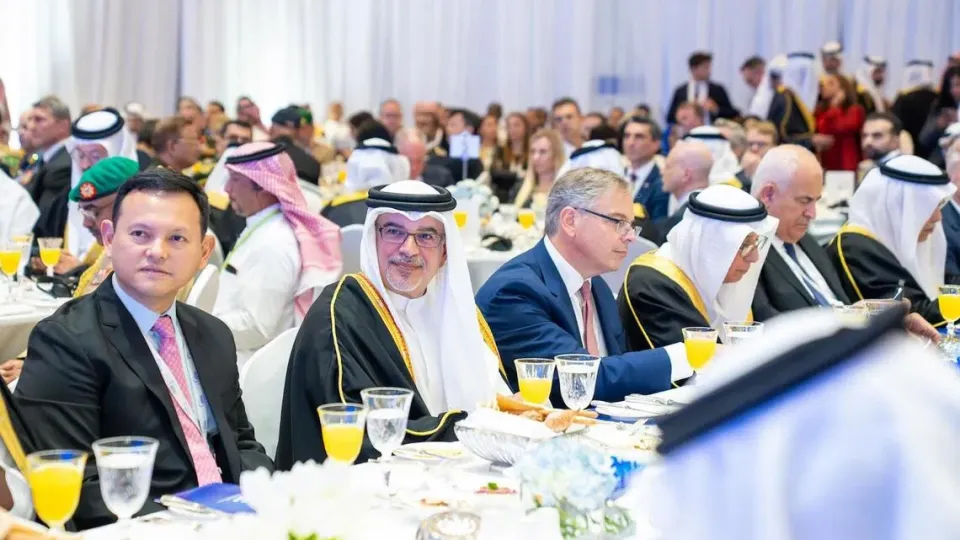
Arya News - At the Manama Dialogue in Bahrain, global leaders—including Singapore—emphasised that maritime chokepoints must never again threaten global trade and livelihoods, a vulnerability recently highlighted by the Strait of Hormuz crisis.
MANAMA – With the war on Iran possibly approaching its denouement one way or the other, maritime nations have started to look over the horizon.
A common sentiment, arising out of the crisis in the Strait of Hormuz where a tense standoff between the US and Iran has disrupted shipping for months, is this: While globalisation and shared economic interests have failed to reduce risk of conflict, never again should economies and livelihoods be held hostage to maritime chokepoints.
That’s one of the key takeaways from this year’s Manama Dialogue, organised by the International Institute of Strategic Studies. It is a point that Singapore and a host of nations articulated at the West Asian region’s premier security conference.
“The lesson from Hormuz is not that our world has become too interconnected. It is that our security cooperation has not always kept pace with our interdependence,” Acting Minister for Muslim Affairs and Senior Minister of State for Defence Zaqy Mohamad said on Nov 1 as he shared a panel on maritime security.
“We must not allow insecurity to become the new normal.”
Noting that no single nation can secure the maritime commons individually, Zaqy called for littoral and user-states of waterways to take the initiative, supplemented by other users of the maritime passages. If countries accept higher risks, longer shipping routes and rising costs as simply the price of doing business, he warned, maritime insecurity would become a permanent feature of international trade. That’s unacceptable.
He suggested three areas for cooperation: sharing information about threats in a timely manner, being prepared to act together, and “securing what we cannot always see”.
“Maritime security is no longer just about the things we see, protecting the ships that we see. It is also about safeguarding the infrastructure beneath the seas on which our connected world depends on.
“As technology advances, defence establishments must work together to understand emerging risks and develop collective responses.”
While Singapore works with neighbours Indonesia, Malaysia and Thailand on the Malacca Straits Patrol, it also has contributed to Combined Task Force (CTF) 151 in the Gulf of Aden and CTF 153 in the Red Sea, Zaqy said, adding that participating in these multi-state naval partnerships underscored the Republic’s dedication to safeguard maritime security beyond its region.
The urgency to find durable solutions to maintaining maritime security has been gaining ground for a while. When Bahrain, host of the Manama Dialogue, presided over the UN Security Council in April it made maritime security and freedom of navigation a priority, bringing attention to the danger of eroding norms of navigation.
Greece, a nation with a long maritime history, has done likewise as president of the UN Security Council in October.
Greek Prime Minister Kyriakos Mitsotakis, in an opening address to the Dialogue, spoke of a broad consensus within the Security Council that “this topic should be treated as an issue of utmost urgency.” The sense of urgency, he said, was driven not only by actions of states, but also non-state actors who are able to use cheap technologies to disrupt navigation and threaten undersea cables.
This issue was not relevant to the Middle East alone, he said, noting that the world now had two “problematic theatres of operation” – the other being the Black Sea which has been heavily affected by the Russia-Ukraine war.
Just days ago, he noted, a Greek-owned container ship was sunk in the western Black Sea. And so much of grain remains unsold in Ukraine’s warehouses because of the disrupted shipping, while markets elsewhere wait for those shipments to arrive.
Even so, Mitsotakis called for European attention to “shift more aggressively” to West Asia.
Greece, as a leading maritime nation, has “a lot of skin in the game when we talk about the freedom of navigation”.
A senior Asian diplomat attending the Dialogue said he expected Singapore’s call for littoral states and users of waterways to take the initiative, to find resonance in the region.
“Where Hormuz and the Black Sea are concerned, the world is looking for credible powers to lead the collective effort to ensure freedom of navigation,” he said.
Recalling that during the Iraq War Singapore had joined the ‘coalition of the willing’ by sending a landing ship tank, he said strong powers stepping forth to lead the effort would bolster the confidence of smaller powers to sign on to such efforts. “Even token behaviour helps make the larger point,” the diplomat added.
This year’s Manama Dialogue concluded amidst widespread apprehension that another US-Israeli attack on Iran is imminent after the US mid-term elections.
Iran has threatened to rain retaliation on Gulf states and other US-friendly regimes across the West Asian region. Led by Qatar, frantic diplomatic efforts were continuing over the weekend to stave off yet another round of conflict.
Thanks to Iranian threats, the Strait of Hormuz through which much of the energy supplies headed for Asia used to pass, remains all but closed. October saw the highest number of strikes on shipping in a single month since war began in late February.
Tehran also has a significant measure of influence over traffic in the Bab el-Mandeb Strait and the Red Sea through irregular forces in Yemen allied or sympathetic to it.
Meanwhile, oil prices remain significantly elevated, stoking global inflation. Iran has a 2,000-km shoreline along the strategic waters of the Persian Gulf and the Gulf of Oman from which it can interdict the flow of commerce in the Strait of Hormuz. It also has a small footprint on the Caspian Sea through which it trades with Russia and Central Asia.
West Asia expert Vali Nasr told an RSIS conference in Singapore in October that control over the Hormuz strait has emerged as strategically more important for Tehran than retaining its nuclear programme.
Indeed, in negotiations to end the war, Iran has demanded that it be given privileges over the strait rather like what was accorded Turkey under the 1936 Treaty of Montreux which left Ankara as a sort of supervisor of the Bosporus Strait.
Such Iranian demands sit uneasily with most countries in Asia.
For South-east Asian states like Singapore, open and secure sea lanes are economic lifelines, Zaqy said at the Dialogue. While security circumstances differ, the principles governing maritime passage must be consistent.
“What happens in Hormuz or in the Bab el-Mandeb matters far beyond the Gulf. We must not allow attempts to restrict transit passage there to undermine navigational rights in the Straits of Malacca and Singapore, or any other strategic waterway,” he said.
At the same panel, Indian foreign secretary Vikram Misri scathingly noted that Indian seafarers using the Strait of Hormuz had been attacked “not just by Iranian actors… and we have not minced words” about it.
Misri was referring to US strikes on merchant mariners to enforce a naval blockade meant to prevent Iranian exports. The most serious of those incidents occurred on June 10th when three Indian seafarers were killed in a US missile attack.