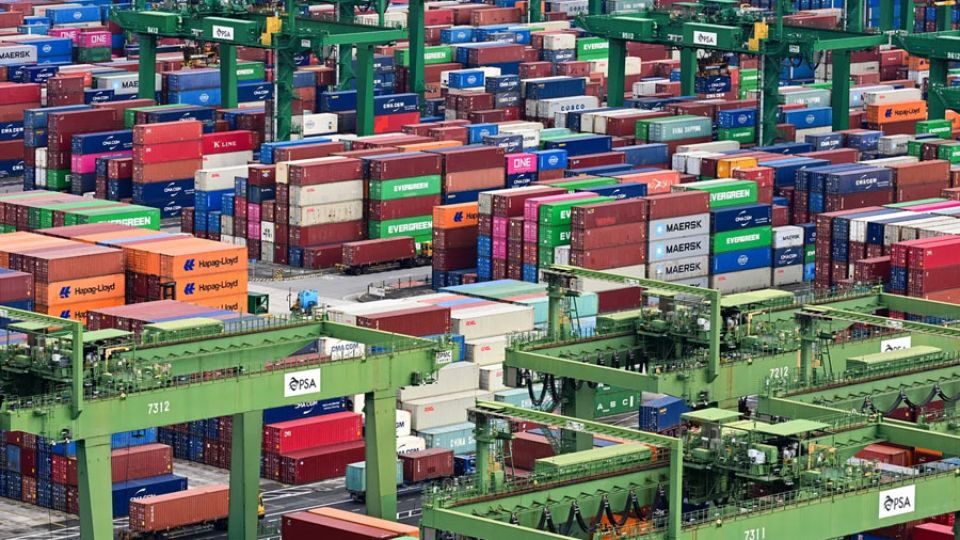
Arya News - While Singapore was mentioned in the report as “a small opportunistic Chinese target”, some analysts think stricter US scrutiny on the so-called “shadow transshipment network” could present an opportunity for the Republic to position itself as a trusted and traceable hub.
SINGAPORE – A centuries-old shipping practice of importing and re-exporting goods, or transshipping, has become the latest source of ire for the United States, which claims that it is being used to hide the goods’ true country of origin.
Singapore has not been spared, with the White House naming the Republic – the world’s biggest container transshipment hub – among dozens of other economies that it said Chinese exporters are using to avoid US tariffs.
The Aug 13 report titled “The Great Transshipment Scam” also stated that the US authorities will now use an artificial intelligence-powered “detective border” tool, among other initiatives, to help crack down on the illegal transshipments that falsify the country of origin for goods headed to the US.
While Singapore was mentioned in the report as “a small opportunistic Chinese target”, some analysts think stricter US scrutiny on the so-called “shadow transshipment network” could present an opportunity for the Republic to position itself as a trusted and traceable hub.
“Singapore is well-positioned to invest in the technological and monitoring requirements for stricter trade compliance enforcement, more quickly and credibly than most other trading hubs,” said Chua Hak Bin, regional co-head of Maybank’s macro research team.
The irony here is that Trump, in designing a maze of varying rates of country-specific tariffs, may have actually encouraged a globally diversified production and sourcing network.
Experts also believe that any attempt to clamp down on this supposed theft of US tariff revenue by unscrupulous foreign firms will only encourage tariff-disadvantaged exporters to further reconfigure their supply chains and find new ways to ship goods to the US from lower-tariffed jurisdictions.
Deborah Elms, head of trade policy at the Singapore-based think-tank Hinrich Foundation, said it is likely that US Customs officials will claim that all trade or at least all trade that might have anything related to China is, by definition, both a fraud and a scam.
“Ironically, such actions will surely lead to further diversification of supply chains and adjustments to shipping patterns that will just as surely trigger new anxiety and more policy changes from the White House,” she said.
Still, as trade enforcement becomes an increasingly important part of the Trump administration’s economic agenda, companies exporting goods to the US may have to focus more on what is legitimate transformation that changes a product’s origin.
“In other words, as companies diversify supply chains and expand sourcing across multiple jurisdictions, the key question will increasingly be whether the manufacturing performed in a third country is sufficient to support a new country of origin,” said Kelly Nelson, managing director in KPMG International’s trade and customs practice.
To appease the Trump administration, some economies named in the report may try to scale up enforcement and tighten rules regarding transshipment, including rules of origin that define the nationality of a product based on domestic and foreign inputs – raw materials, components, parts and semi-finished goods used to manufacture or assemble a final product.
Such actions themselves may raise the cost of compliance and make global supply chains even more complex as exporters try to mitigate costs.
What is transshipment?
Maritime transshipment is a common yet fundamental practice in logistics, designed to ensure that goods reach their final destination efficiently.
Whether it’s about optimising costs, adapting to complex routes or responding to operational constraints at the port of origin or destination, transshipment tends to benefit shipping companies by enabling a hub-and-spoke network.
This is where carriers use massive mega-vessels for high-volume main routes and smaller ships for regional legs. This cuts fuel and operating costs, connects remote ports and increases service frequency without running direct, low-demand ships.
The tariff gap, together with other duties and restrictions on China, may act as a strong incentive for bad actors to take advantage of regulatory loopholes and lax enforcement to use transshipment hubs to hide the true origin of goods.
But experts point out that a vast majority of the goods transshipped – even if they have gone through substantial transformation that changes their origin classification – are not illegal.
For instance, Singapore has been an entrepot that has been used to import, store and then re-export goods for hundreds of years.
In 2025, the Port of Singapore achieved a record container throughput of 44.66 million 20-ft equivalent units (TEUs), representing an 8.6 per cent increase compared with 2024, according to data from the Maritime and Port Authority of Singapore.
About 85 per cent to 90 per cent of those containers are usually transshipped or re-exported to their onward destinations that include neighbouring South-east Asian markets, China, the United States and Europe, according to supply chain management firms.
Singapore reports every month its domestic exports – defined as exports of Singapore origin that comprise primary commodities grown or produced here – and goods which have been transformed, that is, manufactured, assembled or processed in Singapore, including those with imported materials or parts.
It also reports re-exports data, defined as all goods which are exported from Singapore in the same form as they have been imported, without any transformation.
The bulk of Singapore’s re-exports are machinery and transport equipment – such as integrated circuits, semiconductors and electronic parts – chemicals and chemical products, mineral fuels and oil, and manufactured goods.
Re-packing goods, splitting them into lots, or actions such as sorting, grading or marking the goods are not considered as undergoing the process of transformation, says Enterprise Singapore, the state agency that issues the monthly trade performance report.
That distinction between domestic exports and re-exports – transshipped goods – is important for Customs authorities to properly tax the goods.
The role of third countries and South-east Asia
Economists and trade experts have long argued that Trump’s use of tariffs to influence bilateral trade flows with the aim to balance the US trade deficit is misplaced since the deficit is mainly driven by the country’s own macroeconomic conditions and fiscal policy.
Elms said: “Put simply, the US spends more than it saves, and this sucks in goods from abroad.”
No matter how much trade and tariff policies shift, the US will likely continue to face goods trade deficits with many partners, she added.
Trump is apparently focusing on trade malpractice to show why the deficit has not been fixed.
Chinese exports to the US have declined since 2018, when Trump’s first administration imposed tariffs on the world’s second-largest economy.
But in the same period, China has become the top trading partner of virtually every economy on the planet, with its trade surplus rising to record levels above US$1 trillion (S$1.27 trillion). Meanwhile, US trade balance has not improved much as imports rose from other countries, which the White House report identifies as part of the Chinese “shadow transshipment network”.
The report itself admits that that is because of the tariff differential – “China tariff minus the lower duty actually paid when the same goods enter the US from an enabling third country”.
Average US tariffs on Chinese exports stand near 50 per cent. In round numbers, Chinese-origin goods face an average tariff burden of roughly one-half of declared value before any comparison is made to lower-tariff third-country routes, the report said.
Hence, the US assumption is that the increase in exports from third countries with trading links to China are all suspicious transshipments.
In the years following the 2018 tariffs, countries in South-east Asia – mainly Vietnam, Malaysia, and Thailand – became popular destinations for companies looking to adopt the China Plus One strategy – where a business diversifies its sourcing or manufacturing operations by adding at least one other country alongside its existing base in China.
The strategy has since evolved from a narrowly focused defensive strategy to a broader one focused on enhancing resilience and cost-effectiveness. Some call it China Plus N – with N representing any number of alternative locations. That has raised the complexity of the regional supply chain, boosting transshipments between Asian economies.
For instance, while the US is one of Singapore’s top trading partners, it has dropped from being one of the top three re-export destinations. The top three non-oil re-export destinations for Singapore in the first half of 2026 are Taiwan, Thailand and Hong Kong.
Much of this shift reflects supply chain diversification, especially in high-tech computer and networking-related goods as companies like Lenovo, Apple, Dell, and HP moved portions of their manufacturing and final assembly operations from China to ASEAN countries.
US goods imports from ASEAN totalled US$453.7 billion in 2025, up 28.9 per cent from 2024, pushing the US goods trade deficit with the trading bloc up 43.2 per cent to US$327.3 billion, according to the Office of the US Trade Representative.
Not easy to crack down on illegal transshipments
The White House report estimates that potential tariff-evading transshipments may have been within a range of US$40 billion to US$303 billion annually. The annual tariff-revenue loss is estimated from about US$10 billion to more than US$100 billion.
Customs authorities worldwide use various methods to check the veracity of the paperwork filed by shipping agents, including supply chain audits, shipping manifest reviews and surprise inspections. But when millions of containers are passing through a port, it is difficult to examine them all.
Investigators usually focus on unexplained spikes in exports from a specific country or company, especially after a new duty is imposed. That helps them catch big illegal transactions.
But such investigations take time.
For instance, it took more than two years for the US Commerce Department to investigate, make final determinations and collect the penalties in 2024 from several companies in three different South-east Asian countries that were evading anti-dumping duties that the US had imposed on Chinese solar panels.
Trump’s executive order issued in July 2025 allows the Customs and Border Protection agency to impose an additional 40 per cent ad valorem duty on goods it determines were transshipped to evade tariffs.
This additional 40 per cent duty has not been used so far.
In August 2025, a Trade Fraud Task Force – a joint initiative launched by the US Department of Justice and the Department of Homeland Security – was formed to target Customs evasion, illegal imports, tariff avoidance and forced labour violations.
But so far, it has collected only US$1 billion in civil and criminal penalties – far from the White House report’s revenue-loss estimates.
Still, experts said that as tariff levels rise and global supply chains become more complex, the question may no longer be whether trade enforcement will intensify, but how quickly businesses adapt to the authorities’ increasing reliance on data analytics, supply-chain visibility and AI-assisted enforcement tools.