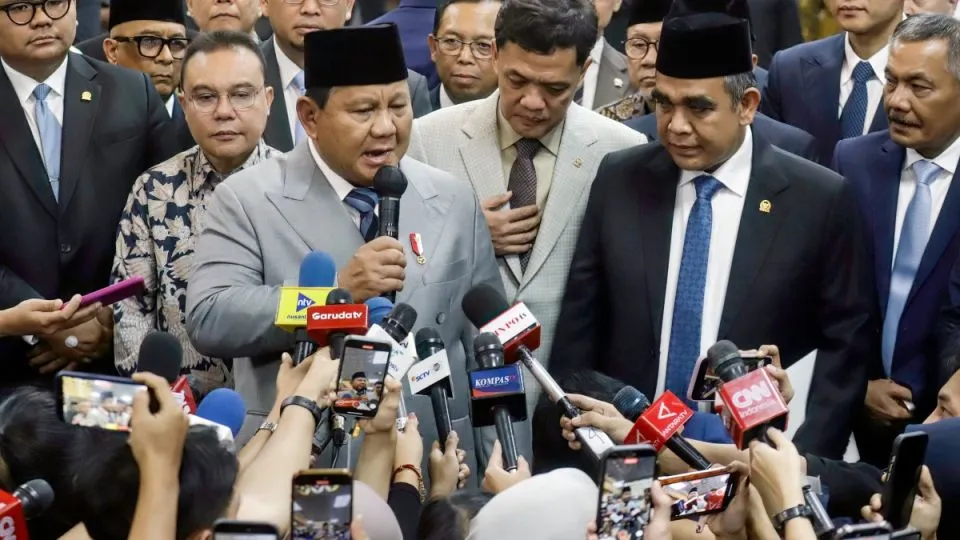
Arya News - An analyst, however, argued that the vice-presidential picks might not help President Prabowo Subianto rebuild public trust, citing his declining approval rating amid controversies surrounding his flagship programmes.
JAKARTA – President Prabowo Subianto’s nomination of two of his ministers, Amran Sulaiman and Sugiono, as vice-presidential candidates to replace Gibran Rakabuming Raka appears to signal his intention to consolidate power.
Agriculture Minister Amran, 58, a businessman from Bone, South Sulawesi, has a background in both business and agriculture. He has served as agricultural minister twice, under former president Joko “Jokowi” Widodo and Prabowo.
He was president commissioner of Jhonlin Agro Raya, a business owned by coal tycoon Andi Syamsuddin Arsyad, better known as Haji Isam, who is his cousin. Amran also founded his own holding Tiran Nusantara Group.
Political analyst Firman Noor of the National Research and Innovation Agency (BRIN) said Amran could advance the government’s populist programs through a pragmatic approach, drawing on his professional background.
“I see his potential role as vice president as helping to improve, facilitate and strengthen programs related to food security, which is on Prabowo’s populist agenda,” he said on Tuesday. “These programs are not only politically appealing but also can strengthen the government’s legitimacy.”
Analyst Yoes Kenawas from pollster Lembaga Survei Indonesia (LSI), however, said that despite Amran’s technocratic background, he could only be expected to act more as a loyal politician.
He cited Amran’s considerable political ties and influence in South Sulawesi, where several of his family members hold regional administration positions, including governor and regent.
More notably, Yoes said Amran’s ties to Haji Isam could provide financial backing for Prabowo. “Amran brings a guarantee that there will be financial resources to support Prabowo in the 2029 election without threatening Prabowo’s own electability.”
Haji Isam was reportedly a prominent financial backer of Prabowo’s 2024 presidential campaign.
The loyalist
Standing on the other side is Coordinating Human Development Minister Sugiono, 47, who is also the secretary-general of Prabowo’s own Gerindra party. His name emerged as a popular contender following Gibran’s resignation on Nov. 12.
Sugiono, often regarded as Prabowo’s “ideological son”, built much of his political career under Prabowo. He worked as Prabowo’s personal secretary and played a part in the founding of Gerindra in 2008.
Sugiono’s nomination carries a stronger political dimension, Firman said, as he could translate Prabowo’s vision into action. A less controversial politician than other Gerindra heavyweights, Sugiono could be more effective in building support and negotiations with political elites in Jakarta.
“Someone who is Prabowo’s thinking partner would naturally have a better grasp of his considerations and could offer more justifiable judgment to the role,” he said. “Prabowo’s interest in having a political lobbyist is more evident in Sugiono.”
Sugiono’s appointment would put the two top government posts in the hands of Gerindra politicians, marking the first such arrangement since the Reform era, Yoes noted.
“Gerindra’s dominance in the executive branch would only grow stronger, alongside its influence in the legislature, which is also controlled by Gerindra,” he said, noting the role of House of Representatives Deputy Speaker Sufmi Dasco Ahmad, who is widely regarded as Prabowo’s political fixer.
Beyond power
After submitting the two names to the People’s Consultative Assembly (MPR) Speaker Ahmad Muzani on Monday, Prabowo expressed his confidence that both Amran and Sugiono would serve the country to the best of their abilities.
Yoes, however, argued they might not help Prabowo rebuild public trust, citing Prabowo’s declining approval rating amid controversies surrounding his flagship programs.
He also doubted either candidate would significantly affect the economy, with investor and business confidence clouded by structural problems rooted in legal uncertainty and inefficient public spending.
The Assembly will convene in a plenary on Dec. 11 to select the new vice president.
In a preparatory meeting on Tuesday, Utut Adianto of the Indonesian Democratic Party of Struggle (PDI-P) floated the idea of having all Assembly members decide on the next vice president through a process of consensus rather than a vote. The proposal remains under consideration.
Under the Assembly’s rules of procedures, the vice president will be selected by vote. A tied vote will trigger a revote. Should the tie persist, the president may appoint the vice president directly.
The Assembly’s verification team, responsible for background checks of candidates, is scheduled to visit Sugiono’s high school in Magelang, Central Java, as well as Amran’s in Bone this week.