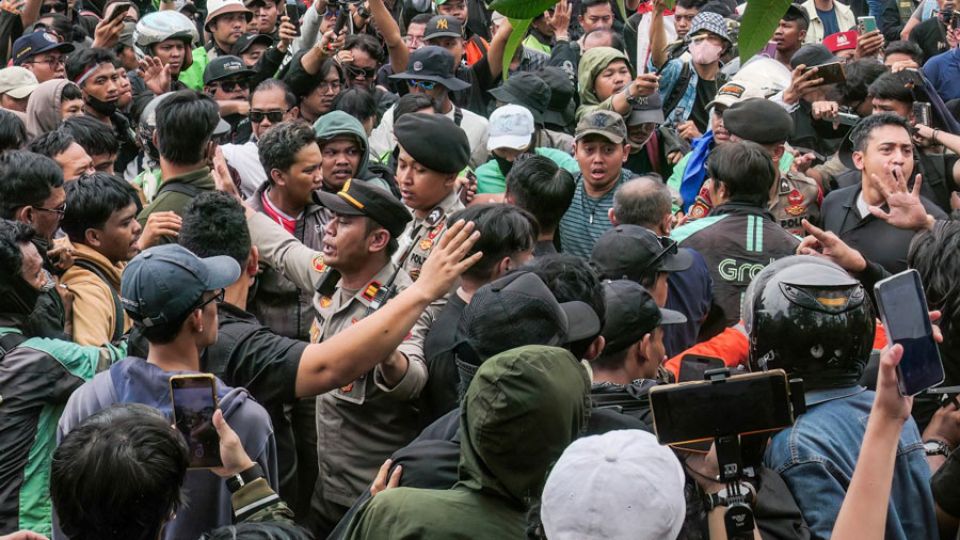
Arya News - By late Thursday afternoon, another wave of people had gathered outside the Senayan Legislative Complex. Some burned trash and attempted to breach the perimeter, with violence continuing in the area through Friday morning. One man reportedly died during the unrest.
JAKARTA – Calls are mounting for a deeper investigation into the unrest that followed Thursday’s largely peaceful protest in Jakarta, with authorities urged to establish who mobilized the crowds and how they were able to sustain hours of clashes despite a massive police presence.
The violence, which continued until Friday morning, left one person dead and damaged several public facilities, including a police post in Slipi, West Jakarta, about 2 kilometers from the Senayan Legislative Complex, where hundreds had gathered since Thursday morning to demand stronger antigraft measures.
The day began with a demonstration organized by the United Pati People’s Alliance (AMPB) from Central Java, which called on the House of Representatives to swiftly pass the long-delayed asset forfeiture bill to strip corrupt officials of their ill-gotten wealth.
The rally, secured by more than 18,000 personnel, remained largely peaceful until AMPB members began leaving the complex on Thursday afternoon after meeting lawmakers, who pledged to pass the bill by Dec. 15.
By late afternoon, however, another wave of people had gathered outside the legislative complex without clear demands. Some burned trash and attempted to push through the complex’s perimeter, while hundreds of other demonstrators remained in the area.
Tensions escalated around 7 p.m., about an hour after the demonstration curfew, when police moved to disperse those who remained by firing tear gas.
As the crowd made their way toward the Jakarta Inner Ring Road, some set fire to tires, motorcycles and other objects along the road. Police responded with water cannon and tear gas as clashes intensified, while protesters threw rocks and other objects at officers and damaged several CCTV cameras.
The unrest escalated further at around 10 p.m., when several trucks arrived in Slipi carrying hundreds of people wearing white headbands and carrying bamboo sticks. The group, whose identity and affiliation remained unclear, moved toward Palmerah and Petamburan, where clashes with police continued.
The violence lasted until around 6 a.m. on Friday, disrupting traffic across the capital and prompting authorities to temporarily close several toll gates, including those at Cawang, Tebet and Kuningan.
A man identified as Bambang Setiyawan, a mirror vendor in Pejompongan, died during the unrest, the police confirmed during a press briefing on Friday afternoon. But, the circumstances surrounding his death remained unclear.
Organized counterprotests?
Politics expert Agung Baskoro told The Jakarta Post that the late-night crowds may not have been entirely organic, citing their apparent level of coordination and the absence of clear demands.
“These are what I call rogue demonstrators, rogue security personnel and members of the public who are organized by certain parties to provoke unrest. What we saw was organized: the headbands, bamboo sticks, and mostly young men,” Agung said.
“It would be difficult to believe that they simply organized themselves. It would be logical for someone to have mobilized them, and for that to be someone with power, whether political influence, financial resources or networks,” he added.
Separately, Amnesty International Indonesia executive director Usman Hamid said the violence bore similarities to past instances of state-backed counterprotests, urging the government to establish that authorities had neither tolerated nor facilitated groups seeking to discredit the broader protest movement.
He also accused authorities of applying a double standard by cracking down on peaceful protesters while appearing slow to intervene as organized groups emerged later in the night.
“When conflict occurs, the state bears full responsibility. Authorities must investigate who facilitated, funded and mobilized the groups involved,” Usman said in a statement to the Post.
During Friday’s press conference, Jakarta police said they had detained 322 people for questioning over their alleged involvement in the unrest, including 162 adults aged 18 to 40 and 160 youths aged between 12 and 18.
Jakarta Police spokesperson Sr. Comr. Budi Hermanto said investigators were still examining the involvement and respective roles of those detained based on available evidence. Police also seized several weapons, including machetes, scissors, arrowheads and bamboo sticks.
Meanwhile, Jakarta Police criminal investigation director Sr. Comr. Iman Imanuddin said investigators had divided those detained into several groups based on their suspected roles.
These included 91 adults accused of participating in the riots outside the House compound and 71 people suspected of damaging public facilities or assaulting others. Based on evidence and witness testimony, police had named 45 of the latter group as suspects.
Investigators were also examining people suspected of carrying weapons, as well as those allegedly involved in organizing, financing and recruiting participants for the unrest.
Read More:
Protesters swarm Indonesia’s House to demand asset forfeiture, end to graft