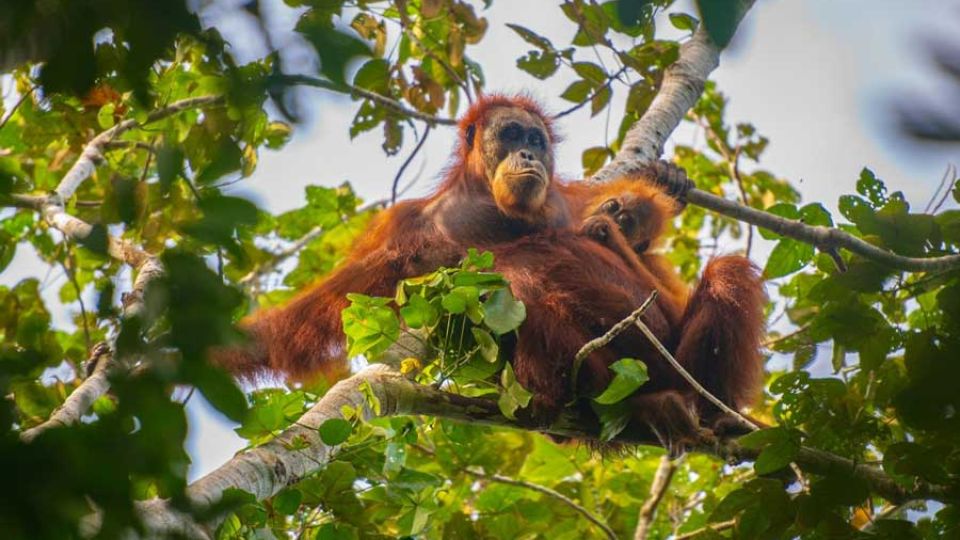
Arya News - Habitat fragmentation limits orangutan movement between populations, potentially reducing genetic exchange and raising the risk of inbreeding, with implications for the species’ long-term survival.
JAKARTA – Manmade arboreal bridges are emerging as a conservation tool to reconnect fragmented habitats for orangutans, as the critically endangered great apes face growing threats from infrastructure development, deforestation and climate change.
In the forests of Sumatra and Borneo, the only natural habitats of Sumatran, Tapanuli and Bornean orangutans, shrinking forests and expanding roads and settlements have increasingly isolated populations.
Habitat fragmentation limits orangutan movement between populations, potentially reducing genetic exchange and raising the risk of inbreeding, with implications for the species’ long-term survival.
At a discussion hosted by the National University in Jakarta on Thursday, conservationists said protecting orangutans should go beyond preserving forests and include ecological corridors that allow the tree-dwelling great apes to move across fragmented landscapes.
“Wildlife rescue cannot rely solely on protecting conservation areas. It must also include restoring connectivity between habitats through ecological corridors, supported by canopy bridges in areas where natural connectivity is no longer possible,” said Didik Prasetyo, director of the university’s Center for Forest and Wildlife Management Studies.
In North Sumatra, the Batang Toru forest is bisected by the Batang Toru river, with settlements and roads cutting across the landscape. Infrastructure development and deforestation have eventually reduced the forest cover and fragmented wildlife populations.
“It leaves their habitat divided into isolated patches, increasing conflicts between wildlife and humans and cutting off genetic exchange, threatening orangutan’s long-term survival,” said Julius Siregar, in-situ conservation head of the Yayasan Ekosistem Lestari-Sumatran Orangutan Conservation Programme (YEL-SOCP).
Batang Toru is home to an estimated 716 Tapanuli orangutans. Across North Sumatra and Aceh, the Sumatra orangutan population stands at 11,694 individuals, a 19 percent decline over the past decade, according to Forestry Ministry data.
In Kalimantan, meanwhile, most of an estimated 57,350 Bornean orangutans live in fragmented forests surrounded by industrial concessions. Only 20 percent of Bornean orangutan habitat is located within protected forests.
Climate change is adding to the pressure, altering habitat suitability through extreme weather, rising temperatures, drought and wildfires, said Word Wildlife Fund (WWF) Indonesia conservationist Fenky Wirada.
He said ecological corridors could provide orangutans with an escape route as environmental conditions change.
Braving the bridges
Although canopy bridges have been installed in several areas for years, orangutans have been slow to adapt to the artificial structures.
Tangguh Hutan Khatulistiwa, a conservation organization operating in North Sumatra, recorded 374 crossings by 14 arboreal species on five bridges it installed in Pakpak Bharat regency between March 2025 and March 2026.
Most crossings were used by Sumatran black langurs and macaques, which are relatively small and tend to adapt more quickly to the structures.
However, in a notable and rare development, the organization recorded two orangutans using the bridges separately in December 2025.
One of the crossings was captured on camera and made international headlines as the first known instance of an orangutan, the world’s largest arboreal animal, using a manmade canopy bridge built for the species.
The sighting demonstrated the bridges’ potential to reconnect fragmented habitats, with Lina Rita Silaban, the organization’s landscape manager, saying they could help orangutans access food and find mates.
“Orangutans cannot tell us directly when they are struggling to cross between split forests, so we try to interpret what they need and help them by building bridges,” she said.
Thursday’s forum agreed that effective corridors and canopy bridges would require stronger commitments to incorporate wildlife considerations into spatial planning and policymaking.
Budi Mulyanto, head of species and genetic conservation at the Forestry Ministry’s Natural Resource and Ecosystem Conservation (KSDAE) directorate, said orangutan conservation should adopt a landscape-based approach that includes restoring ecological corridors and developing mitigation infrastructure.
The ministry is preparing a new Orangutan Species Conservation Strategy and Action Plan covering a 10-year period. The current strategy remains in effect until 2029.
“The strategy and action plan is expected to go beyond serving as a plan for conservation and instead provide a shared framework for integrated management of orangutan landscapes,” Budi said.