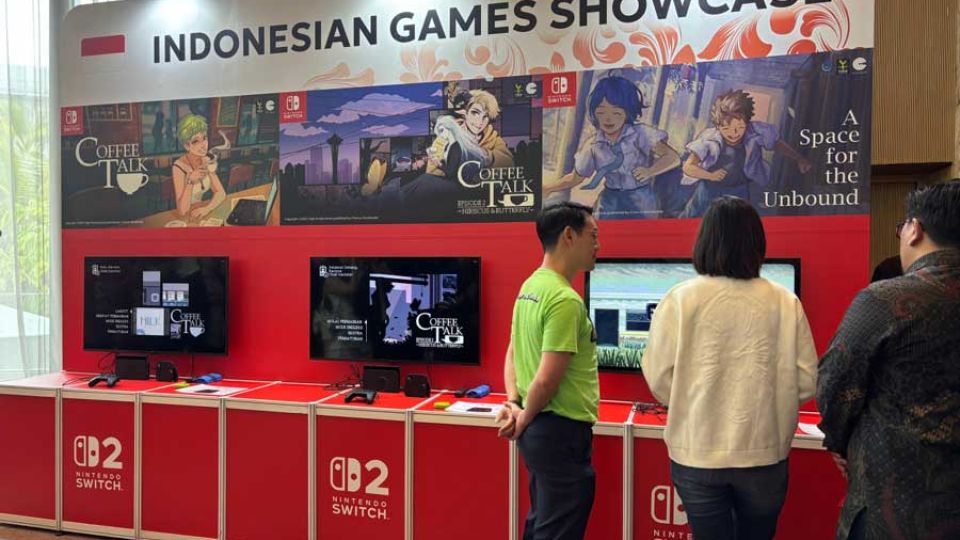
Arya News - The government reported 18.22 percent year-on-year growth in the applications and games subsector in 2025, with locally developed games contributing around Rp 750 billion ($42.2 million) in 2024.
JAKARTA – Indonesia’s gaming industry is pushing for greater access to global gaming platforms and development tools as local studios seek to scale overseas, with developers saying the official arrival of major platforms in Indonesia has yet to translate into meaningful implementation on the ground.
Digital Happiness CEO Rachmad Imron said Indonesia’s gaming industry had grown significantly over the past decade, with several local titles achieving millions of dollars in international sales, often with financing and marketing support from overseas publishers.
The government reported 18.22 percent year-on-year growth in the applications and games subsector in 2025, with locally developed games contributing around Rp 750 billion ($42.2 million) in 2024. Much of that value came from overseas consumers, highlighting gaming’s potential as a digital export industry.
“Many local games have surpassed the million-dollar mark, although they still rely on overseas publishers for funding and marketing,” Rachmad told The Jakarta Post on Aug. 18, citing Kuloniku, Riftstorm and Running Train as newer titles showing potential.
For developers, the challenge is less about reaching global markets, but more about competing for consumers’ attention and generating sustainable sales, with limited access to financing remaining a key constraint on established studios’ growth.
“Mass expansion is difficult because access to funding is limited. Developers still largely depend on overseas publishers, with funding generally below US$500,000 to $1 million, while intellectual property valuations cannot yet be used as collateral for bank financing,” he said.
He said better access to dev kits for platforms such as Nintendo, PlayStation and Xbox could help ease these constraints, as developers without direct access generally have to work through publishers to release games on consoles. This can add porting costs and require developers to give up a significant share of their royalties.
One possible way to strengthen the domestic ecosystem, he added, would be to bundle consoles with locally developed games as part of efforts to increase the local content component.
The issue is becoming more relevant as global gaming platforms expand their official presence in Indonesia, including Nintendo, which is scheduled to launch its products officially in the country in December this year.
CEO and founder of Toge Productions Kris Antoni said Nintendo’s official entry represented a significant milestone because it would not only bring its games and consoles to Indonesia but could also provide a gateway for local developers to publish games on its platform.
“From the perspective of Indonesian game developers, the biggest challenge is access to technology such as dev kits, as well as support from the platform itself,” he said on Aug. 11 to the Post.
He said Nintendo’s presence could make access to dev kits easier and improve communication and the process of releasing Indonesian games internationally.
Toge is an example of a local studio with an established international audience, with games such as Coffee Talk and Space for the Unbound reaching overseas markets, particularly Japan, the United States and Europe.
For him, greater support in marketing is now particularly important. Indonesian developers face challenges including language barriers, the cost of travelling to international events and the difficulty of reaching overseas audiences.
He said global platforms could help bridge that gap by increasing the visibility of local games domestically through retail channels while also showcasing Indonesian titles at international events.
“Having the games available in retail stores could make them more visible and ultimately help build awareness in the local market. Internationally, these platforms could also serve as a bridge to showcase our games at international events,” he said.
While established studios increasingly focus on marketing and global audiences, Kris said newer developers continued to face more basic challenges, particularly funding, technology and experience in game development.
The Creative Economy Ministry is seeking to address these barriers by expanding market access and international exposure, with Deputy Minister Irene Umar saying the government is working to connect Indonesian developers more directly with global platforms, including through access to Nintendo’s development kits.
“If we want to produce something but don’t have the machine, how can we do it? No matter how good the talent is, it will be difficult. So we are pushing for this, if you want the market, please provide the game developers with the development kit,” she said on Aug. 11 during the Nintendo Business Conference in Jakarta.
“Not only providing the dev kit, but also providing lessons on how they can tap into this. Because once you enter the console market, you automatically enter the international market,” Irene said.
She urged Indonesian developers to look beyond the domestic market and target the global audience. She cited Space for the Unbound as an example, with around 70 percent of its market overseas and 30 percent in Indonesia.
The government also sees the arrival of global platforms as part of efforts to strengthen copyright protection in Indonesia’s gaming industry, which Umar said had been another consideration in encouraging Nintendo’s official presence.
Beyond development kits, the government hopes global platforms will support local developers through talent development, knowledge sharing, localization, creative collaboration and intellectual property development.