Arya News - A week into the country’s deadliest disaster in a decade, mental health teams are only beginning to reach survivors and the deeper trauma may still be ahead.
KATHMANDU – For four days, a couple in Nuwakot each believed that the other had been swept away by the flood. They were on opposite sides of the water, cut off, with no way to confirm the other was alive.
A psychosocial team from the Centre for Mental Health and Counseling Nepal finally reached both of them by phone and put them in touch. The moment they heard each other’s voices, they refused to wait any longer, not for the road to clear or for the river to calm.
They wanted to be reunited immediately, and were flown across by helicopter, according to Gopal Bohara, the psychologist who helped make the call. When they reached a holding centre set up to house flood survivors, their children ran to them, crying.
This was one small resolution inside a much larger crisis but a resolution nevertheless. A week into Nepal’s deadliest flood in a decade, the death toll has reached 951 as of Monday evening, with nearly 4,000 people still missing and over 11,000 people rescued. Alongside the massive casualty and physical destruction—with houses, roads, bridges and entire settlements gone—is a psychological toll that is harder to measure, one responders say is now only starting to surface.
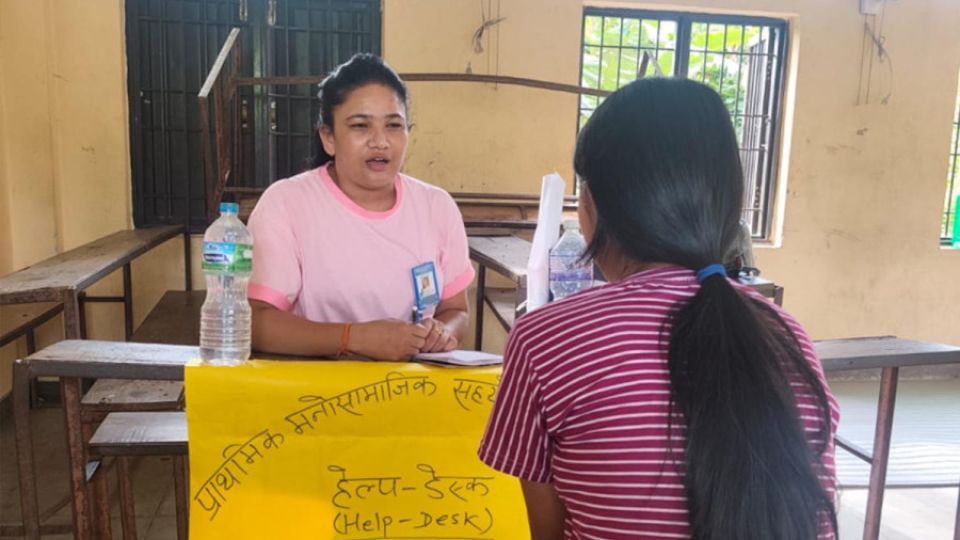
The government’s mental health response has been scaling up quickly. Officials say around 50 psychiatrists, psychologists and psychosocial counsellors are currently deployed across Rasuwa and Nuwakot through the Epidemiology and Disease Control Division. A roster of 64 more trained counsellors are on standby in Bagmati Province. But for most survivors, that support is only just arriving. Typically, Psychological First Aid (PFA) is introduced a week after a disaster, according to mental health professionals involved in the response, which, in Rasuwa and Nuwakot, means now.
Pomawati Thapa, senior consultant and medical generalist at the Department of Health Service, said of the roughly 50 professionals currently deployed, about 10 are providing PFA directly, while a team of four is sent to Uttargaya in Rasuwa, a remote area without road access. Thapa said the department has drawn up a full deployment plan and is coordinating placements to all necessary locations.
The response was initially limited to PFA and volunteer mobilisation as officials assessed the situation on the ground. As information on the scale and needs of affected communities became available, the Health Ministry expanded its deployment, Thapa said. The field response is being supported by partner organisations including the Nepal Red Cross Society, TPO Nepal, CMC Nepal, CWIN and Koshish.
The Ministry of Health and Food Safety Nepal is also providing psychosocial support through three hotlines, informed deputy spokesperson Samir Kumar Adhikari. The 1115 line, he said, handles overall coordination and general health-related counselling. Since the flood increased the need for mental health support, the ministry has also trained staff working on the 1115 line to provide basic psychosocial support.
Dedicated psychosocial support, however, runs through a separate line, 1166, which is based at Patan Mental Hospital, Adhikari said. Calls to 1166 are routed there regardless of where they originate, and callers are connected with psychosocial counsellors. Seven psychosocial counsellors are currently working on rotation to provide round-the-clock services through the hotline. A third line, 1098, is a Child Helpline of a civil nature that the ministry is facilitating, Adhikari said.
On the ground, the stress is visible, with survivors showing signs of grief, anxiety and paranoia, Bohara said.
Bohara has been working with a psychosocial support team at Bhairum Secondary School, a holding centre in Bidur, Nuwakot. His four-member psychosocial team from CMC Nepal—comprising two psychologists and two psychosocial counselors—plans to stay 10 to 15 days, extending if necessary. They are working alongside medical teams and coordinating with local health authorities.
Bohara cited a case where two children have been repeatedly waking at night, having nightmares and crying out that the flood has come again.
“Most of them are currently in shock, unable to articulate their problems,” Bohara said. The team has not yet seen major signs of post-traumatic stress disorder among adults, but many are anxious, easily startled and frightened.
Yet formal counselling has barely begun for most survivors. In Nuwakot’s Bidur Municipality, psychiatrist Nirajan Bhattarai, who is part of a team deployed by the health ministry, said responders are currently prioritsing safety, basic needs and coordination.
“Safety and basic needs have to come first,” Bhattarai said. His team is currently providing emergency medication, including to people whose psychiatric treatment was disrupted and those experiencing severe sleep disturbances. Psychological First Aid and other interventions will follow as the immediate crisis stabilises.
Although counsellors are present in the affected areas, much of their current work involves linking survivors with services, coordinating access to holding centres and helping with other immediate needs rather than conducting formal counselling sessions. Some holding centres have also not yet been able to accommodate everyone.
Bhattarai said it is still too early to expect survivors to openly discuss what they have been through. What he has seen is that the adults are largely unwilling to interact with responders. “Even when people attempted to photograph or film the situation, some questioned why they were being recorded,” Bhattarai said. “Were they doing it to make money or get views?”
Children, meanwhile, appeared more willing to engage. But he cautioned that the psychological impact of the disaster may become more visible only after the dust settles.
That impact is already apparent in isolated but severe cases. In one case, a woman’s medication was washed away by the flood, after which her symptoms worsened. She had already been experiencing psychotic symptoms and was struggling with suicidal ideation, according to a member of Bohara’s psychosocial team. “She had attempted self-harm four times and was referred to Trishuli Hospital, where psychiatric care is available,” Bohara said.
Beyond individual symptoms, Bohara said, survivors are also dealing with a deeper loss: the loss of their community. He added that many displaced people are still moving between their homes and holding centres. Some whose houses remain standing are staying in the centres because they are afraid another flood could destroy them, while others return home during the day to collect food or check their properties. This constant movement has made it difficult for responders to maintain an accurate record of those staying at the centres.
Meanwhile, tensions are also emerging over relief distribution, particularly between people staying in rented rooms and those recognised as displaced. “As relief operations become more organised, providing primary psychological support in groups and making such services more accessible will be important,” Bohara said.
For now, both Bhattarai and Bohara say the priority remains keeping survivors safe, reconnecting those who have been separated, and providing PFA. And as the survivors begin to process what they have lost, they will need sustained psychosocial support.