Arya News - It will deepen the city`s innovation horizon into sustainable development, energy, advanced manufacturing, and materials, precisely aligning with the nation’s green transition needs under the 15th Five-Year Plan (2026-30), HKSAR government officials and scientists said on Tuesday.
HONG KONG – Hong Kong’s government-run innovation platform InnoHK launched its third research cluster — SEAM@InnoHK — on Tuesday, with a funding of HK$2.5 billion ($319 million) being invested into eight labs focusing on frontier technologies and sustainable development.
The SEAM@InnoHK will deepen the city’s innovation horizon into sustainable development, energy, advanced manufacturing, and materials, precisely aligning with the nation’s green transition needs under the 15th Five-Year Plan (2026-30), HKSAR government officials and scientists from the special administrative region said on Tuesday.
The new cluster will develop technologies for emerging industries such as semiconductors, space manufacturing technology and functional materials for energy and sustainability through eight approved research centers.
The R&D centers are partnered with top global universities and research institutions, including the University of Cambridge, Ecole Polytechnique Federale de Lausanne (EPFL) , Nagoya University, National University of Singapore, Tsinghua University, and Peking University. They also feature collaborations with Nobel laureates, including the 2016 Nobel laureate in Chemistry Ben L Feringa; winner of the 2010 Nobel Prize in Physics Konstantin Novoselov, who is known as the “Father of Graphene”; and Hiroshi Amano, one of the three laureates of the Nobel Prize in Physics in 2014.
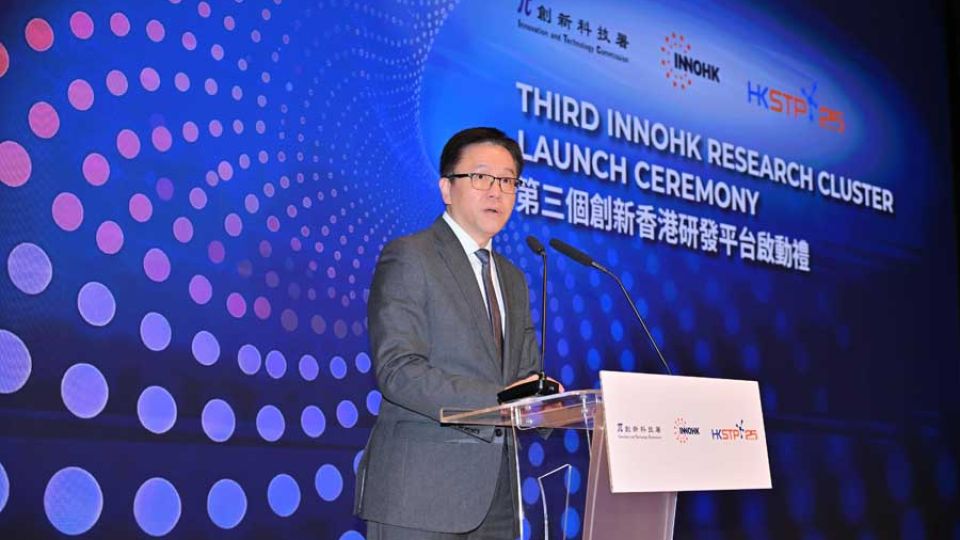
Speaking at the launch ceremony at Hong Kong Science Park, Sun Dong, secretary for innovation, technology and industry, said the research projects under the new platform echoed the national 15th Five-Year Plan by promoting the development of high-end manufacturing, accelerating the growth of strategic emerging industries, and deepening green transformation.
He noted that Hong Kong has five world-class universities ranked among the global top 100, and holds a leading position worldwide in multiple fields including engineering, environmental science, and materials science. He added that he believes that the new InnoHK research platform will deliver tangible economic and social benefits, nurture a new generation of research talent, and contribute to the sustainable development of the city, the nation, and the world.
Cordelia Chung, chairman of Hong Kong Science and Technology Parks Corporation (HKSTP), operator of the park, noted that InnoHK has been partnered with the HKSTP for five years, and has demonstrated the power of collaboration amongst world eminent scholars, researchers, and global partners. She stressed that the HKSTP will give full support to the InnoHK teams, and thus contribute to the city’s innovation landscape.
Speaking to reporters after the ceremony, leading scientists expressed their confidence in utilizing the new platform to accelerate the commercialization and solve more practical issues through the innovative outputs.
Wang Gong, head of InnoHK Centre for Space Manufacturing Technology, a center under SEAM@InnoHK, noted that space manufacturing is an interdisciplinary and emerging field in which innovation plays a vital role. He stressed that the center will leverage its cutting-edge advantages in space-based 3D printing, advanced functional materials, and on-orbit assembly technologies to drive industrial upgrading and promote green manufacturing.
Shao Minhua from another SEAM@InnoHK center — InnoHK Hong Kong Center for Renewable Energy and Storage — said that many of the team’s experimental results, covering solar energy, hydrogen energy, and batteries, have already been trialed in the industry, and the center hopes to validate them over the coming year so that they can be further commercialized.
Shao said the center’s research directions can ensure energy security by reducing dependence on external geopolitical influences, address carbon emissions, and promote electrification. He also highlighted some current challenges in the industry, including the low energy conversion efficiency of solar power, as well as the high cost and safety concerns associated with hydrogen energy — all of which require further research.
Led by experts from the City University of Hong Kong and EPFL from Switzerland, InnoHK Sustainable Materials and Advanced Renewable Technologies Centre briefed that the center aims to discover, synthesize, and refine advanced materials for sustainable consumer products and clean energy at unprecedented speeds by combining AI, robotics, and automated self-driving laboratories. The center aims to lower clean energy adoption costs, and advance carbon neutrality goals through collaboration,
Launched in 2022, InnoHK is a flagship initiative put forward by Hong Kong SAR government with a funding of HK$10 billion to position Hong Kong at the frontline of the global advanced technology map.
Two InnoHK research clusters have already been established: Health@InnoHK focusing on healthcare technology, and AIR@InnoHK focusing on artificial intelligence and robotics technologies.
So far, InnoHK has funded 30 laboratories, connecting over 30 leading universities and research institutions from 12 economies and bringing together some 3,000 local and international researchers and collaborators.