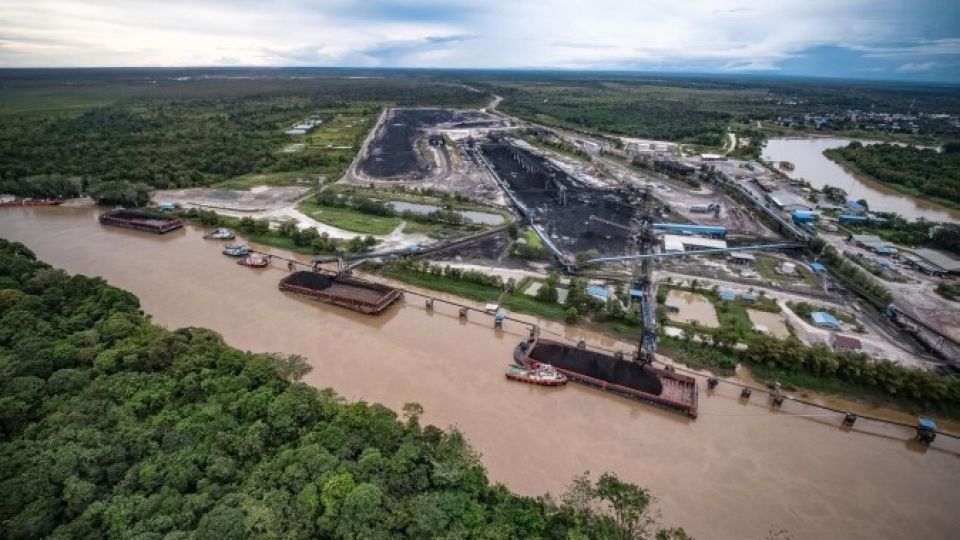
Arya News - The Indonesian Coal Mining Association (APBI) has cautioned that an extended dry season could further disrupt shipments, with supply chains already under strain in key producing regions.
JAKARTA – Aprolonged El Niño-driven dry spell is disrupting Indonesia’s coal shipments as rivers used to transport the export commodity run shallow. Analysts said producers may turn to alternative routes, including land transport or smaller vessels, but these options could drive up costs.
The Indonesian Coal Mining Association (APBI) has cautioned that an extended dry season could further disrupt shipments, with supply chains already under strain in key producing regions.
APBI Executive director Gita Mahyarani said the impact of the prolonged dry spell is not uniform across the country but is becoming increasingly evident.
“It will certainly have an impact, though not in every region, and is already occurring, particularly in Central Kalimantan,” she told The Jakarta Post on Monday.
A central concern is the shallowing of major waterways used to transport coal. Asked about how the declining depth of the Barito and Mahakam rivers affects existing export contracts, Gita said the disruption is already tangible, though its scale varies by company.
Indonesia’s seaborne coal exports fell sharply in August, extending a three-month decline as prolonged dry weather hampers shipments from mine sites to export terminals.
Citing data from the Shanghai Metals Market (SMM), exports totaled 36.10 million tonnes in August, down 23.34 percent year-on-year (yoy) and 6.54 percent month-on-month (mom), the lowest August level in five years.
Shipments to key destinations diverged. Exports to China and India rose to 14.47 million tonnes and 7.10 million tonnes respectively, up 1.26 percent and 12.01 percent mom. By contrast, shipments to the Philippines and Vietnam fell 26.38 percent and 21.58 percent.
“I cannot provide precise data as it depends on the individual companies, but what is certain is that the supply is being disrupted. It is still moving, but not smoothly,” Gita said.
Argus Media on Sept. 2 attributed the decline to reduced river depths, which have restricted the movement of coal from mines to export terminals, prompting several producers to declare force majeure on shipments.
“Parts of the upstream Barito River have become completely impassable for vessels, and a number of mining companies in the area have already declared force majeure on shipments because of these conditions,” Argus reported.
Coal market media Sxcoal also noted that the decline in Indonesian coal exports was caused by uncertainty over this year’s production quota, as well as shallower rivers in Kalimantan.
“The depth of the Barito River has dropped from 8-18 meters to just 3-4 meters, forcing barges to reduce their loads by half [of their typical capacity]. Some parts of the river are impassable, prompting companies to declare force majeure,” the firm stated, as reported by Bloomberg Technoz.
Mursidi, head of the Samarinda Harbormaster and Port Authority (KSOP), has instructed coal miners along the Mahakam River to cap their barge loads at 5,500 – 6,000 tonnes, down from the typical 7,000 tonnes.
With shipments slowing, the Indonesian Mining Experts Association (Perhapi) urged miners to pursue alternatives, including shifting to land routes, though costs would rise, or deploying smaller, shallow-draft barges despite inefficiency.
“As the world’s largest thermal coal exporter, Indonesia certainly influences fluctuations in international coal trade volumes, because any disruption to production or transportation will more or less affect export sales,” Perhapi chairman Sudirman Widhy Hartono said.
Production disruptions typically stem from weather events such as prolonged rain that floods mining areas, cutting output and pushing prices up as demand outstrips supply. Now, he said, the opposite is happening.
“From an operational and production standpoint, we have received reports that there are no obstacles to production because dry weather is actually a positive factor for increasing coal output at various mining companies,” Sudirman said.
On another occasion, Sudirman noted that the global coal price in the first eight months of this year increased to US$122-$150 per tonne, compared to between $100 and $120 per tonne during the same period last year.
“The surge in coal prices has become a crucial factor supporting Indonesia’s export performance, keeping it solid despite a decline in the volume of coal shipped to other countries,” he said on Tuesday, as quoted by Bloomberg Technoz.
Sudirman explained that the rise in coal prices was not only driven by Indonesia’s production limits, but also the escalation of the Iran war and the ongoing conflict between Ukraine and Russia, which is pushing up oil prices and has a spillover effect on other energy commodities, including coal.
Rice output decline
The same dry weather that is stranding coal barges on Kalimantan’s rivers is also casting a shadow over the country’s rice fields, where the coming planting window in October and November will determine whether next year’s harvest holds.
“The cushion this time is more substantial than during the 2023 El Niño,” Eliza Mardian, researcher at the Center of Reform on Economics (CORE), told the Post on Tuesday.
Government rice reserves now stand at around 5.2-5.4 million tonnes, compared with only about 1.5 million tonnes in 2023.
“So there is room to withstand price volatility,” she said, adding that the buffer provides a relatively secure stockpile.
Should a decline persist into 2027, price hikes and distribution bottlenecks would emerge first, she added.