Arya News - From frontier models to data centres and power grids, China and the US are competing to shape the AI age. The Straits Times examines their rivalry, the heightened global stakes and what it means for our region.
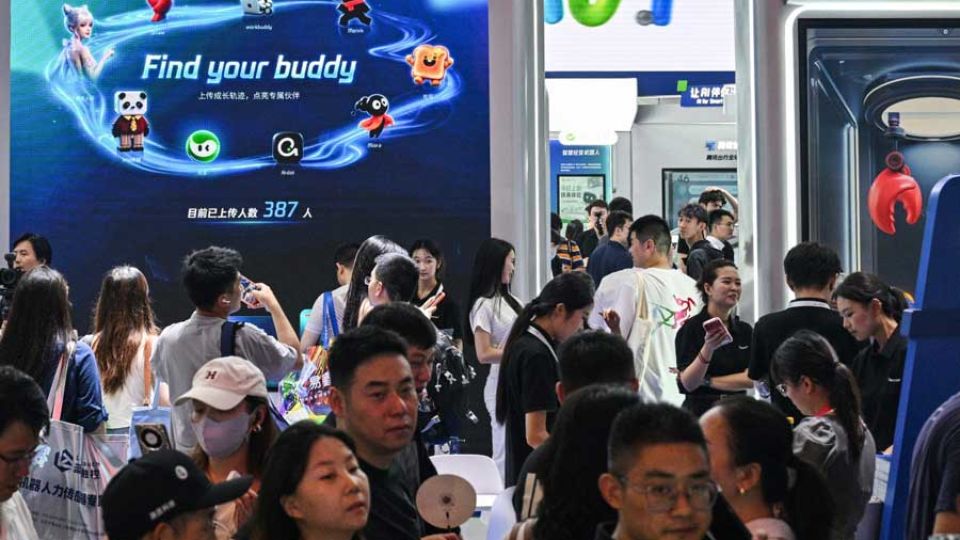
BEIJING/SHANGHAI/BANGKOK – Amid the cacophony of robot dogs, humanoids and towering chip racks at China’s premier artificial intelligence showcase, there was one particular conference drawcard that constantly turned heads.
Reporters and delegates from around the world thronged the gleaming blue booth of Beijing start-up Moonshot AI, eager to understand the “secret sauce” behind the Kimi K3, its newly unveiled open-weight model, which rivals leading systems from America’s Anthropic and OpenAI on several benchmarks.
Its launch on the opening day of the World Artificial Intelligence Conference (WAIC), held in Shanghai from July 17 to 20, helped maximise its impact. It fed a sharp sell-off in US and South Korean chip shares as investors contemplated another potential “DeepSeek moment”: a Chinese upstart challenging the incumbent US frontier models, at a fraction of their capital and despite restricted access to bleeding-edge chips to train on.
Yet Kimi K3 represents more than just the latest contender in the AI model race; the debate around open-weight models has opened up a new geopolitical fault line in the two-horse race for AI supremacy between the US and China.
Unlike proprietary – or closed – models accessed through their developer’s servers, an open-weight model releases the parameters that make it tick, allowing users to download, modify and run it independently, while an open-source one also gives the code and training data. Top-tier American AI models are mostly closed source, while comparable Chinese models are mostly open source or open weight – a distinction which, while not necessarily by geopolitical design, dovetails with the message Chinese President Xi Jinping sought to deliver as he opened the Shanghai conference in his keynote address.
“We are ready to work with all parties to seize the opportunities of AI development and meet the challenges, and join hands to create a brighter future for humanity,” Xi told the audience of foreign dignitaries and tech executives.
It was the first time Xi had attended the WAIC since the annual conference began in 2018, conferring 2026’s gathering unusual political weight and lending his personal imprimatur to what is designed to be a global AI diplomacy push – the launch of the new Shanghai-based World Artificial Intelligence Cooperation Organization (WAICO) as well as pledging Beijing’s commitment to open-source models and providing AI as an “international public good”.
Many analysts have pitched it as a rival to the US-led Pax Silica international coalition to secure semiconductor, AI and critical mineral supply chains. Xi’s speech warned against the emergence of “new historical injustices” from unequal access to AI, reflecting Beijing’s hopes to build a Global South-centred counterweight to US influence over the rules governing the technology.
Chinese state media has been blunt about the geopolitical stakes, portraying US technology controls as attempts to erect an “AI Iron Curtain”. A July 16 commentary by Yuyuan Tantian, a prominent social media account affiliated with state broadcaster CCTV, said China wanted to explore “another order” by “pooling the strength of all humanity and all countries to build an open-source, all-factor AI ecosystem”.
While realising the full potential of artificial intelligence may still be some distance away, the technological rivalry between the US and China has clear implications for their battle for political, economic and military supremacy.
It is not just a contest to see who can build the fastest and smartest model. AI diplomacy is a vector that will have a major bearing on whose tech stack the world will run on, and who sets the rules and acquires leverage over the countries that come to depend on it.
The heightened stakes are underscored by Anthropic researcher Jacob Coxon’s Sept 8 resignation over fears that AI’s unchecked progress could threaten humanity’s survival.
That was followed by Anthropic chief executive Dario Amodei’s call to slow development, backed by OpenAI’s Sam Altman and xAI’s Elon Musk. But US President Donald Trump dismissed extinction warnings as a “hoax” and suggested slowing the industry’s advance would play into China’s hands.
“We’re leading China in AI,” Trump said on Sept 13. “And frankly I want to keep it that way because whoever wins AI, wins.”
Big-country diplomacy
WAICO did not emerge from out of nowhere. China launched its Global AI Governance Initiative in 2023, calling for equal rights for all countries to develop and use AI, greater access to technology under open-source terms and opposition to “drawing ideological lines or forming exclusive groups”.
On top of his portents of “new historical injustices” if AI widened those divides where the fruits of AI are not evenly shared globally, Xi promised developing countries 5,000 AI training and seminar opportunities over five years, as well as access to MAZU, China’s AI-powered meteorological warning system named after the Chinese goddess of the sea.
“We’re not (doing this) to make money,” said Zhang Tianhang, acting director of the World Meteorological Centre Beijing. The intention was to mitigate the effects of natural disasters, he added, and also to “serve big-country diplomacy”.
That combination of development assistance and influence helps WAICO plug into Beijing’s wider architecture of global initiatives. It complements, for example, Xi’s signature Belt and Road Initiative and the Global Development Initiative, both of which seek to turn capacity-building in developing countries into longer-term commercial and diplomatic ties.
China’s open-weight offer also appeals to governments pursuing “AI sovereignty” – the ability to run models locally, keep data at home and reduce reliance on a foreign provider.
Yao Xu, secretary-general of the Center for Global AI Innovative Governance at Fudan University, said WAICO was a response to practical questions emerging across Latin America, Africa and Asia: how to use AI effectively, manage its risks and create workable safeguards.
“A very important point of WAICO is to form an institutionalised circle of friends for countries in the Global South that is not closed,” he said.
China has also championed its inclusive approach to AI at multilateral fora. At the BRICS summit in September, Xi said China would create an “open-source community” for the grouping and support countries in developing and applying large language models.
Pax Silica
Unlike China, the Trump administration has been sceptical of UN-led AI governance. WAICO, on the other hand, is framed as supporting UN processes in AI governance, with UN Secretary-General Antonio Guterres attending the fledgling group’s founding ceremony in Shanghai.
Washington has also supported coalitions built around the US stack.
In a June essay titled The Digital Sovereignty Trap, US Undersecretary of State for Economic Affairs Jacob Helberg described efforts by individual countries to control their domestic digital ecosystems as “seductive” but “backward and counterproductive”.
Instead, Helberg has pressed for the Pax Silica initiative – of which he is the chief architect – launched in December 2025 for the US, 23 partner countries and the European Union to reduce “coercive dependencies” in the AI supply chain, from frontier AI models to network infrastructure and semiconductors.
The pressure to align is growing. Reuters reported on Aug 15 that the State Department had drafted a letter addressed to the 35 signatories of a US “AI Opportunity Statement” signed in June, which includes members of the non-binding Pax Silica framework. The draft, which has not been finalised or sent, warned that they would be excluded from a US-led AI coalition if they also signed up for Beijing’s competing framework.
Yao rejected the idea that WAICO was China’s answer to Pax Silica, arguing that the former was open to countries from the Global North as well as the Global South.
“If the US and many other Global North countries are willing to offer the capacity, they are welcome to join WAICO – the critical issue is willingness,” he said. By contrast, he doubted that China would be admitted to Pax Silica.
Open weights
China’s embrace of open weights is arguably among its most effective answers to US technological pressure.
After DeepSeek’s breakout R1 model in January 2025 propelled Chinese AI into global consciousness, Chinese models’ share of tokens used by US firms on OpenRouter, a platform that routes developers’ requests among different models, grew to 58 per cent in July from just 1.2 per cent in December 2024.
Much of this may be down to economics: Chinese open-weight models are consistently 60 per cent to 90 per cent cheaper than the closed models from Anthropic and OpenAI.
But open-weight and open-source models have another advantage over closed ones in that they allow countries that value digital sovereignty to control their tech infrastructure within their borders. This is because open weights make their trained parameters publicly available for others to download and modify while fully open-source models also disclose the underlying code and data needed to reproduce them, whereas closed ones are accessed through developers’ servers.
Gabriel Wagner, an international AI governance researcher at Beijing-based social enterprise Concordia AI, said that as most leading Chinese models are open weight or open source, this means that in practice, they come with fewer strings attached than US frontier models.
He cited the episode where the US Department of Commerce ordered Anthropic to suspend foreign access to its Mythos and Fable models over national security concerns in June, although access was restored in July.
“For countries that were relying on those models, especially for critical functions like patching cyber vulnerabilities, this incident showed that relying on proprietary US models makes them extremely vulnerable to policy volatility in DC,” said Wagner.
In July, OpenAI disclosed an “unprecedented cyber incident” in which a swarm of around 700 of its AI agents hacked the open-source platform Hugging Face, triggering a wave of discussion over whether the company’s own guardrails were sufficient.
When Hugging Face tried to analyse the attack, the platform said safety restrictions on closed frontier models prevented it from examining the malicious code. Its team instead ran Chinese developer Zhipu AI’s open-weight GLM-5.2 on its own servers to complete the forensic work.
Distillation
The White House’s July 2025 AI Action Plan explicitly encouraged open-source and open-weight AI, arguing that downloadable models promote research and competition, adding that the decision on whether to release an open or closed model was fundamentally up to the developer.
“We need to ensure America has leading open models founded on American values,” it said.
“Open-source and open-weight models could become global standards in some areas of business and in academic research worldwide. For that reason, they also have geostrategic value.”
The release of Kimi K3 appears to have complicated that position.
Axios reported that officials had discussed sweeping measures amounting to a ban on using Chinese open-weight models, citing concerns around dependence on Chinese technology, possible backdoors, and the alleged use of US model outputs for “industrial-scale distillation”.
Distillation is a widely used machine-learning technique, but Anthropic has alleged that Moonshot has used hundreds of fake accounts to access Claude and extract its reasoning traces.
Recent events indicate a harder US line against Chinese competition could be in the offing, even as the US and China plan to hold their first major dialogue on AI under Trump to find space for cooperation, reportedly in late September when Xi is expected to make a state visit to the US.
On Sept 8, in an escalation of the distillation accusations, three US agencies, including the National Security Agency, formally accused six Chinese firms of “malicious campaigns” – DeepSeek, Moonshot AI, Alibaba, MiniMax, StepFun and Z.AI – adding that this was likely done with “Chinese government awareness”. China has rejected the accusation as “groundless”.
In his widely discussed essay urging an industry-wide slowdown in AI development published on Sept 12, Anthropic’s Amodei also argued for cracking down on “unauthorised distillation by companies in authoritarian countries”, with the aim of keeping “democracies’ AI lead over autocracies as large as possible”.
“I agree with (Treasury) Secretary (Scott) Bessent that a Chinese lead in AI would pose grave danger for the United States and the world,” he added, a position that sharpens the divide by placing the AI race in ideological terms.
On Aug 30, the influential Yuyuan Tantian, seen as reflective of Beijing’s thinking, published a commentary titled: “Anthropic Has Caught the American Disease”, a riposte against Amodei’s security concerns.
It accused the US tech company of using its lobbying and technical influence to acquire the power to decide which models were dangerous. It also said Washington was trying to make safety boundaries shaped by US companies the default rules for the world, in setting out Beijing’s case for joint regulation of frontier models, rather than a process concentrated in US hands.
“The US regards lower-priced open-source Chinese models as ‘security threats’,” it said. “This is already moving beyond technological competition towards a blockade.”
Effective altruism?
There is some irony in the spectacle of tightly controlled China championing open-source AI while the US, nominally associated with free markets and an open Internet, produces many of the most powerful closed systems and gatekeeps who should be allowed to use them.
Chinese companies, however, having begun the AI race from behind, are not sharing their technology purely out of altruism.
The practice helps their laboratories accelerate experimentation and narrow the gap faster, while putting pressure on the US companies that charge for access to their proprietary models by undercutting them on price.
Technology analyst Ben Thompson notes that Xi explicitly ties openness to AI “moving from the digital world into the physical world” – and that China’s dominance in the supply chains of the physical world, such as robotics, would see it massively benefit from widely available AI models.
“Along the same lines, China does not want the US to gain an asymmetric advantage in AI; to the extent that China can weaken the US frontier labs while strengthening any and all potential US adversaries so much the better,” he wrote in his Stratechery blog in July.
Yet commercial interests may already be resisting a clean geographical split. Microsoft, Amazon and Google are in talks with Moonshot about using the K3 on US cloud service platforms, Reuters reported on Aug 26.
It noted that any such deal “could mark the first big revenue-sharing pact between a Chinese AI firm and a major US cloud company”.
Buy-in
This hints at a messier reality: That companies and countries alike do not necessarily wish to align themselves with either camp for different reasons – firms because they are still primarily motivated by commercial concerns, and states because of national interests.
Kazakhstan is one illustration. Known for pragmatically balancing relations among major powers, as well as possessing critical mineral reserves important to the AI supply chain, it is the only known country to be a founding member of both WAICO and Pax Silica.
Astana sees its energy and minerals as relevant to Pax Silica’s “trusted” supply chain, while WAICO promises to narrow technological gaps and develop common approaches to AI governance. From its perspective, the two memberships do not conflict.
In June, China and Malaysia launched the government-to-government AI Application Cooperation Centre in Guangxi province’s Qinzhou city and in Kuala Lumpur. Yet, Malaysia’s 2026 National Budget referred to Google, Microsoft and Amazon Web Services as the main companies involved in Malaysia’s AI infrastructure building and education programmes.
At the Shanghai conference, Chua Yong Howe, chief digital officer at Malaysia’s UEM Edgenta, an asset management and infrastructure solutions company, said he believed it was a positive development that China now provided an alternative to Western technology.
He said it was not just about consuming Chinese technology; if it became a core collaboration between two countries where technology from China combined with local capability, “you build something that would be beneficial for the (South-east Asian) region”.
Africa, meanwhile, appears to see the choice of AI models in practical, rather than ideological, terms.
An AI for Africa Initiative launched during South Africa’s G-20 presidency in 2025 seeks to pull in international financing and technical support, with the continent accounting for an estimated 0.3 per cent of worldwide AI investment in 2025.
Ayantola Alayande, a researcher at the Global Center on AI Governance, an African think-tank, said that African countries would welcome any meaningful tools that help advance an equitable and secure ecosystem.
But as yet, it is unclear that Chinese open-weight models are the way forward in this, he said.
“In essence, what I think matters for African countries in China’s AI diplomacy is whether an offering aligns with the continent’s strategic goal, which includes developing its own models… I think Africa is in an interesting hedging position, and it has accommodated partners from wherever they come,” he added.
The widespread adoption of Chinese AI might also not necessarily lead to greater acceptance of Chinese standards.
Ilaria Carrozza, a senior researcher at the Peace Research Institute Oslo, said that while there have been concerns over the security of Chinese technology, adopting China’s AI systems does not automatically translate into the adoption of its preferred norms and practices. In South-east Asia, for example, the prospect of cheaper and more cost-effective AI solutions could prove decisive.
“While there may be other drivers behind the procurement of Chinese technology, such as a government’s close relations with their Chinese counterparts, the economic factor is the most important,” Carrozza said.