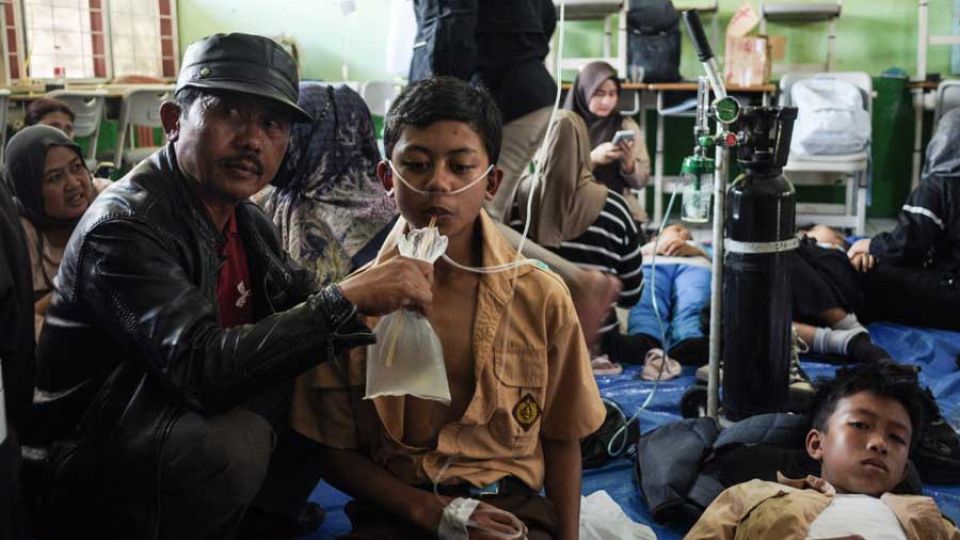
Arya News - Calls by parents, rights groups and students to halt the Indonesian government`s free nutritious meals program have intensified following the series of food-poisoning incidents. Some schools have also suspended or declined to participate in the program over food-safety concerns.
MEDAN – Almost 200 students in North and West Sumatra experienced food poisoning on Monday after consuming meals provided under the free nutritious meal program, as opposition to President Prabowo Subianto’s flagship initiative grows among students and parents.
Thirty-six students at the SMK Negeri 1 Merdeka vocational high school in Karo regency developed symptoms on Monday after eating a government-provided meal of rice, spicy tilapia, crispy tempeh, stir-fried papaya and snake fruit, local authorities said.
The students complained of stomach pain and difficulty breathing and were taken to hospital.
On the same day, 30 students at the MTsN 2 Asahan Islamic junior high school in neighboring Asahan regency also fell ill after consuming meals provided under the program. The meal consisted of rice, chicken rendang, tempeh, cucumber and carrot pickle and watermelon.
Thirteen of the students were still receiving inpatient treatment at a local hospital as of Tuesday.
Investigations are under way to determine the cause of the incidents. The kitchens responsible for preparing the meals have been suspended pending the results of the investigations, authorities said.
The latest cases came about a month after 353 students at SMA Negeri 1 Berastagi and Yayasan Bersama high schools in Karo regency fell ill in another food-poisoning incident involving meals distributed under the program.
That outbreak drew national attention after parents said some students continued to suffer serious health problems a month after the incident. At least 15 students were reported to have ongoing medical problems, including one who parents said experienced memory loss, multiple seizures and speech impairment.
Parents of affected students have filed a criminal complaint against the kitchen operator, alleging possible negligence.
Donal Simanjuntak, head of the Medan Office for Nutrition Fulfilment Services (KPPG), said his office had summoned kitchen managers and representatives in North Sumatra, to provide guidance and discuss measures to prevent further incidents.
“We have issued a circular instructing kitchen staff to undergo refresher training on hygiene and food safety in cooperation with the provincial Health Agency,” Donal told The Jakarta Post on Tuesday.
Also on Monday, 126 students at two junior high schools in Pariaman, West Sumatra, fell ill after eating meals distributed under the free meals program.
The students reported stomach pain, dizziness, nausea and vomiting after consuming black pepper chicken, stir-fried long beans, fried tofu and watermelon and were taken to hospital for treatment.
Authorities are investigating the outbreak while the kitchens that prepared the meals have been suspended pending the results of the investigation.
The incident was the second food-poisoning outbreak involving the program in West Sumatra this month.
On Sept. 1 and 2, 344 students, teachers, toddlers and breastfeeding mothers in Agam regency reported food poisoning symptoms including stomach pain, nausea, vomiting, diarrhea and dizziness after consuming meals provided under the program. Subsequent laboratory tests detected Bacillus cereus bacteria in chili and tofu served to beneficiaries.
Launched on Jan. 6, 2025, the free meals program is one of President Prabowo Subianto’s flagship initiatives. But the ambitious program has faced growing criticism over its large budget, corruption allegations and a series of food poisoning incidents.
Charles Honoris, deputy head of the House of Representatives’ Commission IX, which oversees health and social security affairs, said nearly 53,000 students had suffered food poisoning in incidents linked to the program, including about 3,000 this month alone.
Calls by parents, rights groups and students to halt the government’s free meals program have intensified following the series of food-poisoning incidents. Some schools have also suspended or declined to participate in the program over food-safety concerns.
On Monday, parents at SDN Beber state elementary school in Central Lombok regency, West Nusa Tenggara, agreed to suspend the program at the school after 352 students fell ill last week following the distribution of government-provided meals.
“We and our children are traumatized and do not want to take the risk. No one can guarantee that the incident will not happen again,” said Surya Darmawan, head of the school’s parents’ committee, as quoted by Detik.com.
SMPN 2 Jepara state junior high school in Central Java also suspended the program after about 112 students and 13 teachers fell ill after consuming meals provided under the initiative last month.
Several other schools and Islamic boarding schools in Central Java have also declined to participate in the program over food-safety concerns despite not having experienced any suspected food-poisoning incidents themselves.
“We decided to refuse the free meals program to avoid the risk of food poisoning because we have heard about many such cases, including in Boyolali,” said Maulana, the head of Istiqomah Islamic boarding school in Boyolali regency.
On Tuesday, thousands of students from elementary to high school staged protests in several parts of Papua, demanding that the government halt the free meals program.
Leo Mulikma, field coordinator of the West Papua Student Solidarity Alliance, said the protests were driven by concern over the recent series of food-poisoning incidents involving the program in several parts of Indonesia.
“The protests are an expression of solidarity because many students in Indonesia have gotten food poisoning after consuming the free meals. Instead of providing free lunch, the funds should be redirected to free education,” Leo said in Jayapura on Tuesday as quoted by Kompas.com.
Amid growing opposition to the free meals program, National Nutrition Agency (BGN) head Sudaryono told school principals across the country that they have the authority to reject meal deliveries if the food fails to meet safety standards or is suspected of being spoiled.
“There [could be] an unusual smell, a possibility that the food has spoiled, the meal container is properly labeled or the serving time has exceeded the prescribed limit. If the food is deemed unsafe, instruct the teachers to stop its distribution and ensure that it is not consumed,” he said on Tuesday, as quoted by CNN Indonesia.
Sudaryono also urged school principals to take a firm stance when meals are deemed unsafe, saying they should not hesitate to halt distribution rather than risk being held responsible if a food-poisoning incident occurs.