Arya News - Japanese and U.S. sources said the three nations intend to cooperate in the Arctic in order to strengthen economic security, amid intensifying competition with China and Russia over the region’s shipping routes and resources.
WASHINGTON/NEW YORK – Japan, the United States and South Korea are arranging to sign a memorandum of understanding aimed at launching maritime cooperation in the Arctic and expanding energy supplies, it has been learned.
Japanese and U.S. sources said the three nations intend to cooperate in the Arctic in order to strengthen economic security, amid intensifying competition with China and Russia over the region’s shipping routes and resources.
Foreign Minister Toshimitsu Motegi, U.S. Secretary of State Marco Rubio and South Korean Foreign Minister Cho Hyun are expected to meet in New York on the sidelines of the U.N. General Assembly to sign the memorandum.
According to the sources, the draft of the memorandum argues that cooperation in the Arctic is essential for the economic security of Japan, the United States and South Korea, and the countries agree to establish a working group — tentatively named the “Arctic-Pacific trilateral partnership” — to discuss potential areas of cooperation. They will also explore collaboration with the “Arctic Council,” a group of eight Arctic nations that includes Denmark and Norway.
The two main pillars of the trilateral cooperation are said to be maritime cooperation and economic partnership in the Arctic.
Regarding maritime cooperation, Japan is expected to collaborate with the United States and South Korea in response to unforeseen developments, as well as cooperate over marine observation and icebreaker construction technology, which is cultivated through the development of vessels such as the Antarctic research vessel Shirase.
Regarding economic cooperation, the three countries plan to engage in dialogue aimed at expanding the production and supply of energy resources, such as oil and natural gas, which are abundant in the Arctic region.
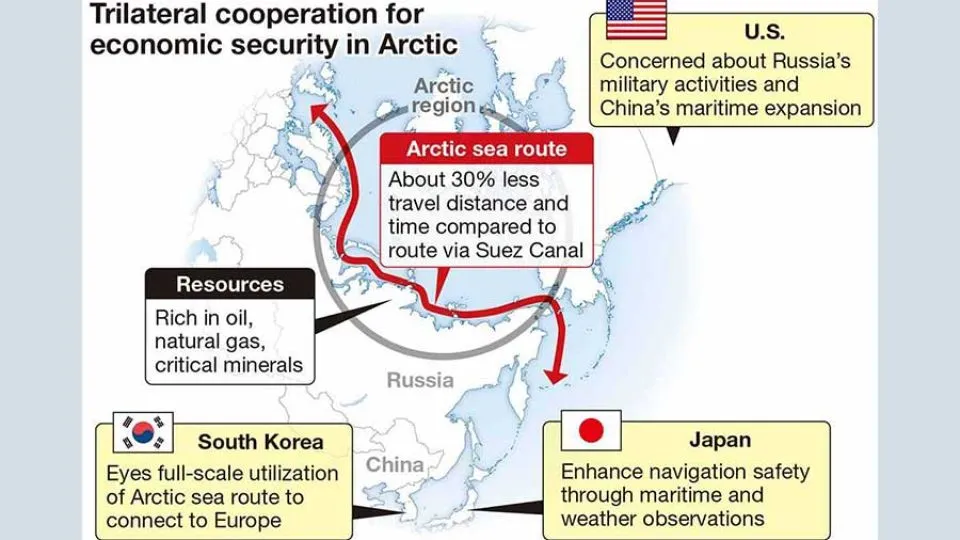
Japan plans to begin the operation of Arctic research vessel Mirai II this year. A planned project using the Mirai II is aimed at enhancing navigation safety through marine and meteorological observations, to strengthen Tokyo’s influence in future Arctic Ocean endeavors and for the development of international rules.
For its part, the United States, which has a presence in the Arctic region through Alaska, is concerned about Russia’s military activities and China’s maritime expansion in the region. In its Arctic Strategy compiled in 2024, the U.S. Defense Department cited the expanding cooperation between China and Russia as a security issue.
Through the planned trilateral framework, Washington intends to work with its allies of Japan and South Korea to advance surveillance and improve navigation capabilities in the region.
Finally, South Korea hopes for the full-scale utilization of the Arctic Sea routes that connect Asia to Europe. These routes are expected to reduce both the distance and travel time by about 30% compared to the current conventional routes through the Suez Canal. Seoul hopes this will lead to the establishment of a new logistics network.