Arya News - In recent years, several bones that were kept in private homes in a village in Kanagawa Prefecture have been confirmed as genuine. Why were these precious bones in these locations? The answer lies in a wolf-worshipping tradition that has been passed down through generations.
TOKYO – The Japanese wolf is believed to have gone extinct in the early 20th century — and with only a few stuffed specimens remaining in Japan, there have been few ways to study the species’ history.
In recent years, however, several skulls and other bones that were kept in private homes in Kiyokawa, a village in Kanagawa Prefecture, have been confirmed as genuine. The bones were appraised through DNA analysis and based on their morphological characteristics.
Why were these precious bones in these locations? The answer lies in a wolf-worshipping tradition in the village that has been passed down through generations.
Donation led to discovery
Musashi-Mitake-Jinja shrine stands at the summit of Mt. Mitake in Ome, western Tokyo, overlooking the entire Kanto region. The site is also where a wolf legend has been passed down through centuries.
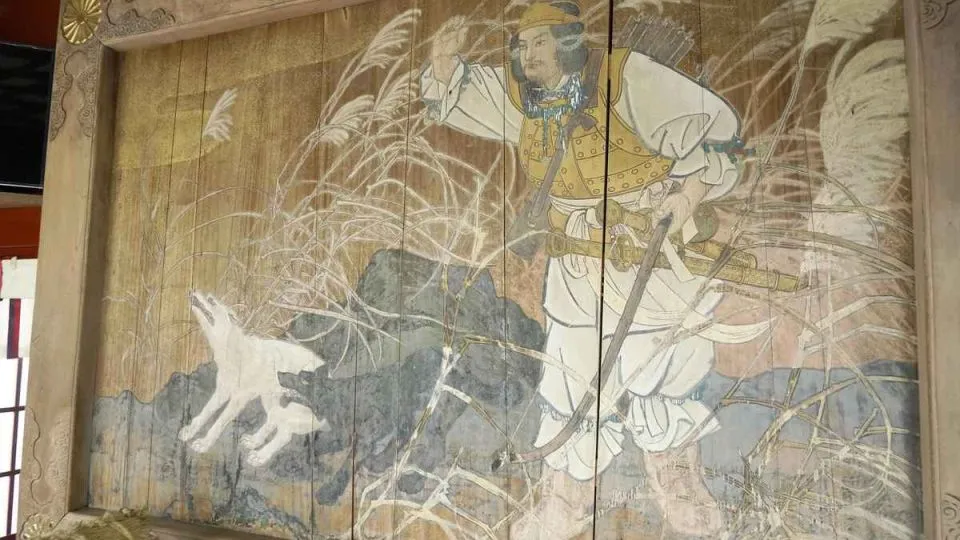
Legend has it that a white wolf guided the march of Prince Yamato Takeru to safety and remained in the area, where it was enshrined and worshiped as a god known as “Okuchimagami.”
During the Edo period, shrines across the country had Shinto priests known as “oshi.” As well as performing incantations to protect worshippers against misfortune and take care of them, the priests also traveled to various regions to spread the faith. Musashi-Mitake-Jinja shrine was one of the locations visited by the Oshi. They spread the faith throughout the Kanto region, and worshippers organized religious associations called “ko” at each village and clan.
Oshi also visited Kiyokawa village and handed out good luck “Oinusama” (a popular name for Okuchimagami) charms to members of these associations.
Even today, a number of homes in Kiyokawa still house shrines dedicated to the Musashi-Mitake-Jinja.
The skull of a Japanese wolf was donated to the shrine in 2022 by a relative of a Kiyokawa villager. This led to the DNA analysis of the wolf’s bone. The donated skull has reportedly been passed down through generations in the home of a relative of a “ko” member.
The chairman of the cultural properties protection committee at the village inquired about the bones, and he found that four skulls, one lower jawbone, and one leg bone were being kept in several private homes.
“It seems the bones were ground into a powdered medicine and administered to sick people, or lent out when someone became ill, thus having been used in folk remedies,” he said.
The existence of the bones was kept secret even among those involved in the religious association. Only relatives were informed of their presence.
High-precision gene editing
Bones that had been passed around as those of Japanese wolves have been found in various parts of the country. However, in many cases, it was discovered that they were in fact of dogs, foxes and other canids.
Among the bones found in Kiyokawa, the forelegs were morphologically identified as those of a Japanese wolf.
Associate Prof. Yohei Terai of the Graduate University for Advanced Studies, who specializes in DNA analysis, extracted bone powder from the skulls and lower jawbones and examined the mitochondrial DNA within the cells.
The Japanese wolf exhibits a unique pattern in which 50 to 60 of the 16,000 base pairs that make up their DNA differ from those of other kinds of wolves.
As a result of the analysis, four skulls and one lower jawbone were confirmed as genuine.
Since some of the bones had deteriorated due to being exposed to soot and smoke from a fireplace of a house, a “next-generation sequencer” — capable of deciphering DNA base sequences with high precision — was used.
“It’s rare for this many bones to be found in one and the same area,” said Terai.
As the skull donated to the shrine is designated as a treasure, Terai did not carry out any DNA analysis. However, he said it is highly likely it belongs to a Japanese wolf.
Lacquer applied to jawbone
The last recorded sighting of a Japanese wolf was in Nara Prefecture in 1905. It is thought that hunting and culling may have led to its extinction.
An article published in The Yomiuri Shimbun in 1876 reads: “Wolves appear frequently, causing damage to cattle and horses; farmers prepare to hunt for a reward.”
There was also a report with gruesome details about hundreds of wolves being blown up in a cave.
Did the number of wolves decline gradually, or did they die out all at once because of human actions? DNA analysis from specimens left in various areas of Japan might shed light on how they became extinct.
For example, when a species no longer has sufficient numbers, inbreeding proliferates. This would lead to a loss of genetic diversity, leaving the species with a higher susceptibility to disease or a lower reproductive ability. Such signs were reportedly observed in the DNA of well-preserved specimens.
One example that Terai analyzed is a “netsuke,” a small ornament used to suspend small accessories, passed down by the family of a chief retainer of a former feudal lord in Hyogo Prefecture.
According to Associate Prof. Hisashi Yoshimura of Nippon Veterinary and Life Science University, who discovered the artifact, the upper jawbone was coated with lacquer. Because of the coating, deterioration was minimal, allowing the sequencing of complete genomes.
“We were unable to sequence the genomes of specimens such as the skulls found at Kiyokawa village,” Terai explained.
“If technologies for analyzing degraded DNA advance further, we will be able to determine the extent of genetic diversity within a given region. The specimens preserved in various locations will certainly prove useful going forward.”
Wolves from the continent
It has been confirmed that Japanese wolves were already inhabiting Japan during the Jomon period, approximately 9,000 years ago.
A research team from the University of Yamanashi, the National Museum of Nature and Science and other institutions revealed in 2022 that a different “giant” wolf existed in earlier times and was also linked to the origins of Japanese wolves.
The research team compared fossilized bones of a giant wolf from 35,000 years ago excavated in Tochigi Prefecture to those of a Japanese wolf dating back 5,000 years ago.
The estimated withers height — the height from the ground to the shoulder — was 70 centimeters for the giant wolf and 56 to 58 centimeters for the Japanese wolf, marking a difference of more than 10 centimeters.
Previously, there had been two theories on the Japanese wolf’s origins: One suggested it was a smaller version of the giant wolf, while the other proposed it was a completely separate species.
The research team extracted DNA from the fossils to investigate. Analysis revealed that between 57,000 and 35,000 years ago an assembly of giant wolves migrated from the continent to the Japanese archipelago.
Then, between 37,000 and 14,000 years ago, another population migrated to the Japanese archipelago. It is thought that this group carried the genetics of both Siberian wolves and the ancestors of modern wolves, which are now located around the world.
The latter group intermixed with the giant wolves already inhabiting Japan to form the Japanese wolf, which subsequently thrived and established itself independently in the Japanese archipelago, separated from the continent by the sea.
Takahiro Segawa, a lecturer at the University of Yamanashi and scholar on ancient environmental DNA, said: “The difference in size between the Japanese wolf and the giant wolf has long been a mystery. We want to decipher the genome of ancient Japanese wolves more precisely and elucidate the process by which they became smaller.”