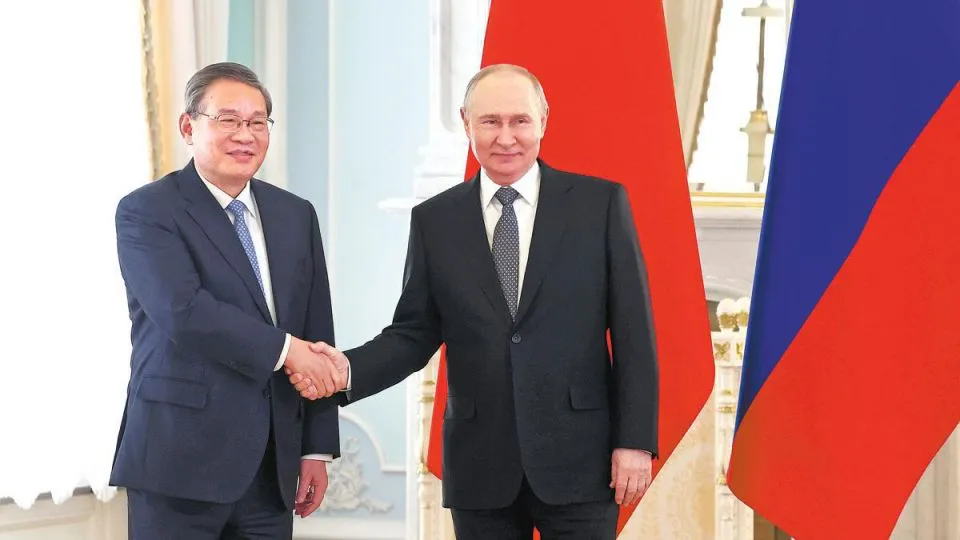
Arya News - Through dynamic and resilient cooperation, the two sides have managed to offset the impact of instability and external uncertainties by broadening bilateral cooperation, Chinese Premier Li Qiang said.
BEIJING – China and Russia have agreed to foster new drivers of development in frontier areas such as artificial intelligence, biotechnology and the digital economy, in addition to advancing cooperation in key traditional sectors, according to a meeting between the two countries’ heads of government.
Premier Li Qiang, who co-chaired the 31st regular meeting with Russian Prime Minister Mikhail Mishustin in St. Petersburg on Wednesday, said that China and Russia, faced with a complex and turbulent international landscape in recent years, “have stood shoulder to shoulder and moved forward in unity” under the strategic guidance of the two countries’ heads of state.
Through dynamic and resilient cooperation, the two sides have managed to offset the impact of instability and external uncertainties and broaden bilateral cooperation, Li said, noting that the China-Russia strategic partnership of coordination for the new era is entering a new phase, marked by greater achievements and faster development.
China is willing to work with Russia to build on the spirit of mutual respect and mutual benefit, and to promote even deeper and more substantive cooperation in various fields, Li said.
China also stands ready to work with Russia to better translate the important consensus reached by the two heads of state into concrete actions and tangible outcomes, better serve the development and revitalization of both countries, and bring greater benefits to the two peoples, he added.
Li also met with Russian President Vladimir Putin on Wednesday.
This year marks the 25th anniversary of the signing of the China-Russia Treaty of Good-Neighborliness and Friendly Cooperation.
Mishustin said the bilateral relationship is currently at its highest level in history and serves as a model for relations between countries.
Despite uncertainties in the international landscape, Russia-China economic and trade cooperation has maintained sound momentum, he said.
Russia is willing to work with China on the basis of mutual benefit, win-win cooperation, mutual respect and good-neighborliness and friendship, in order to further strengthen practical cooperation in various fields and safeguard the common interests of the two countries, he added.
After the meeting, Li and Mishustin signed a joint communique, and the two sides agreed on cooperation documents covering a wide range of areas.
The Chinese Foreign Ministry said that both sides agreed to “advance cooperation in key areas such as trade, economy, investment, energy, resources, connectivity, aerospace, finance and industry”.
According to the Chinese embassy in Russia, the value of bilateral trade surpassed $185 billion in the first eight months of 2026, up 28.4 percent year-on-year.
As part of a fresh consensus reached at the meeting, the two sides underlined the need to ensure the success of the “China-Russia Year of Education”, strengthen people-to-people exchanges in tourism, culture, youth and media, and stimulate the vitality of local cooperation.
China and Russia also agreed to maintain close communication and coordination on multilateral affairs and strive to reach more practical outcomes.
Li and Mishustin heard reports from representatives of several China-Russia bilateral cooperation committees and affirmed the work of these committees over the past year.
The committees cover investment cooperation, energy cooperation, people-to-people and cultural exchanges, regular meetings between heads of government, and intergovernmental cooperation between China’s Northeast and Russia’s Far East.