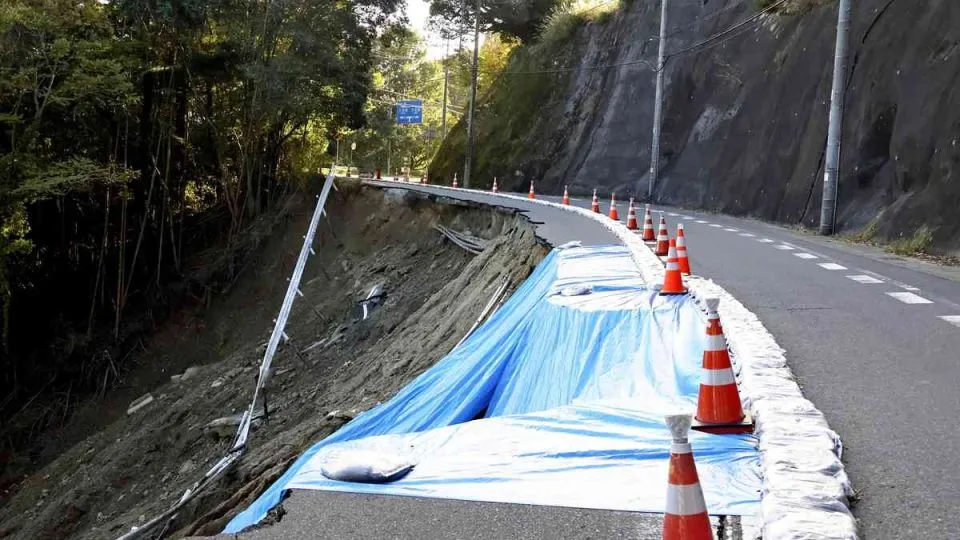
Arya News - Typhoon Dujuan, also known as Typhoon No. 25, came closest to Japan`s Kanto region on Sept. 21, bringing heavy rainfall and causing landslides. Chiba Prefecture bore the brunt of the storm, with 10 people dying as a result of the disaster.
CHIBA – Chiba Prefecture is still recovering from the serious damage wrought by Typhoon Dujuan last month, particularly to its tourism industry as many sections of prefectural roads remain closed.
Typhoon Dujuan, also known as Typhoon No. 25, came closest to the Kanto region on Sept. 21, bringing heavy rainfall and causing landslides. Chiba Prefecture bore the brunt of the storm, with 10 people dying as a result of the disaster.
One month later, 46 sections of roads managed by the prefectural government are still closed, including one that runs near the Yoro Valley, one of the major sightseeing spots in the prefecture.
“We’re reopening on Oct. 30, but we only have a few bookings,” said Yasuo Akiba, 67, who runs a hot spring inn near the valley.
Although his inn escaped damage from the typhoon, the facility had to suspend operations because several sections of the road collapsed due to heavy rains.
In some sections, almost an entire lane collapsed, and Akiba was not able to reach his inn by car until Oct. 14. The road is expected to be fully restored next year.
The Kominato Railway, which has the nearest station to the Yoro Valley, also suffered damage to its tracks at 26 locations. It may take close to a year to resume operations on the entire line.
Parts of the hiking trails in the valley have also been closed due to landslides, and they likely will not open before mid-November, which is part of the autumn foliage season for the valley.
Kazuhiro Yonemoto, the manager of a roadside rest area near the Yoro Valley, said the number of visitors to the facility has been declining since torrential rains hit Chiba Prefecture in August.
“Now it’s just about 30% of the average,” said Yonemoto, 67. “I’m worried if people will come even after the autumn foliage season begins [at the valley].”
According to East Japan Railway Co. (JR East), service on some sections of its lines in Chiba Prefecture remain suspended. Those between Anegasaki and Nagaura stations are expected to resume around the end of the year.
In some communities, residents have been unable to return to their homes due to landslides and flooding caused by the typhoon. According to the prefectural government, 76 people lived in evacuation centers across five municipalities as of Tuesday.
In the Kominato district of Kamogawa, for example, heavy rains from the typhoon caused a hill behind a residential area to collapse over an area about 50 meters long and about 55 meters high, killing three residents. Destroyed homes and the dirt from the landslide have been left untouched, and 28 residents continue to live in a nearby evacuation center.
Fisherman Shinji Kobayashi, 74, cannot reach the entrance of his home because a section of the road in front of the building has been blocked by the dirt and fallen trees brought by the landslide. To get inside his house, he sets a ladder against a wall about 4 meters high at the back of the building.
“I want to get back to our normal life as soon as possible,” his wife Harue said.