Arya News - Minister for Energy, Trade and Industry (Energy and Industry) Tan See Leng announced on Oct 26 that Singapore will embark on a study to further assess the feasibility of harnessing heat from deep underground to produce energy for electricity, cooling and heating.
SINGAPORE – The Republic’s pursuit of geothermal energy is hotting up after an earlier survey found that underground heat sources in Singapore had the potential to generate more than 60 times the nation’s current annual electricity consumption.
Minister for Energy, Trade and Industry (Energy and Industry) Tan See Leng announced on Oct 26 that Singapore will embark on a study to further assess the feasibility of harnessing heat from deep underground to produce energy for electricity, cooling and heating.
“We were very pleasantly surprised… If it is realised, it can power us for the next 60-odd years using geothermal energy,” said Tan.
He was speaking at the opening of the Singapore International Energy Week, an annual conference by the Energy Market Authority (EMA), the Republic’s energy regulator.
The five-day event convenes politicians, policymakers and industry players to discuss energy issues.
The 15-month study will start at the end of 2026. It will be conducted by a consortium formed by Surbana Jurong and energy consulting group GLJ.
The study will cover safety considerations, technical viability and the cost of harnessing geothermal energy.
It will also include assessments of the technical, environmental and commercial feasibility of deploying deep geothermal systems.
The consortium will identify areas for further assessment, potentially using invasive methods like drilling.
Singapore’s geothermal resources are located several kilometres underground, and the nation’s dense urban environment will affect the number of plants that can be deployed, noted Tan.
The amount of electricity that can be produced will depend on the cost and technical feasibility of extracting geothermal resources, as well as the pace of advances in deep drilling technology, added the minister.
“Most importantly, we must keep safety as a top-of-mind consideration,” he said.
His comments come as Singapore continues to explore cleaner, low-carbon energy options that are not yet commercially viable, including advanced nuclear and geothermal energy, to beef up its energy security.
Emerging technology, including nuclear and geothermal energy technology, could potentially supply around 10% of Singapore’s energy needs by 2050, a 2022 report had found.
Both these emerging energy sources could improve Singapore’s energy security, as they are resources that the country can tap from within its own borders, instead of relying on imported fuel.
Traditionally, geothermal energy is harnessed from hot water reservoirs underground. Volcanically active regions, such as Iceland and parts of the US, are rich in such resources.
Singapore’s geothermal resources, however, could come from dry, unfractured hot rocks deeper in the ground.
Singapore will thus need deep geothermal systems to tap such a resource.
This could include injecting fluid farther into the ground, where it is heated up and pumped back to the surface for electricity generation.
But Mark Lim, an adjunct research scientist at the Energy Research Institute @ NTU, explained that this method may involve widening existing fractures or creating new cracks to pick up more heat. This carries the risk of causing tremors, earthquakes and other safety issues.
An alternative to this is to install a series of closed pipes underground through which fluid circulates to absorb heat and transfer it to the surface for power generation, he said.
This is a closed-loop system where the fluid does not directly mix with rock.
Tan said Singapore has not made a decision on tapping geothermal energy, and it could take many years to reach one.
“No option is off the table for us here in Singapore. We will therefore explore this option seriously,” he said.
Quantifying Singapore’s geothermal potential
An earlier survey commissioned by EMA conducted between 2024 and 2026 involved the use of a special aircraft and ground sensors to closely map Singapore’s underground geology at depths of up to 10km.
That effort found that Singapore’s geothermal resources underground could potentially generate more than 60 times the nation’s annual electricity consumption, which currently is around 60 terawatt-hours.
EMA added in a statement that Singapore has high-temperature geothermal resources at depths of several kilometres underground, which may be suitable for electricity generation.
Once fluid injected into the ground is heated up and drawn to the surface, it is used to drive turbines that produce electricity.
The new study will help to confirm Singapore’s geothermal potential and provide greater clarity over the amount of energy that can be extracted, added EMA.
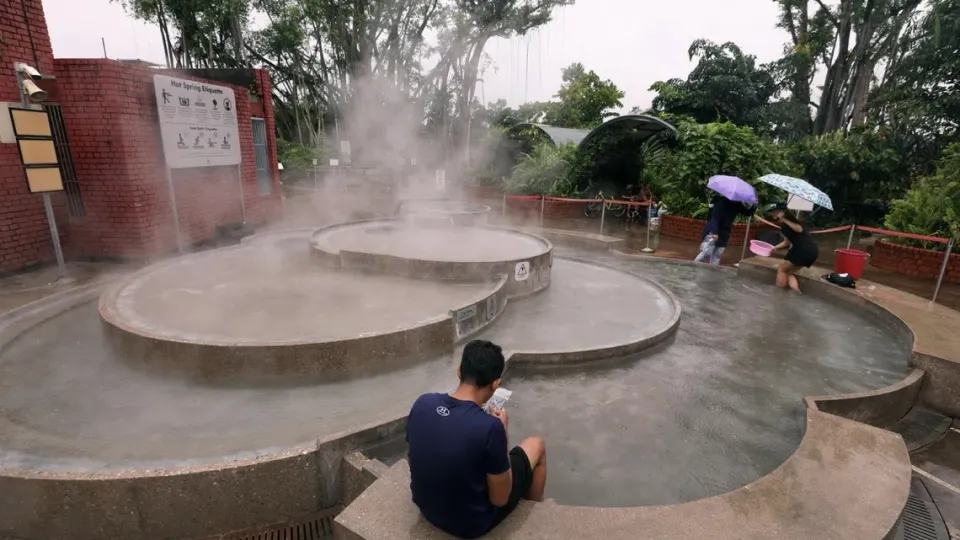
Separately, academic research by local researchers has pointed to parts of Sembawang, Admiralty and Pulau Tekong as harbouring possible sources of geothermal energy.
In July 2025, it was reported that a research team had made a second discovery of high temperatures underground in Sembawang, suggesting potential for electricity generation.
In March 2023, the team from Nanyang Technological University and TUMCREATE – the multidisciplinary research platform of the Technical University of Munich – found temperatures of 70 deg C at a depth of 1.12km in Admiralty.
Besides Admiralty and Sembawang, another known hot spot is on Pulau Tekong, where a hot spring is located in its northern Unum region.