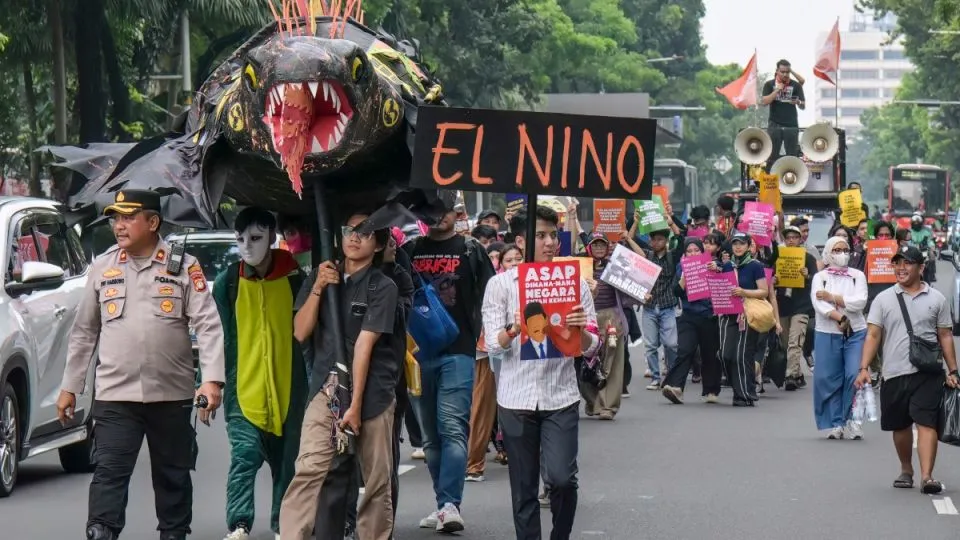
Arya News - Thousands of university students and civil society groups staged nationwide protests across major Indonesian cities, demanding the government declare ongoing fires a national disaster, hold corporations accountable, lower education costs, and protect civil liberties.
JAKARTA – Student protests have gained momentum across the country, as they vowed to sustain their protests and rally broader public support into the movement amid growing frustration over the government’s lack of meaningful follow-through on their demands and its perceived disregard for the needs of ordinary citizens.
Two years into Prabowo’s administration, student protests have become a regular occurrence, with demonstrators repeatedly taking to the streets to voice grievances over policies they say have failed to address public concerns and call for greater accountability, policy reforms and stronger protection of democratic rights.
Thousands of students from different universities, alongside several civil society groups, protested last week in Jakarta and some other major cities, including Yogyakarta, Surakarta, Makassar, Malang and Balikpapan. The demands include declaring the fires a national disaster, restoring public health and holding responsible corporations accountable, redirecting public spending toward people’s needs, lowering education costs, and protecting civil liberties.
Ezra Al Bara of Padjajaran University, one of protesters in a Wednesday demonstration in Jakarta, said that students had yet to see concrete progress on their demands, with the government yet to demonstrate a willingness to engage directly with protesters or address their concerns.
“We haven’t seen any meaningful changes,” Ezra, who is a member of the student coalition Komite Sadar (Save the People’s Sovereignty) organizing Wednesday’s protest, told The Jakarta Post on Saturday.
He said protesters were disappointed that government officials had instead highlighted the administration’s achievements rather than addressing their demands and continued to prioritize the interests of the political and business elites.
The protests began last Wednesday, coinciding with Youth Pledge Day, and followed demonstrations on Oct. 20 marking the second anniversary of Prabowo’s administration.
Acknowledging that the government might not meet their demands, Ezra said the movement’s goals went beyond securing immediate policy concessions, with students also seeking to raise public awareness and encourage broader participation in political affairs.
“Our purpose in taking to the streets is to awaken the nation and remind our fellow citizens that Indonesia’s sovereignty belongs to us, the people, not to political elites, oligarchs, corporations or the current administration,” he said.
“As Indonesian citizens, we have the power to reclaim our sovereignty. We will continue to grow in numbers across Indonesia until the day comes when people throughout the archipelago awaken and join us in taking back our country.”.
Alleged attempts to discredit student activism through paid protesters posing as university students and staging counter-demonstrations have emerged, such as the one held by the Jakarta Police at the Hotel Indonesia (HI) traffic circle on Thursday.
But Ezra said solidarity among student protesters remained strong, with support continuing to grow across the country.
Government Communication Agency head Syahganda Nainggolan said last week the government respected students’ right to demonstrate and remained “open to public input” as part of efforts to safeguard democracy and that public opinions could help the government evaluate policies.
Political researcher Wasisto Raharjo Jati of the National Research and Innovation Agency (BRIN) said student demonstrations had become more frequent under Prabowo compared to his predecessors, as the government’s failure to meaningfully address grievances from earlier protests had fueled further public discontent and demonstrations.
He warned that the government should not dismiss the possibility of youth-led protests developing into a broader movement amid growing awareness of social injustice, urging it to take note of demonstrations in France, Serbia and Nepal.
“What happens in other countries could potentially happen here as well. The underlying causes of these movements are often the same: injustice and uncertainty,” he said.
“While students act as the intellectual engine behind the movement, we are also now seeing other groups, such as football supporters and gig workers like ojol (online motorcycle transportation) drivers, building strong solidarity to drive mass mobilization on their own.”
In a statement received by the Post on Sunday, the communication agency said student criticism was a valuable input “to ensure that government policies are increasingly well-targeted and deliver tangible benefits to the public”. The agency said while the government continued to address issues raised by the protesters through various policies, it did not mean all problems had been resolved, underlining that further work and evaluation were still needed.