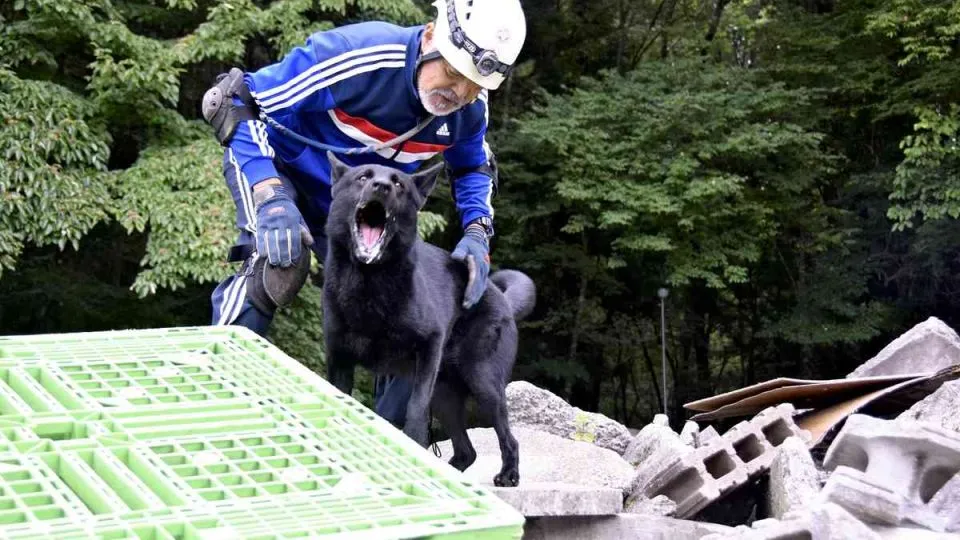
Arya News - Following the powerful earthquake in Kumamoto Prefecture in July, many rescue dogs were sent to the area to assist search efforts.
TOKYO – With earthquakes and floods occurring frequently, search-and-rescue dogs have increasingly been deployed to affected areas to search for missing victims. Following the powerful earthquake in Kumamoto Prefecture in July, many rescue dogs were sent to the area to assist search efforts.
However, much of this work is carried out by volunteers in the private sector. The skill levels of dogs from the private sectors vary widely, which can hinder rescue operations. There are calls for administrative authorities to support private sector’s operations and introduce qualification systems to certify the dogs.
On a recent day, Sonya, a 7-year-old female German shepherd, was attending the Murase Dog Training Center, located in the mountains at an elevation of about 950 meters in Fujimi, Nagano Prefecture. For about one minute, Sonya ran around a pile of debris simulating a collapsed house, then stopped and began barking. She had found a member of the center playing the role of a missing victim underneath the rubble. Sonya detected the person’s smell carried by the wind and alerted her handler, Hidehiro Murase.
About 30 dogs, including those owned by Murase, 73, and others entrusted to the center by people contracted with the center, receive training every day from morning until evening to prepare for their deployment. To date, the dogs have been sent to various areas, including those affected by the 2011 Great East Japan Earthquake and the 2024 Noto Peninsula Earthquake. Sonya also worked at the shopping complex Aeon Mall Kumamoto in Kashima, Kumamoto Prefecture, where a major explosion occurred following the 2026 Kumamoto Earthquake
“Saving lives and searching for the missing are urgent priorities at disaster sites. Rigorous training is essential,” said Murase, who runs the center. Murase also serves as chairperson of the Rescue Dog Trainers’ Association, a Kanagawa Prefecture-based nonprofit organization.
Locating survivors
Search-and-rescue dogs must be able to detect the smell of unspecified individuals and remain calm and work even under adverse conditions, which can include aftershocks and noisy environments.
German shepherds and Labrador retrievers are the primary breeds for search-and-rescue dogs. There are about 120 rescue dogs with police departments nationwide and about 30 with the Self-Defense Forces. More than 100 dogs also work with private organizations.
Rescue dogs spread in the private sector nationwide following the 1995 Great Hanshin Earthquake. Reports of rescue dogs dispatched from overseas to participate in rescue operations led to the establishment of numerous search-and-rescue dog training organizations in Japan.
Many rescue dog organizations engaged in rescue operations in areas affected by the Great East Japan Earthquake. Rescue dogs also reportedly found survivors following the 2024 Noto Peninsula Earthquake.
Sent using individual judgment
There is no official framework governing the activities of search-and-rescue dogs belonging to private organizations. In most cases, the organizations go to disaster-hit areas based on their own judgment and coordinate their operations on the spot, working with the police, the SDF or other entities. While some local governments have agreements with private organizations to cover their expenses in exchange for deploying rescue dogs during disasters, such cases remain limited.
In principle, Murase covers operational expenses with membership fees from about 50 members of his training center, and to save money he uses a camper van when traveling to disaster-hit areas.
When the Kumamoto Earthquake occurred on July 28, Murase departed from Nagano shortly after noon the following day. He and his colleagues took turns driving through the night and arrived early in the morning on July 30.
There are no certification exams for search-and-rescue dogs or their handlers, and the rescue dogs’ skill levels vary widely. During one disaster in the past, a rescue dog with insufficient training went missing in the mountains.
Takeru Oka, 50, a director of the NPO Japan Rescue Association in Hyogo Prefecture, which sent three rescue dogs to the areas affected by the Kumamoto Earthquake, is placing his hopes in the National Disaster Management Agency established earlier this month. “Local governments may feel more at ease requesting the assistance of search-and-rescue dogs if the central government were to endorse rescue dogs by creating, for example, a registration system for those that meet a certain level of ability,” Oka said.
In the case of guide dogs and service dogs trained in the private sector, organizations designated by the National Public Safety Commission or the Health, Labor and Welfare Ministry certify them through qualification tests. Government financial assistance is available for their training.
“In preparation for large-scale disasters such as a major earthquake directly under the capital, the central government should support the creation of a framework that allows search-and-rescue dogs to be used,” said Mamoru Onuma, a specially appointed professor of veterinary medicine at Chiba Institute of Science and an expert on rescue dogs. “It is also necessary to consider providing subsidies to relevant efforts,” he added.