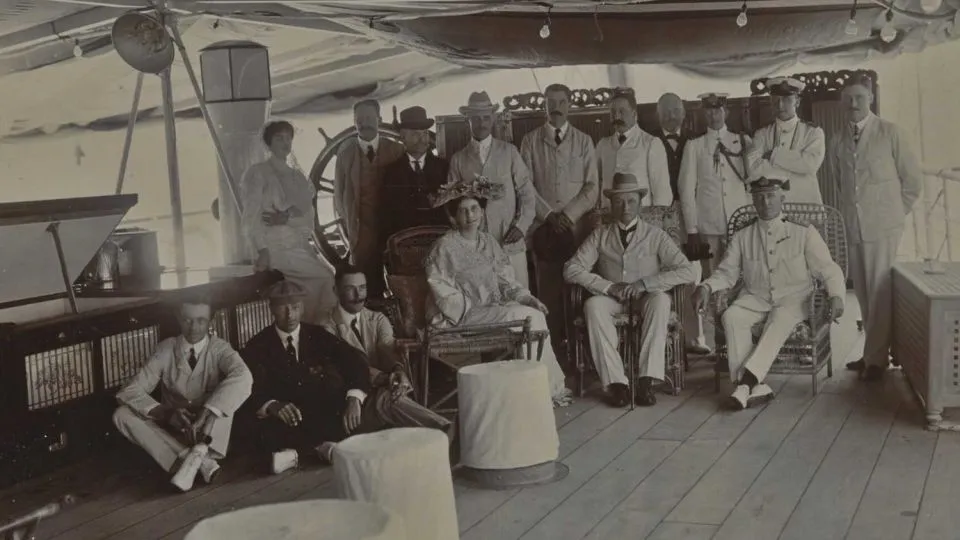
Arya News - Missionaries like Moyser and dollar princesses like Mary Curzon were therefore two examples of non-state American figures woven inextricably into the Raj’s imperial tapestry.
DHAKA – In an issue of the Vancouver-based newspaper The Province from 18 October 1907, one can find a four-tiered headline that reads as follows: “India Generally Free From Political Unrest. Some Disappointed Agitators Are Trying to Make Trouble in Bengal. England’s Rule Praised. American Missionary Says Situation Has Been Misrepresented.”
The American missionary in question was a certain Rev. William Moyser, who had stopped in Vancouver on his way back to his hometown of Portland, Oregon, after working in India for thirteen years. The journalist had asked Moyser for his opinion on the anti-Asian riots that had engulfed the West Coast of North America that year, as well as on rumours about anti-British agitation in India. Moyser responds that he was not as familiar with the West Coast context but could speak to the Indian one, of which he says that—contrary to the many misrepresentations—there is no general unrest in the country, except perhaps in Bengal, where the agitators are merely “disgruntled over the fact that they have not been able to obtain every lucrative office they may have desired.” Moyser conveniently glosses over the infamous Partition of Bengal just two years earlier—more on that in due course—and its role in the agitation. He goes on to dispel any fears that there is a mass exodus of Indians from the subcontinent to North America, or that the British are levying exorbitant taxes on the people.
He ends with the following admission: “Now, I am an American citizen, and not a subject of Great Britain, so I cannot be accused of saying these things to shield a Government of which some one might hastily conclude me to be a citizen, but I cannot keep still when I hear the untrue and unjust things that have been said about the country in which I am so vitally interested.”
What are we to make of this American missionary defending the British imperial project in India, a project in which he is so “vitally interested”? And what do we make of the fact that Moyser is so hyper-aware of his being misconstrued as a British citizen by virtue of his race and language?
To a seasoned historian of transatlantic relations, Moyser’s statement would be unsurprising. This is because, in the late nineteenth century, there had transpired what we have come to know as the “Great Rapprochement”, a geopolitical event wherein Britain and the United States came to increasingly recognise each other as two branches of the same ancestral tree, united by a shared Anglo-Saxon race, common law, language, and customs. However, in many accounts of this “great white reunion”, what falls out of view is another shared burden, a burden that Kipling identified as possibly the greatest for the white man: empire. More specifically, histories of the Rapprochement and of imperialism do not adequately illustrate the extent to which American state and non-state actors—such as missionaries like Moyser—were integral to the fabric of British imperialism. This has been a question that has plagued me since my own upbringing and education in Pakistan, where—as I imagine it is in Bangladesh as well—the history of British colonialism in the subcontinent is taught in an insular fashion. In such historiography, the Pax Americana suddenly cycles past the Pax Britannica in the mid-century, as if the former did not practise with its training wheels in the playgrounds of the latter. Newer histories, such as those by Seema Sohi and Stephen Tuffnell, seek to disrupt this very insularity and give more global accounts of inter-imperial collaboration, and my own seeks to build on those. In fact, Sohi’s book—on the Ghadar Party’s resistance against Britain from the West Coast of North America—would powerfully contextualise the above newspaper article.
Just adjacent to that article is an illustration of Gladys Vanderbilt and her fiancé, the Hungarian Count Szechenyi, riding in a carriage in Newport, Rhode Island. “Vanderbilt Wedding Will Be Very Gay Society Event,” it says above the illustration, accompanied by a short caption that tells us that Gladys is heir to $15,000,000.
The illustration caught my eye not just because of how HBO’s The Gilded Age (now in its fourth season, released just at the beginning of this month) has fictionalised the life of Gladys and the Vanderbilts, but also because British India was home to its own “dollar princess” at the time: Mary Leiter Curzon, wife of Viceroy Curzon, the very same man who partitioned Bengal in 1905.
“Dollar princesses” were American heiresses who married into European—especially British—nobility, the immense wealth they brought helping to keep their new husbands’ estates running. Mary Leiter was one of these so-called princesses, except she came to the rescue of not just Curzon’s marquessate of Kedleston but India itself, using her influence in Chicago’s elite circles to fundraise for famine and plague relief in India.
Missionaries like Moyser and dollar princesses like Mary Curzon were therefore two examples of non-state American figures woven inextricably into the Raj’s imperial tapestry. What interested me in the writing of Parasitic Empires, however, was the involvement of such figures more specifically in a medicalised and public health-related imperial collaboration, which I call “parasitic imperialism”. I define this as the ways in which “white English-speaking or Anglo-Saxon empires in the long twentieth century collaborated and competed with one another through racially inflected discourses of hygiene and infectious disease management, thereby reconfiguring Anglophone whiteness itself.” To be sure, both the American vicereine and American medical missionaries were heavily invested in such health-related discourses of the liberal civilising mission. Mary Curzon, apart from her fundraising activities, was closely associated with the Dufferin Fund for native Indian women’s health, and missionaries like William Wanless, associated with the Presbyterian Church of Philadelphia, established missionary medical schools, leprosaria, and tuberculosis sanatoriums in Western India.
Anglophone parasitic imperialism became especially conspicuous through the work of missionaries and social hygiene activists who sought to curb prostitution and venereal disease. For instance, American missionary and doctor Katherine Bushnell and her colleague Elizabeth Andrew collaborated with the British reformer Josephine Butler to conduct research on the Contagious Diseases Acts in India; these Acts codified the regulation of sex work in India and the incarceration of prostitutes in “lock hospitals” if they were found to be infected with venereal disease. Their exposé was published as The Queen’s Daughters in India in 1898, the very year the United States acquired its own maritime empire in the Caribbean and the Pacific in the wake of the Spanish-American War. Fast forward to the 1920s, and another, more infamous American woman—Katherine Mayo—published Mother India (1926), an even more controversial book that condemned and sensationalised the Hindus’ so-called depraved sexual practices and defended the British imperial presence in India. In fact, the book opens with a lurid description of the worship of Kali at a Calcutta temple.
Interestingly, Bushnell’s and Mayo’s accounts are haunted by the spectre of the “white slave trade”, which was the trafficking of European women for prostitution. This was an especially huge problem in the colonies because the presence of European sex workers—and the possibility of sexual congress with non-white men—would be incredibly damaging to white prestige. America and Britain collaborated very closely through social hygiene associations to halt the white slave trade. Bombay and Calcutta were known to have a small number of European prostitutes. However, no mention is made of them in Bushnell’s and Mayo’s writings. For instance, in 1901, Sir John Woodburn, the Lieutenant Governor of Bengal, passed an order forbidding the employment of European barmaids in Calcutta. This was the first in a long line of legal actions that led to the passage of the Suppression of Immoral Traffic Act (SITA) in Calcutta in 1923.
In Parasitic Empires, I argue that one can read E. M. Forster’s famous novel A Passage to India (1924) by contextualising it within this inter-imperial history of legislation against the white slave trade. Those familiar with the novel will remember that after the Muslim physician Dr Aziz is accused of sexually assaulting the British woman Adela Quested in the Marabar Caves, the prosecution produces evidence of Aziz wanting to visit brothels in Calcutta to prove his immoral character. Against the backdrop of possible white prostitutes in Calcutta, Dr Aziz’s intentions become even more questionable, with the result that Adela Quested becomes not a chaste English girl but a fallen colonial woman.
A Passage to India was published a year before American novelist Sinclair Lewis’s Arrowsmith (1925), which I also read as another node in what I call an “inter-imperial social hygiene network”, given that the latter text, like Forster’s, includes references to social vice, venereal disease, and white women in the colonies. The colony in question here is not India but a fictional Caribbean island under British control named St Hubert, where the protagonist Martin Arrowsmith, an American bacteriologist, is sent by the McGurk Institute to fight bubonic plague. The McGurk Institute is Lewis’s fictionalised version of the Rockefeller Foundation’s International Health Board (IHB). The IHB, I argue, was the last but perhaps the most important instantiation of parasitic imperialism. As historian Steven Palmer suggests, the IHB was like a “parasite”, using British colonial possessions in the Caribbean to conduct its research on tropical diseases like hookworm. Bengal and India writ large also played host to the IHB’s parasitological activities, a major representative of which was the physician John B. Grant.
Grant was born to Canadian missionaries in China in 1890 and, after being educated at the University of Michigan and Johns Hopkins, went on to have an illustrious career in public and global health. As part of the Rockefeller Foundation’s IHB, he conducted hookworm surveys in China and, in 1921, became an associate professor of public health at Peking Union Medical College, a medical school that the Rockefeller Foundation itself helped establish in 1917. After his time in China concluded in 1939, Grant was appointed director of the All-India Institute of Hygiene and Public Health in Calcutta, a role in which he served until 1945. He was also associated with the famous Bhore Committee of 1944, which laid the foundation for medical care and public health in independent India.
John Grant’s work in India shows, however, that Anglophone parasitic imperialism was not just about collaboration but also about rivalry and competition. Like many of his fellow Rockefeller associates stationed in British territories, Grant regularly critiqued the British colonial status quo and bemoaned the conservatism, inefficiency, and backwardness of the Indian Medical Service. It is notable that after Grant retired from the Rockefeller Foundation, he settled in San Juan, Puerto Rico—an American, not British, colonial acquisition—where he advised the government on the coordination of its medical services. Grant’s work in Puerto Rico would have been contemporaneous with the horrific, unfettered sterilisation of Puerto Rican women that the US government had been conducting for decades.
As far as we know, Grant was not in any way affiliated with these practices, but his inter-imperial medical itinerary—from China to India to Puerto Rico, born to Canadians and becoming a naturalised American—testifies to how knowledge of health and disease moved across multiple imperial spheres of influence and was transformed in the process, even as it engendered simultaneous collaboration and competition between the imperial actors in question. Rockefeller Foundation doctors—like missionaries, dollar princesses, and social hygiene activists—were, therefore, yet another group of agents of parasitic imperialism in the long twentieth century.