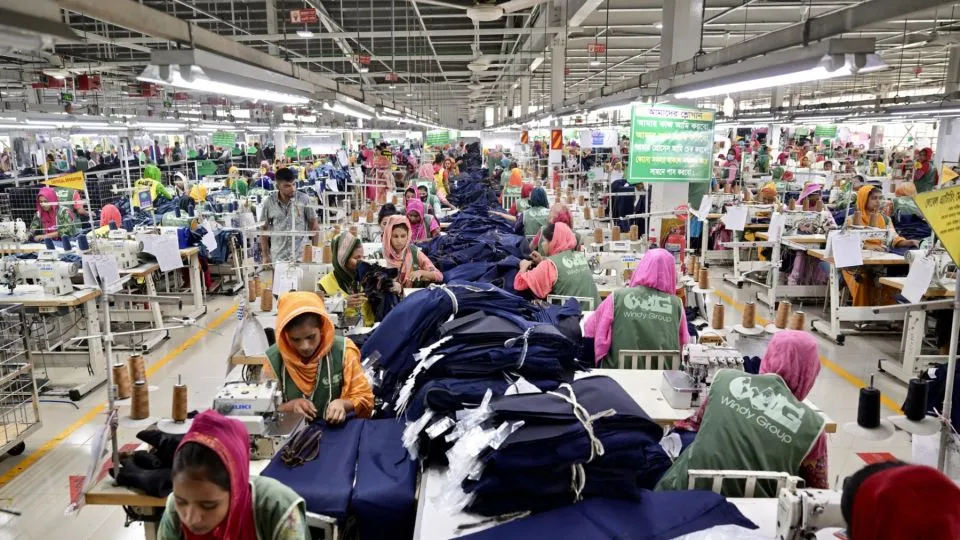
Arya News - Bangladesh is not alone, as the same tariff has also been proposed for competing countries such as China, Vietnam, and India. With its export prices lower than those of its rivals, local exporters may gain.
DHAKA – The Trump administration has proposed an 18 percent tariff on Bangladesh’s exports to the US market. A tariff of this kind has also been proposed for 13 other countries, including China, Vietnam, India and EU nations.
In a statement, the Office of the US Trade Representative (USTR) accused Bangladesh of unreasonable acts, policies and practices. These include industrial plans to maintain and expand its manufacturing sector, particularly in key sectors; production incentives to promote production and exports; and inadequate labour protections.
The USTR also accused Bangladesh of financial repression policies (government controls on interest rates and credit that steer funds to favoured sectors) and of failing to address global excess capacity (producing more than markets can absorb) and production, according to the statement.
This includes imports and foreign direct investment from non-market economies (countries where the state heavily controls prices and production).
The USTR said these acts, policies and practices burden or restrict US commerce by reducing commercial opportunities for US producers and exporters in Bangladesh and third-country markets.
It said they harm the US economy by contributing to lost production, exports, jobs and investment in the US manufacturing sector, and increase US economic security risks, including through reliance on inputs from non-market economies.
This is especially true in the ready-made garment and apparel sector, the USTR added.
In his second term, Trump imposed reciprocal tariffs, which were intended to match the tariffs other countries charge on US goods, mainly to reduce the trade gap and raise revenue.
The US Supreme Court, however, nullified the reciprocal tariff concept under his Agreement on Reciprocal Tariff (ART).
His administration launched two investigations: one into manufacturing inputs made with forced labour, and the other into excess production capacity in some countries that may hurt the US economy. Both were mainly aimed at imposing new tariffs and collecting revenue, as reciprocal tariffs could no longer be imposed.
The US first completed the forced labour investigation. In Bangladesh’s case, a 10 percent forced labour duty was imposed and is still in place, citing the use of Chinese materials by Bangladeshi garment manufacturers that were produced by Chinese firms using forced labour.
Simultaneously, the Trump administration also launched the excess capacity investigation. On November 25, the USTR shared its findings and proposed an 18 percent duty on Bangladeshi exports to the US.
The levy would replace, rather than be added to, the 10 percent duty imposed in July following the separate investigation into forced-labour enforcement.
These two sets of tariffs “are not really additive,” US Trade Representative Jamieson Greer told CNBC. “When it all nets out, it really will just top up a few percentage points.”
Regular most-favoured-nation (MFN) duties (the standard rate charged on imports from countries without a preferential trade deal), which average 15.62 percent on Bangladeshi goods, would continue to apply. This would take the overall rate to 33.62 percent, up from 25.62 percent now.
The US is Bangladesh’s single largest export destination as a country, with garments making up more than 90 percent of exports to the American market in a year.
US goods and services trade with Bangladesh totalled an estimated $13.7 billion in 2025, according to the USTR: $11.9 billion in goods and $1.8 billion in services, with a US goods deficit of $7.1 billion and a services surplus of $1.1 billion.
Bangladesh is not alone, as the same tariff has also been proposed for competing countries such as China, Vietnam and India. With its export prices lower than those of its rivals, local exporters may gain.
Higher tariffs mean costlier goods, and price-conscious consumers could help Bangladesh sell more in the US.
The Bangladesh Garment Manufacturers and Exporters Association (BGMEA) told the USTR, through the commerce ministry, that Bangladesh has no overcapacity, saying exporters suffer from the lower prices offered by American retailers and brands.
Though a least developed country (LDC), Bangladesh gets no duty-free access for garments. The US allows such access only for some African countries under the African Growth and Opportunity Act.
Overall, the US allows duty-free access for 97 percent of LDC products, short of the 100 percent it committed to at the World Trade Organization’s ministerial conference held in Hong Kong in 2005, leaving textiles and garments out.
Bangladesh is not expected to be significantly affected, and the ART it has signed with the US could help in negotiating the tariff.