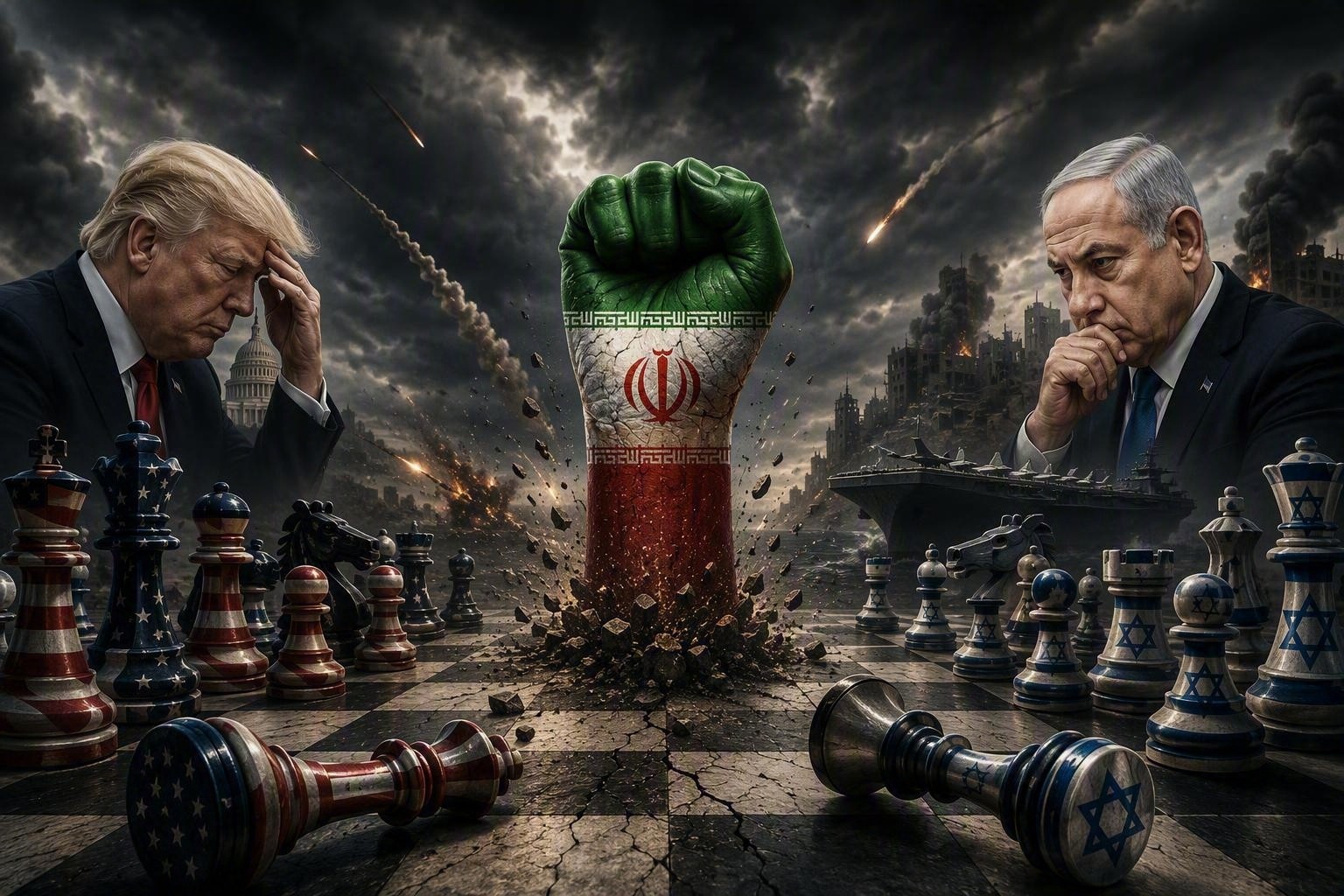
Arya News Agency -Six months after the launch of the joint U.S.-Israeli military campaign against Iran, the picture emerging from the battlefield stands in stark contrast to the initial narrative presented by the White House. What Donald Trump had described as a "short, limited operation" has now devolved into a protracted war of attrition—one that has not only failed to achieve its declared objectives but has also imposed mounting political, economic, and security costs on the United States and its allies.
According to published assessments, the most telling reality of this conflict is that Iran, despite suffering significant military and economic damage, has not retreated from its positions and continues to retain the capacity to shape regional and international dynamics. This outcome has made it clear that the strategy of maximum pressure and military action—contrary to Washington’s assumptions—has failed to break the Islamic Republic’s political will.
Trump’s Miscalculations
Among the war’s most consequential effects is its transformation into a political liability for the U.S. president. Trump’s declining approval ratings, deepening rifts within the Republican Party, and growing public anxiety over the war’s costs all point to a White House that is far from achieving a swift, low-cost victory.
Rising energy and gasoline prices in the U.S. have also directly undercut one of Trump’s key campaign pledges—lowering the cost of living. As a result, the war with Iran is no longer merely a foreign-policy file; it has become a domestic quandary for the U.S. administration.
Iran Damaged but Not Defeated
Though Iran’s military and economic infrastructure has sustained considerable blows, the campaign’s primary goal—neutralizing Iran’s deterrent capability—has not been met. Reports indicate that a significant portion of Iran’s missile and drone arsenal remains intact, and Tehran has leveraged its remaining deterrence tools to raise the war’s strategic costs for its adversaries.
The reality is that after six months of hostilities, the U.S. and Israel have yet to reach a point from which they can speak of "Iran’s defeat." Persistent disruptions to maritime traffic and continued global concern over energy security are testaments to this fact.
The Strait of Hormuz: Still a Decisive Card
One of the conflict’s most critical dimensions has been the role of the Strait of Hormuz in the balance of power. Although the global economy has partially adapted to the new conditions and avoided a full-blown oil shock, the sustained disruption to energy supply routes underscores an enduring truth: the security of the Persian Gulf remains inextricably linked to the security of Iran.
For Western powers, the message has never been clearer—no lasting equation for energy security can be designed without factoring in Iran’s position and role.
Regional Security: A Casualty of Military Adventurism
From a regional perspective, the claim that the Middle East has become more secure does not align with ground realities. Reciprocal strikes, rising maritime transport costs, flight disruptions, and growing economic uncertainty across neighboring states all indicate that the war has not reduced threats—it has only heightened the region’s security fragility.
This experience has reaffirmed that regional security cannot be achieved through military force, but rather through dialogue and indigenous security arrangements.
U.S. Military Fatigue: A Hidden but Significant Cost
Perhaps the most profound strategic takeaway for international observers is the strain placed on the U.S. military. Depleted missile stockpiles, lost equipment, extended aircraft carrier deployments, and the large-scale redeployment of forces from other global hotspots to the Middle East all reflect the heavy price Washington is paying for this confrontation.
This situation may also undermine America’s capacity to simultaneously manage crises in Europe and Asia—raising serious questions about its global intervention capabilities.
At the end of six months of war, what stands out most is the failure of the strategy of "submission through military pressure." Iran, despite bearing a heavy cost, remains an influential actor in regional and international equations. The U.S. and Israel, in contrast, find themselves mired in a conflict with no clear end in sight—and no gains commensurate with the sacrifices made.
Perhaps the most important lesson of this crisis is that against a nation with geopolitical depth, indigenous capabilities, and national resolve, the military option not only guarantees no victory—it may well be the beginning of a strategic dead end.
Source:Arya Analysis Desk