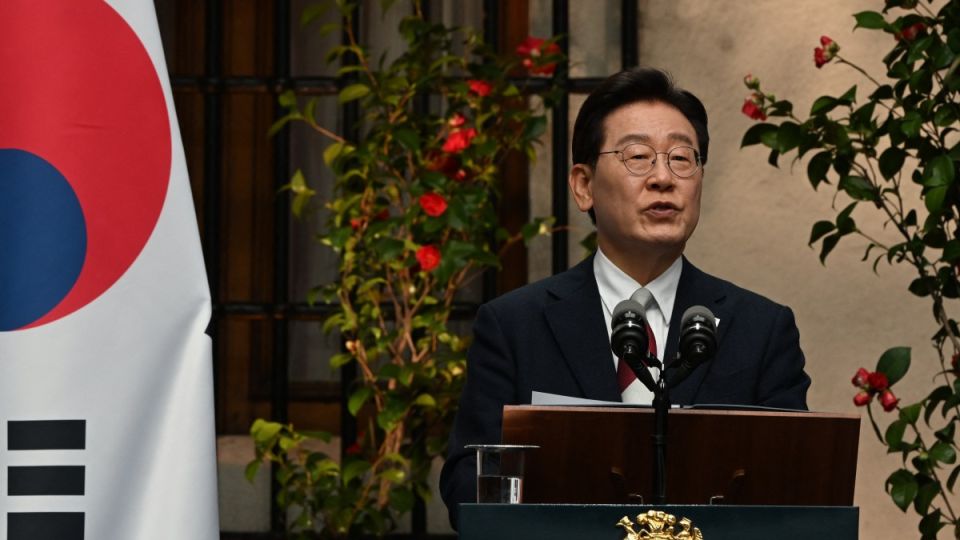
Arya News - Covering semiconductors, physical artificial intelligence and AI data centers, the projects aimed to disperse investment across the country and reduce the concentration of growth in the Greater Seoul area.
SEOUL – President Lee Jae Myung on Monday ordered military operations to be shifted from Gwangju Air Base to other airfields by mid-2028, seeking to accelerate the construction of a second semiconductor belt.
The directive came at the second public-private review of his administration’s three flagship megaprojects. Covering semiconductors, physical artificial intelligence and AI data centers, the projects aimed to disperse investment across the country and reduce the concentration of growth in the Greater Seoul area.
“At this stage, securing the site and infrastructure matter above all else,” Lee said during the meeting that began at 2 p.m. at Cheong Wa Dae, about a month after Lee convened the first review on July 6.
Lee called for the planned semiconductor cluster in the southwestern Honam region to be developed at least as quickly as TSMC’s chip plant in Japan’s Kumamoto Prefecture, which was completed just 22 months after construction began.
Lee issued specific instructions to speed the relocation of military functions from Gwangju Air Base, which was selected at the first review meeting as the site of the new semiconductor cluster.
Defense Minister Ahn Gyu-back, Joint Chiefs of Staff Chairman Gen. Jin Yong-sung and Gen. Son Sug-rag, Air Force chief of staff, attended the meeting.
“I would like the Defense Ministry to temporarily transfer Gwangju Air Base’s functions to other military airfields by mid-2028 and take the necessary steps to ensure that the Gwangju military airport site can be used as a semiconductor industrial complex as soon as possible,” Lee said.
“Even before the temporary transfer takes place, I ask that every effort be made to begin construction of the industrial complex on land near the military airfield at an early date,” he added.
Gwangju Air Base is one of five sites designated as collocated operating bases, or COBs, where US Air Force units and aircraft would deploy in the event of a contingency on the Korean Peninsula. The base shares its airfield with the civilian Gwangju Airport, which handles commercial flights, adding another layer of complexity to plans to redevelop the site.
The initiative seeks to develop Honam into the country’s second major semiconductor production belt, the central Chungcheong region into an advanced semiconductor packaging hub and the southeastern Yeongnam region into a center for physical AI. The government also plans to build large AI data centers across noncapital regions.
Lee pressed officials to accelerate the projects, saying conventional efforts to speed up investment were no longer enough, saying, “The situation calls for more than a race for speed. It calls for a blitz.”
Lee instructed ministries to pursue the necessary procedures simultaneously to sharply shorten project timelines, while continuing to ease regulations that could delay implementation.
Lee asked Prime Minister Han Seong-sook to oversee a government-wide review to ensure that ministerial silos, regulatory barriers or infrastructure shortfalls do not weaken companies’ willingness to invest or delay the projects.
Samsung Electronics, SK hynix and other companies have pledged sizable investments under the initiative. The government has committed to providing the power, water, transportation, housing and other infrastructure needed to support them.
Kim Yong-kwan, corporate president of Corporate Management, Strategy & Operation for Samsung Electronics’ Device Solutions Division, and Cheong Seung-il, president in charge of future growth at SK, also attended the meeting on Monday.
During the meeting, Lee underscored that “plans to supply power and water must, of course, proceed without disruption.”
“We must also work closely with the National Assembly to expedite the enactment and revision of related laws,” he added. “The first push of the pedal is always the hardest. Please make an all-out effort, treating the year ahead as a critical window.”
Following Lee’s opening remarks, Minister for Government Policy Coordination Lim Ki-keun briefed participants on regulatory and administrative reforms intended to support the projects.
Minister of Trade, Industry and Resources Kim Jung-kwan and Science and ICT Minister and Bae Kyung-hoon, who is also deputy prime minister, presented measures aimed at spreading the benefits of the investments across related industries and regional communities.
Kim and Finance Minister and Deputy Prime Minister Koo Yun-cheol reported on progress and future plans for the projects in Chungcheong and Yeongnam.
The defense minister; heads of JCS and Air Force; Minister for Land, Infrastructure and Transport Kim Yun-duck; and Climate, Energy and Environment Minister Kim Sung-whan presented plans for securing the semiconductor cluster site and supplying the electricity and water needed for its operation.
Read More:
Seoul to consult US on swift Gwangju military relocation for chip belt