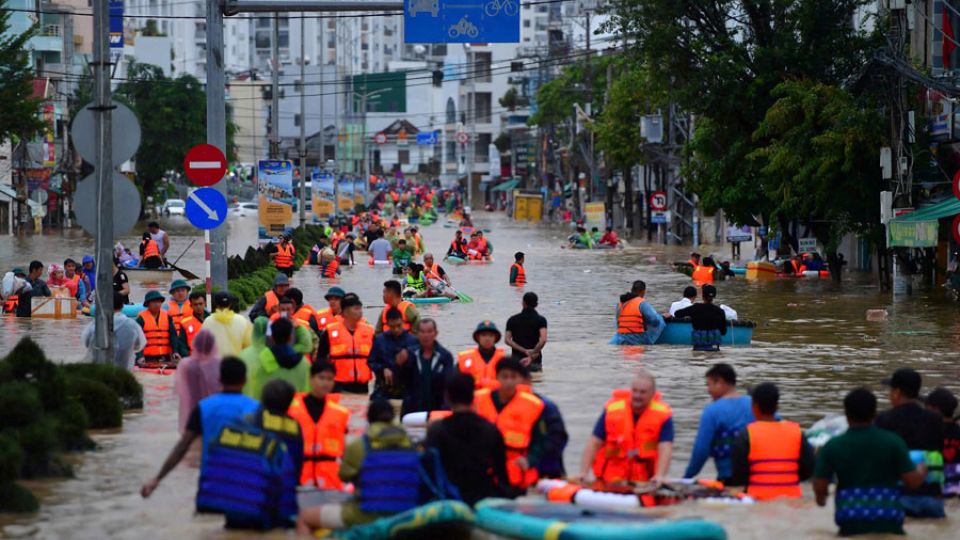
Arya News - The region`s vulnerability stems from outdated infrastructure and urban planning designed for a climate that no longer exists, coupled with fragmented governance where dozens of agencies fail to coordinate.
BANGKOK – Climate resilience has stopped being an environmental issue and become an economic one. Experts explain why ASEAN’s cities remain underprepared.
When 35 per cent of a year’s rainfall falls within a single week, as it did in parts of Thailand last year, the failure is not simply meteorological. It is a failure of design, of coordination, and — increasingly — of economics.
That was the argument advanced at a CAsean Forum 2026 panel on “Strengthening ASEAN’s Physical Resilience”, held in Bangkok on Friday, 7 August, where engineers, a landscape architect and a Japanese development specialist made the case that Southeast Asia’s climate exposure is no longer a side issue for environment ministries but a direct threat to the region’s economic competitiveness.
The panel’s premise was blunt: ASEAN’s infrastructure, urban planning and governance systems were built for a climate that no longer exists. The question it tried to answer was not whether resilience matters but why the region keeps failing to deliver it — and what would actually need to change.
The Scale of the Problem: Risk Priced in Billions, Not Millimetres
Assoc Prof Dr Witaya Wannasuphoprasit, dean of engineering at Chulalongkorn University and chairman of its Center for Water Resilience, framed Thailand’s exposure through three converging failures.
First, rainfall patterns have become faster and more erratic than existing forecasting tools can track, overwhelming drainage systems designed for a gentler climate.
Second, decades of unplanned urban sprawl have eroded the natural floodplains that once absorbed excess water.
Third — and most structurally damaging — roughly 50 separate Thai government agencies hold some responsibility for water management, each with its own budget and agenda and little shared data or common metrics.
“It’s quite impossible to combine all 50 agencies into one,” Dr Witaya said, arguing instead for a “system integrator” role to align them around common goals.
Satoshi Iemoto, chief advisor to a Japan International Cooperation Agency (JICA) project supporting Thailand’s climate adaptation efforts, put figures to the risk.
Myanmar’s Cyclone Nargis in 2008 and the Philippines’ Typhoon Haiyan left catastrophic damage; Thailand’s 2011 floods alone cost an estimated US$46 billion and disrupted global supply chains reliant on the country’s manufacturing base.
According to the Germanwatch Climate Risk Index, Myanmar ranks second globally for climate vulnerability, the Philippines seventh, Vietnam 14th and Thailand 22nd — a ranking, Iemoto noted dryly, that “should worry us”.
As one of the world’s key logistics and manufacturing hubs, he added, any disruption to ASEAN’s ports, airports and digital networks from climate disasters threatens not just local communities but the region’s broader economic competitiveness.
Rethinking Water as an Asset, Not Just a Threat
Perhaps the panel’s most striking reframing came from Dr Witaya’s “water economy” concept: treating water not merely as a hazard to be managed but as a productive resource whose value can be measured and grown.
Citing UN data spanning roughly two decades, he noted that water productivity — the economic value generated per cubic metre used — has stagnated across Southeast Asia even as other regions have steadily improved theirs, representing what he called “a big room of opportunity”.
In one pilot project, his centre worked with a Thai province to redesign water use planning, lifting agricultural output and generating tens of millions of baht in additional local revenue — evidence, he argued, that resilience investment can pay for itself rather than being treated purely as a cost.
Central to this shift is data. The centre is co-developing a “Thailand Climate Model” with MIT and international academic partners, aimed at using AI to predict rainfall with far greater speed and precision than conventional forecasting allows — giving officials an operational tool for decisions measured in hours, not days.
Dr Witaya also stressed empowering local communities directly, describing efforts to build local “water schools” so residents — not only central agencies — understand and manage their own flood and drought risk.
His proposed policy roadmap moves in three stages: protect existing infrastructure, adapt to live alongside water rather than solely resist it, and eventually lead by exporting successful models to other climate-exposed regions.
Designing With Nature, Not Against It
Wannaporn Phornprapha, founder and managing director of landscape architecture firm P Landscape, argued that much of the region’s vulnerability stems from a design philosophy still rooted in “grey” concrete infrastructure rather than natural systems.
Drawing on projects across 30 countries, she outlined four principles guiding resilient design: nature, culture, people and time.
Crucially, she argued planners should treat trees, waterways and soil as infrastructure in their own right – “blue and green infrastructure” – rather than treating landscaping as a decorative afterthought.
Her portfolio, including Bangkok’s One Bangkok development and long-term land regeneration projects, was built around connecting fragmented green corridors, water systems and public spaces rather than designing isolated plots in isolation from their surroundings.
Asked to name planners’ most common mistakes, she pointed first to fragmentation — designing single projects to withstand, say, a hundred-year flood without accounting for what happens beyond their boundaries, since “water has no boundary”.
Second, she said regulation and data routinely lag the pace of climate change itself, citing the lack of research into which tree species actually filter fine particulate pollution effectively.
Third, resilient design is still widely perceived as an avoidable added expense when its real returns — public health, liveability, and long-term value — are simply harder to put a number on.
Why Regional Cooperation, Not National Fixes, Is the Answer
Iemoto’s central argument was that no single country can adapt alone, because climate risk itself ignores administrative borders — river basins and coastlines connect neighbouring states regardless of policy.
JICA’s support for Thailand spans climate information systems, capacity-building for local governments, and – critically – help accessing international climate finance, which he said remains under-utilised across the region chiefly due to a shortage of strong funding proposals.
He pointed to Tokyo’s evolving approach as a possible model: rather than treating green space purely as something to preserve, the city now actively expands parks and vegetation as infrastructure to counter urban heat and flooding, a public-private effort he called the Tokyo Greenery Vision.
He closed with three recommendations for the region: strengthen knowledge sharing between countries facing similar disaster risks; empower local governments and communities, since disasters are ultimately experienced locally; and combine modern technology with traditional wisdom — from Thailand’s sufficiency economy philosophy to comparable community-based traditions in Indonesia, the Philippines, Malaysia and Cambodia.
The Underlying Argument
Stripped of its technical detail, the panel’s case was straightforward: ASEAN’s physical resilience has been undermined less by a lack of engineering knowledge than by fragmentation – of agencies, of data, of individual construction projects, and of national policies that stop at borders climate risk does not respect.
Fixing that, the panellists agreed, is less about inventing new technology than integrating what already exists: shared data, nature-based design, community knowledge and cross-border cooperation.
As the moderator summarised in closing, resilience cannot be built by any single country, sector or discipline acting alone — it has to be, in Dr Witaya’s phrase, “everybody’s responsibility”.