Arya News - Indonesia also sought a preferential trade agreement (PTA) with South America’s Mercosur bloc as negotiations for a broader Indonesia-Mercosur Comprehensive Economic Partnership Agreement (IEU-CEPA) made little progress.
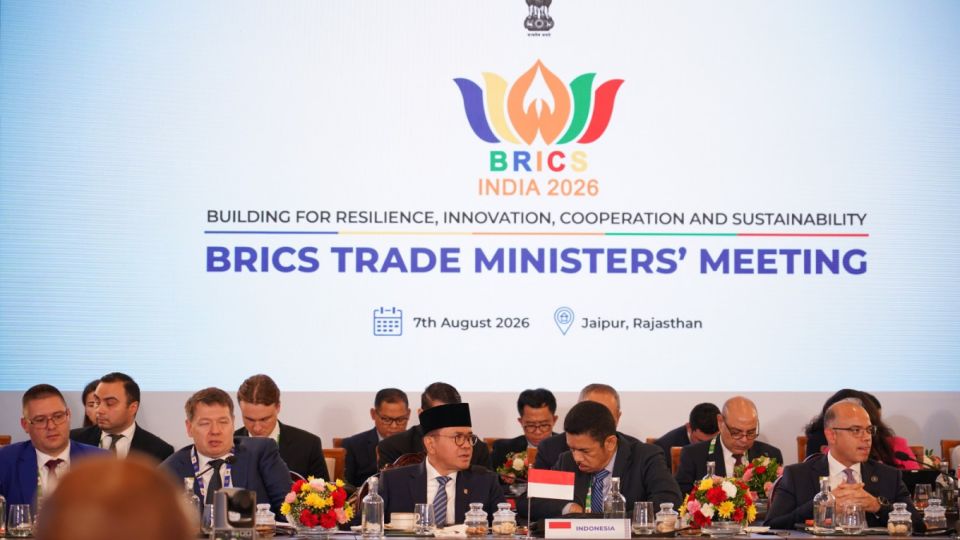
JAKARTA – The BRICS trade ministers’ meeting ended without a joint statement despite reaching agreement on “most agenda items”, Trade Minister Budi Santoso said in a statement on Saturday, underscoring the difficulty of forging a common position within the group as geopolitical tensions reshape global trade.
The ministerial-level meeting was held in Jaipur, India, on Aug. 6-7, focusing on several areas, including strengthening an open, inclusive and rules-based trading system with the World Trade Organization at its core. The group also pushed to help small and medium-sized enterprises (SMEs) go global and build resilient global value chains to support market opening and economic diversification among members.
“Indonesia stresses the importance of maintaining a rules-based multilateral trading system through a strong, inclusive and adaptive WTO. At the same time, the BRICS need to continue delivering concrete cooperation that directly benefits the growth of developing countries,” Budi said.
As the bloc’s newest and nonaligned member, Indonesia called on BRICS to pursue cooperation that “could deliver the greatest benefits” for its members, while warning against the risks of a more fragmented global economy.
Although Budi said the response was a natural form of self-protection amid growing uncertainty, he warned that countries should remain mindful of the risks of growing global fragmentation.
“We must continue to consider the risks behind it. The world could become increasingly divided, fragile and less able to address common challenges,” Budi added.
The trade ministers discussed the Jaipur Consensus, which calls for examining mechanisms for BRICS invoice discounting and credit assessment, with Indonesia stressing the need for better access to finance for small businesses seeking to export.
The ministers also backed completing the Strategy for BRICS Economic Partnership 2030, a framework covering multilateral trade system, services, industry and sustainable development that will guide sectoral strategies and economic cooperation through the end of the decade.
Separately, Indonesia participated in the BRICS Industry Ministers’ Meeting, where it discussed industrial cooperation priorities under the BRICS Partnership on New Industrial Revolution (PartNIR).
Global industrial resilience could no longer depend solely on a country’s investment or production capacity and collaboration is key in maintaining industrial competitiveness, Deputy Industry Minister Faisol Riza said in separate statement.
The meeting focused on SME development, startups, industrial logistics and solar panel manufacturing, while Indonesia also identified opportunities with BRICS members in green industries, semiconductors and agribusiness.
“These areas are important to strengthen industrial resilience and boost manufacturing competitiveness in the future,” Faisol said, adding that Indonesia was ready to pursue concrete cooperation through the group.
BRICS, originally formed by Brazil, Russia, India and China and later joined by South Africa, now has 11 members after its expansion to include Egypt, Ethiopia, Iran, Saudi Arabia, the United Arab Emirates and Indonesia.
China is set to assume the rotating BRICS chair and host the major summit next year, putting the world’s second-largest economy at the center of efforts to steer the expanded bloc’s economic agenda.
India Trade and Industry Minister Piyush Goyal said BRICS members had made progress in strengthening trade and economic cooperation during India’s year-long chairmanship, and expressed hope that those efforts would continue when Beijing takes over the chairmanship in 2027.
Stalled deal with Mercosur
Separately, Indonesia has sought a preferential trade agreement (PTA) with South America’s Mercosur bloc as negotiations for a broader Indonesia-Mercosur Comprehensive Economic Partnership Agreement (IEU-CEPA) made little progress.
Together, the bloc represents a 295 million-strong market and a $3 trillion economy, spanning Brazil, Argentina, Paraguay, Uruguay, Bolivia and currently suspended Venezuela.
Internal political dynamics and differing economic priorities among Mercosur members had historically slowed momentum for a comprehensive pact, Budi said, adding that the narrower agreement could eventually develop into a broader economic partnership.
Under the new proposal, Jakarta views Brazil as a regional beachhead for Indonesian manufactured goods, while offering Southeast Asia’s largest consumer market as a gateway for Brazilian commodities.
Unlike a full-scale CEPA, a PTA offers immediate, targeted tariff reductions or exemptions on select goods without requiring broader institutional alignment.
Indonesia and Mercosur officially agreed to a framework to begin negotiating the Indonesia-Mercosur CEPA in end of 2021 in a bid to boost exports to nontraditional markets outside the United States and China, with President Prabowo Subianto and Brazilian President Luiz Inácio Lula da Silva to push to accelerate the CEPA talks under Brazil’s regional presidency last year.
Beyond Mercosur, Indonesia has been steadily widening its trade footprint in the region, signing a CEPA with Chile in 2017 and another with Peru last year.