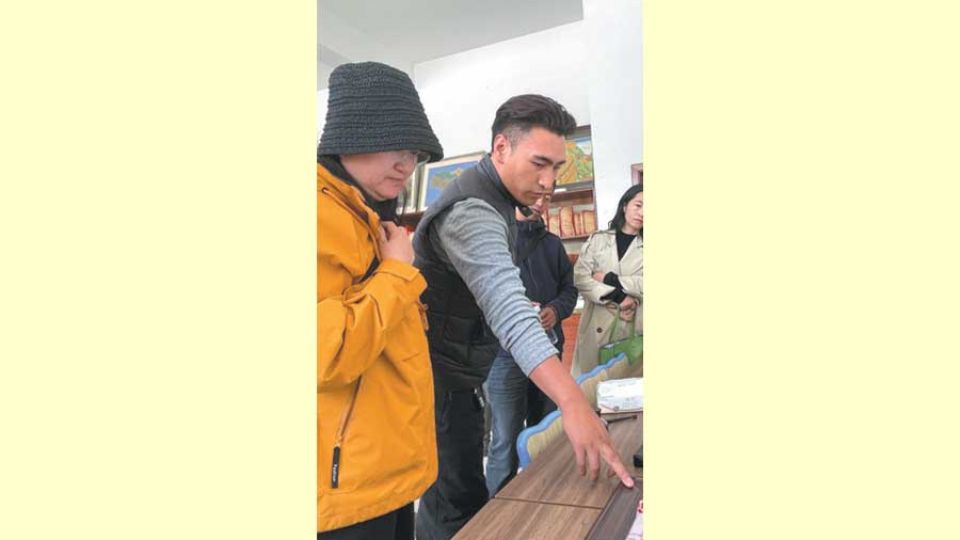
Arya News - A young entrepreneur breathes new life into Tibetan art, creating jobs for locals.
ZADOI – Fine golden wires bend into intricate patterns before brightly colored enamel pigments are carefully placed into the spaces between them. After setting and mounting, the metal lines and vivid colors form an image rooted in Tibetan artistic traditions.
The painstaking process is known as filigree thangka making, an art form that combines the imagery and composition of traditional thangka painting with filigree and enamel techniques.
In Zadoi county, Yushu Tibetan autonomous prefecture, Qinghai province, the craft has become more than a means of preserving cultural heritage. It is creating employment for herdsmen, encouraging young people to return home and exporting local products to consumers beyond the Qinghai-Tibet Plateau.
Behind the effort is 26-year-old Tibetan entrepreneur Lungdrub Jamcai, founder and chairman of Zadoi County Lanyuan Filigree Thangka Tourism Products Co.
Lungdrub Jamcai spent his early 20s working away from home. During that time, he witnessed how other regions were turning unique folk traditions into cultural and tourism products, generating income while keeping local customs alive.
The experience made him think of his hometown. Zadoi possesses rich Tibetan cultural traditions, yet many local artisans struggled to find buyers for their work. At the same time, young herders were leaving the plateau in search of jobs, raising concerns about the loss of certain traditional crafts if there were no one left to pass them down to.
“I did not want a craft passed down by our ancestors to slowly disappear,” Lungdrub Jamcai said. “I wanted to build a local cultural tourism business around filigree thangka, preserve the craft and create jobs that would allow people to remain close to home.”
Humble beginnings
Lungdrub Jamcai began laying the groundwork for the company in 2017. His first obstacle was not the technique itself, but convincing local residents that handicraft production could become an occupation with a stable source of income.
For generations, animal husbandry had been the principal source of income for many families in the county. For some herders, making thangka-related handicrafts was little more than a pastime and could not provide a sustainable livelihood.
“Many people were reluctant to give up their familiar way of life, and it was difficult to find local residents willing to spend time learning the craft,” he said.
A shortage of startup capital and limited access to markets added to the challenges at hand. Lungdrub Jamcai invested savings accumulated while working outside the county and applied for local entrepreneurship subsidies supporting rural vitalization and traditional cultural industries.
In a bid to earn trust, Lungdrub Jamcai made a range of filigree thangka products himself and approached tourist shops in Yushu to sell them. Actual sales, he believed, would be more persuasive than promises.
He initially placed products in scenic areas and cultural tourism stores across Yushu, gradually building a customer base. As orders increased, more residents expressed an interest in learning and eventually sought to join the business.
However, the plateau environment brought another set of challenges. Zadoi has an average elevation of about 4,290 meters and experiences long, bitterly cold winters. Communities are scattered across a vast pastoral area, making daily travel to a central workshop difficult. In the early days, the company converted a sheltered courtyard into a temporary workshop, installed insulation and developed ways to store pigments, filigree materials and other supplies in the cold climate.
Lungdrub Jamcai also divided production into stages. Some artisans were allowed to complete basic components at home, which were later collected for finishing, quality checks and mounting. The arrangement reduced travel and opened the work to women who needed to care for children or elderly relatives at home.
The company’s development was far from smooth. During a downturn in plateau tourism, visitor numbers fell and offline sales declined sharply, leaving the business operating at a loss.
Some residents again questioned whether filigree thangka could support a lasting industry. Lungdrub Jamcai said his attachment to his hometown kept him going.
“If all the young people leave to make a living elsewhere, the craft could eventually face a break in transmission,” he said. “I believed that as long as we continued improving the products, the business would find a way forward.”
The company has since expanded beyond large, traditionally styled works. Its product range now includes small wall ornaments, jewelry and gift sets designed for different budgets and uses.
Income streams
Traditional Tibetan imagery and elements inspired by the grasslands and nomadic culture of the Sanjiangyuan area have been incorporated into the designs, giving the products a recognizable local identity.
Sales have also moved beyond tourist shops. The company supplies cultural products to scenic areas across Yushu and uses livestreaming and short-video platforms to reach consumers elsewhere in China. The change has helped reduce its reliance on seasonal tourism and created new means of income for residents.
Some herders work in the workshop and are paid per completed piece, local painters are commissioned to produce original designs under long-term purchasing arrangements and women working from home receive materials, finish the initial steps and are paid when the components are collected.
The model allows people from families that have emerged from poverty to earn money without traveling to distant cities, while continuing to care for their households and livestock.
Training is central to the operation because many participants have no formal artistic education. Experienced artisans offer free classes in villages, teaching drawing, wire shaping and pigment filling from the basics.
The company also provides practical short-video courses. Participants learn to record the production process and the landscape and daily life on the plateau, using the footage to introduce their products online. For older artisans unfamiliar with digital platforms, the company’s operation team handles promotion and sales. Such efforts reflect a broader shift in the protection of intangible cultural heritage across China. National policies encourage the establishment of heritage workshops that combine preservation with employment and rural revitalization. By the end of 2025, about 14,900 such workshops had been established nationwide, according to the Ministry of Culture and Tourism.
Zadoi has strong foundations for this approach. The county is home to the source of the Lancang River and the southern source of the Yangtze River, while the entire Lancang River source area of Sanjiangyuan National Park, also known as the Three-River Source National Park, lies within its boundaries. Its distinctive ecology and Tibetan culture have supported the growth of nature-based and cultural tourism.
Local authorities have also established inheritance bases for traditional crafts, including Zadoi thangka, stone carving, Tibetan calligraphy and metalwork, providing training opportunities for younger generations.
Distance, however, remains a barrier. Shipping products from the plateau is costly, and Zadoi lacks nationally recognized cultural tourism brands. To lower logistics costs, Lungdrub Jamcai’s company combines orders into larger shipments and works with express-delivery providers. It also participates in cultural tourism exhibitions and uses media coverage and online content to promote products under a brand associated with Sanjiangyuan.
The changes Lungdrub Jamcai has witnessed extend beyond his company. In the early years, many residents regarded migrant work as their only alternative to herding. Now, he said, more people approach the workshop voluntarily, while some young Tibetan people who once worked elsewhere have returned to learn the craft.
Improved roads, internet access and tourism facilities have also made it easier to develop and market products. “My original goal was to build a career for myself,” Lungdrub Jamcai said. “Over time, it became a responsibility to pass on our local heritage and contribute to the development of my hometown.”
The company’s operations are now stable, its team of artisans is expanding and its products have established long-term supply relationships with tourism businesses across the region, he added.