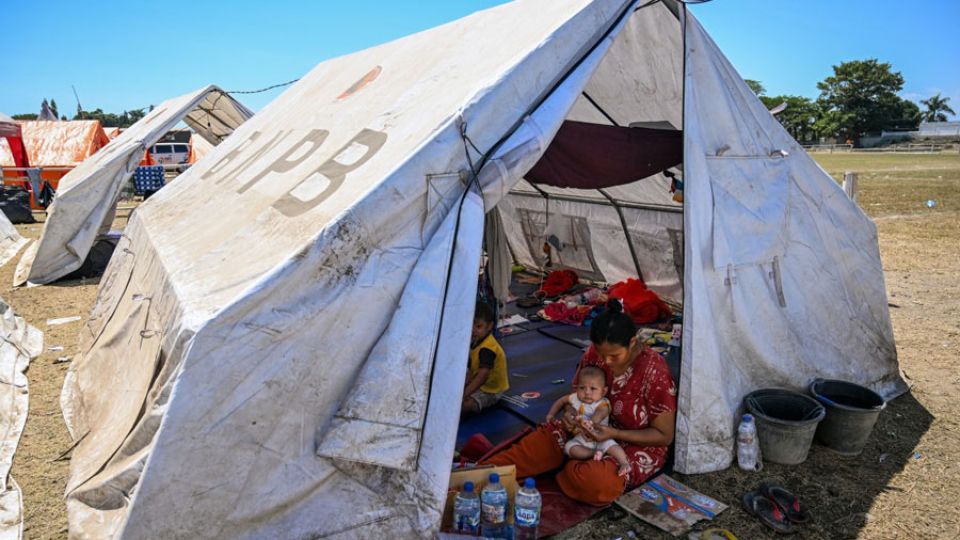
Arya News - Nearly 60,000 people are still taking shelter across the quake-hit regions. According to seismologists, the province is still facing potential threats from aftershocks that can crumble buildings and other structures already damaged in the initial earthquake on August 15.
JAKARTA/EAST MANGGARAI, EAST NUSA TENGGARA – As thousands are still taking shelter in East Nusa Tenggara (NTT), President Prabowo Subianto has faced pressure to roll out robust recovery efforts as the region is standing on shaky ground from the initial earthquake.
Five days after the 7.7-magnitude quake jolted most parts of Flores Island, some residents in West Cibal subdistrict, Manggarai regency, NTT, were forced to build makeshift tents from scratch, while still needing other provisions to survive.
“Now we need tarpaulin covers, food and medicines, [because] the tents we built by ourselves are so fragile,” West Cibal resident Yohanes Lesing told The Jakarta Post on Wednesday.
In Kota Komba district in East Manggarai, residents also called for clean water access that has been disrupted after the earthquake.
The Aug. 15 earthquake’s epicenter was located off the coast of Flores Island, triggering brief tsunami alerts and damages in at least nine regencies across the province. The National Disaster Mitigation Agency (BNPB) confirmed at least 71 casualties, as of Wednesday afternoon.
The disaster agency recorded nearly 60,000 people taking shelter across NTT after the earthquake as of Wednesday afternoon.
In a statement on Wednesday, Cabinet Secretary Teddy Indra Wijaya said the government, as per Prabowo’s order, had distributed a total of 253 tonnes of logistics to the impacted regions since the quake struck.
Five aircraft were dispatched from Halim Perdanakusuma Air Force Base in Jakarta on Wednesday carrying 65 tonnes of food, drinking water, tents and medical supplies for survivors. Authorities also set up two new emergency centers in Labuan Bajo and Maumere.
“According to the Public Works Minister, all land routes [to impacted regions] have been restored since the second day [after the quake],” Teddy said.
But authorities are urged to work quickly to help the survivors, as Flores is facing potential threats from further tremors that have been jolting the island since the initial earthquake.
The Meteorology, Climatology and Geophysics Agency (BMKG) recorded that at least 3,002 aftershocks had struck NTT since the Aug. 15 earthquake. The size of the follow-up tremors varied, ranging from 1.1 and 6.2 in magnitude, with at least 25 recorded above magnitude-5.
NTT is deemed highly vulnerable to earthquakes thanks to its geological position, squeezed by multiple tectonic zones, including a deep subduction zone to the south where the Indo-Australian plate collides and is thrust beneath the Eurasian. The province also has a highly active Flores thrust fault, where the Aug. 15 earthquake’s epicenter was located.
Fragile ground
In their joint analysis issued on Tuesday, seismologist Kadek Hendrawan Palgunadi of Surabaya Institute of Technology (ITS) and Andrean Simanjuntak of BMKG warned the aftershocks during first two weeks after the initial quake would be the most critical and fragile phase for NTT.
“It is not that the aftershocks will grow stronger, but because many buildings are already damaged and have lost their structural strength,” the researchers wrote. “Even an aftershock with [smaller] magnitude of 5 could destroy critical structures.”
Despite NTT being among the more earthquake-prone regions in the country, the scale of damages and casualties shows that disaster prevention efforts were not in place in the province, as suggested by Melva Harahap of environmental group Indonesian Forum for the Environment (Walhi).
“It should serve as a reminder to reform the spatial planning in the region,” she said on Wednesday.
Melva urged the government to launch robust recovery interventions, particularly for isolated areas where aid remained limited to prevent prolonged isolation and blackouts to prevent what happened in Aceh, North Sumatra and West Sumatra after the cyclone-induced floods and landslides in November 2025, in which at least 1,200 were killed.
The perceived sluggish disaster recovery effort from the government led to a lawsuit against President Prabowo, BNPB and three ministries from several Sumatrans disaster survivors.
Official statements about the NTT earthquake largely came from the BNPB and State Secretariat. Meanwhile, the President himself only briefly mentioned the disaster during the Independence Day flag-raising ceremony at the State Palace on Monday, which the public deemed not enough.
State Secretary Prasetyo Hadi said on Tuesday the Presidential Palace was still planning for Prabowo’s visit to NTT.
“[The visit] is currently being planned,” he said as quoted by Antara. “But we also need to note that in the early stages of disaster, the current situation on the ground sometimes requires us to focus on handling immediate problems first.”