Arya News - The Jakarta Police’s plan to prohibit public protests at the Hotel Indonesia Hotel traffic circle has drawn strong opposition from students and activists – who described the move as “unlawful” and warned that it could further restrict freedom of expression.
JAKARTA – The Jakarta Police’s plan to prohibit public protests at the Hotel Indonesia (HI) traffic circle has drawn strong opposition from students and activists, who have described the move as “unlawful” and warned that it could further restrict freedom of expression.
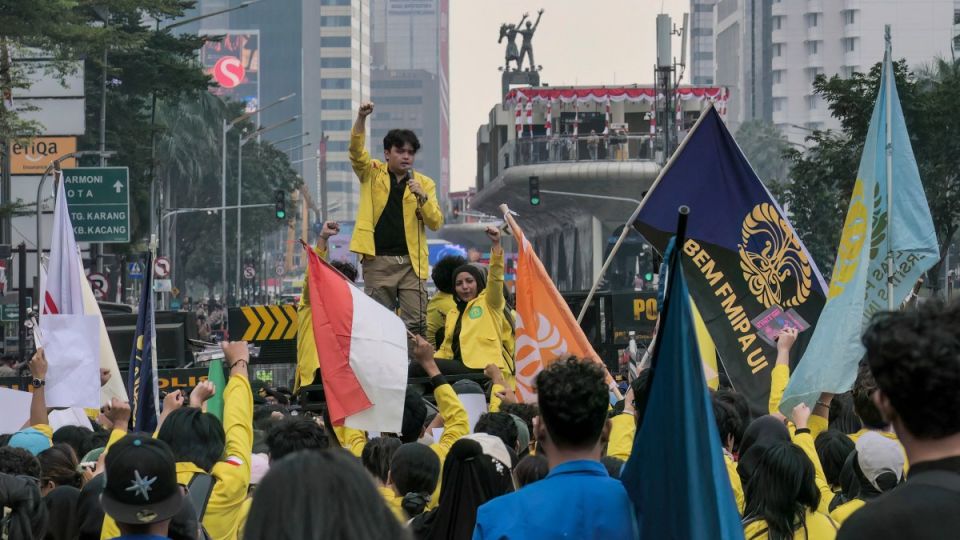
The plan was announced by police spokesperson Sr. Comr. Budi Hermanto on Tuesday, as hundreds of university students were blocked by six layers of police barricades along Jl. Sudirman, less than a kilometer from the traffic circle.
The barricades prevented more than 200 students, mostly from the University of Indonesia (UI), from reaching the traffic circle before the protest ended late Tuesday afternoon.
Budi said the traffic circle was considered the “center of gravity” for Jakarta and argued that protests there could disrupt business climate and public activities.
“It is the center of the economy, international tourism and public activities, where shopping centers and transportation hubs are located,” Budi told reporters.
“If the area is used for public assembly or protests, it will disrupt the activities of others,” he continued.
The traffic circle is surrounded by foreign diplomatic missions, public transit hubs, offices and commercial areas.
Police have previously cited a 2015 gubernatorial regulation as the legal basis for restricting protests as the site.
The regulation designates only three locations for public demonstrations, namely Parkir Timur Senayan at the Bung Karno Sports Complex, Alun Alun Demokrasi at the House of Representatives complex and Silang Selatan at the National Monument (Monas) park. All three areas are in Central Jakarta.
Students and activists, however, have challenged the restriction, arguing that the 1998 law on freedom of expression in public provides a stronger legal basis for their right to demonstrate.
The law guarantees the right to hold demonstrations in public spaces, with restrictions applying to locations including the presidential palace, places of worship, military installations, hospitals, airports and seaports, railway stations, terminals and vital national objects.
“Therefore, the regulation doesn’t automatically turn the HI traffic circle into a prohibited protest venue,” Jakarta Legal Aid Institute (LBH) director Muhammad Fadhil Alfathan told The Jakarta Post on Wednesday.
A student protester holds up a placard reading “reform” on Aug. 18 in the city center a day after the 81st Independence Day in Jakarta, demanding the government eradicate corruption, collusion and nepotism, end wasteful programs, and lower the prices of basic necessities and fuel. (AFP/Azwar Ipank)
He warned that an arbitrary ban on particular protest venues could instead fuel resistance and potentially trigger clashes between security forces and protesters.
Haeril Halim of Amnesty International Indonesia similarly urged the police to lift the restriction, arguing that the traffic circle remained a public space where peaceful protests should be allowed.
“If police try to stop or limit a protest, that intervention must be proportionate and necessary, or in other words, must do more good than harm and must be the least rights-restricting option,” Haeril said.
UI student executive body (BEM UI) member Namoradiarta Siahaan also questioned the legal basis for the restriction, describing the police plan as “baseless”.
“Since it’s a country governed by the law, what is the legal basis that prohibits us from staging a protest at the traffic circle?” Namoradiarta said during Tuesday’s rally.
Separately, the Jakarta administration said it remained “fully committed” to protecting the public’s right, including that of students, to peacefully express their aspirations, according to Chico Hakim, a special staffer for Jakarta Governor Pramono Anung.
Students took to the streets on Tuesday to renew their calls for President Prabowo Subianto’s administration to cut wasteful spending amid deepening economic woes and a series of natural disasters.