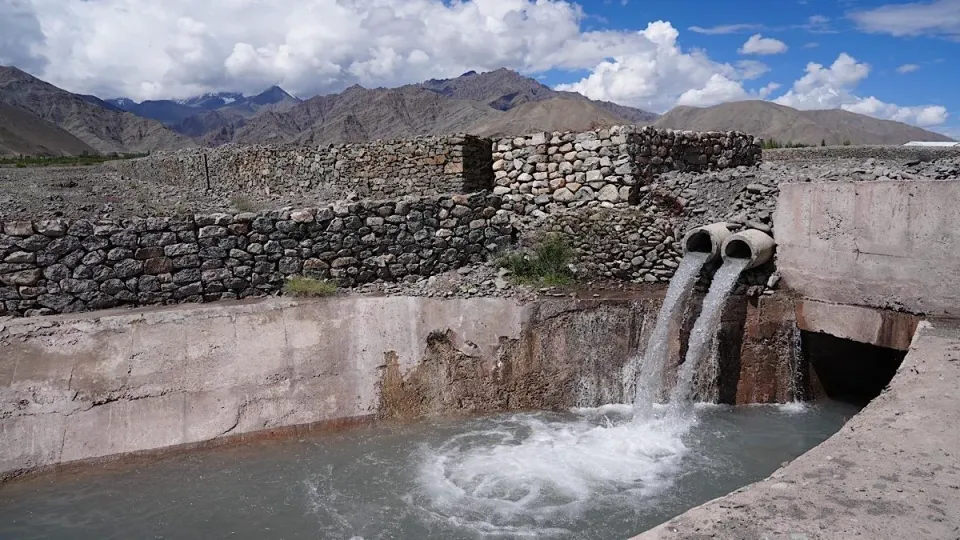
Arya News - A decades-old regional irrigation problem could be headed for a turnaround after the administration diverted 26 cusecs of glacier water from Stok Nallah into the Igoo-Phey Canal, adding nearly 90 million litres of water to the system every day.
JAMMU – A decades-old irrigation problem in Ladakh could be headed for a turnaround after the administration diverted 26 cusecs of glacier water from Stok Nallah into the Igoo-Phey Canal, adding nearly 90 million litres of water to the system every day.
With this, the water that had been flowing unused into the Indus River is now being put to agricultural use in the cold desert region of Ladakh.
The diversion, carried out on the directions of Lieutenant Governor Vinai Kumar Saxena, is expected to increase the canal’s water availability from around 50 cusecs to nearly 80 cusecs, allowing daily water supply to all 12 villages instead of the earlier roster-based distribution.
This landmark initiative uses simple earthwork to channelise and utilise the glacial runoff without incurring any capital expenditure.
While Ladakh is endowed with abundant glacier and snowmelt resources, vast stretches of its cultivable land have historically faced acute irrigation shortages. The imbalance between the large volumes of untapped, draining water and the parched agricultural lands has, for ages, constrained rural livelihoods.
Recognising this critical gap, LG Saxena ideated and spearheaded a comprehensive, systematic campaign during his visits to various villages to identify such places where large quantities of glacier water were flowing down the Indus River.
To ensure that every drop of glacier and snowmelt is harnessed for productive use rather than going to waste, the Lieutenant Governor first identified Stok village Nallah as one such place for diverting the glacier water into the existing canal. The Stok Nallah is fed by the Stok Kangri Glacier near Leh.
The discharge from Stok Nallah, flowing downstream and ultimately into the River Indus, was assessed at approximately 36.60 cusecs. However, two diversions have been created to channelise an additional 26 cusecs of water – 19 cusecs towards Igoo village (upstream) and 7 cusecs towards Phey village (downstream) – from the Stok Nalla into the Igoo-Phey Canal. Planning is underway to utilise the remaining 10 cusecs of water.
Notably, construction of the 43-kilometre-long Igoo-Phey Canal began in 1979 and was completed in 2005. During that period, about 200 metres of the canal was constructed underground to allow Stok Nallah water to pass over it without disturbing the canal’s flow.
“By successfully saving 90 million litres of glacier water daily and diverting this huge volume of water from the Stok Nallah into the Igoo Phey and Yokyur canals, we have proven that large-scale, sustainable water management is entirely feasible in our cold desert. This is a monumental step towards our vision of a green, water-secure, and self-sustaining Ladakh. This successful model is just a blueprint. We will expand these cost-effective interventions across Ladakh, transforming scattered glacier flows into a permanent lifeline for agricultural prosperity, revitalised rural economies, and long-term climate resilience for the people of Ladakh,” Saxena said.