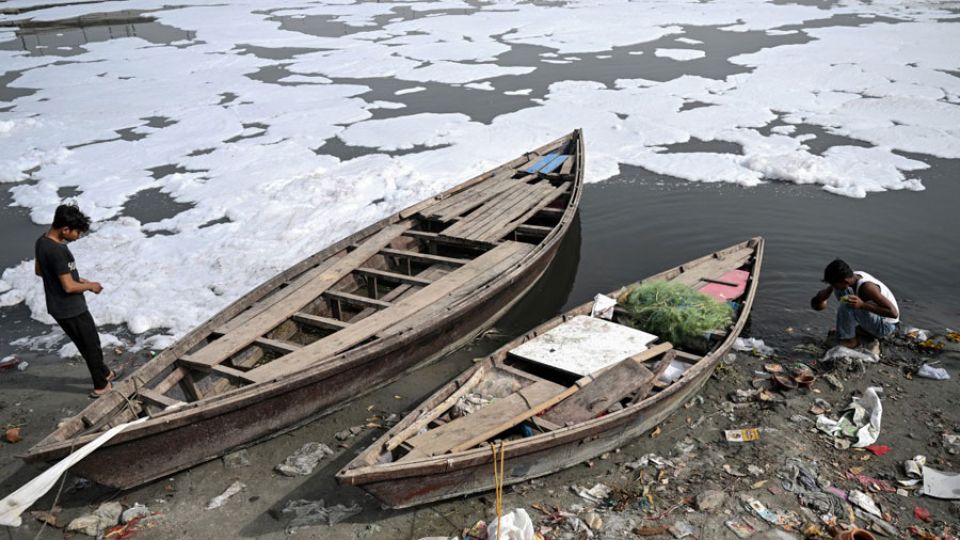
Arya News - The court’s interim measures will remain until experts complete a scientific exercise to identify the river’s high flood line and ecological buffer zones. The case concerns the wider Jojari-Bandi-Luni river system.
NEW DELHI – For years, residents living along Rajasthan’s Jojari River have raised concerns over foul-smelling, chemically contaminated water and its impact on daily life. Now, the Supreme Court has stepped in, restricting construction near the river and ordering safeguards against activities that could worsen pollution.
The apex court on Monday imposed an interim ban on construction and development activities within 100 metres of the edge of the Jojari River, citing serious ecological degradation and the need to protect the river ecosystem.
The order came in a suo motu case concerning pollution in the Jojari River, where the court is examining the impact of industrial discharge and contamination on the wider Jojari-Bandi-Luni river system.
Supreme Court orders 100-metre construction ban, wider pollution buffer
A bench of Justices Vikram Nath and Sandeep Mehta said temporary protection measures were necessary until a scientific exercise determines the river’s high flood line and ecological buffer zones.
The court also directed that no industry or activity capable of causing pollution, contamination or damage to the river ecosystem would be allowed within 500 metres on either side of the identified flood line.
In areas where the flood line has not been identified, the restriction will apply within 500 metres on either side of the river’s present flow path.
The directions will remain in force until the completion of the scientific assessment.
Villages living with polluted river water for years
The court’s intervention follows concerns over industrial and municipal pollution affecting communities along the Jojari River.
According to a report by Mongabay India, nearly 50 villages and hamlets have been dealing with the impact of polluted river water for almost two decades. Residents have reported problems linked to contaminated water, including concerns over health, livelihoods and agriculture.
The river, which passes through areas affected by industrial activity, has become a source of concern for communities dependent on its surroundings.
Pregnant women, newborn health concerns raised by residents
Residents interviewed by Mongabay India have spoken about the difficulties faced by families living near the polluted river.
A resident of Doli Kalan told Mongabay India that pregnant women often had to be taken to doctors and alleged that some pregnancies did not continue or women had to be moved elsewhere to protect newborn health.
Experts cited in the report also raised concerns over exposure to pollutants. Gynaecologist Veena Acharya said chemicals such as lead and cadmium can pose risks to foetal development, including effects on brain development, birth weight and neurological health.
Residents also described wider health concerns in villages along the river, with some reporting recurring illnesses among families living in the affected areas.
Industrial pollution remains at centre of legal battle
The Supreme Court had earlier taken suo motu cognisance of the Jojari River pollution issue following reports of industrial effluent discharge and its impact on local communities.
The proceedings also cover the broader Jojari-Bandi-Luni river system and concerns related to industrial and municipal waste.
The apex court later constituted a High-Level Ecosystem Oversight Committee headed by former Rajasthan High Court judge Justice Sangeet Lodha to prepare a comprehensive restoration and rejuvenation plan for the river system.
The matter has been listed for further hearing on September 22.