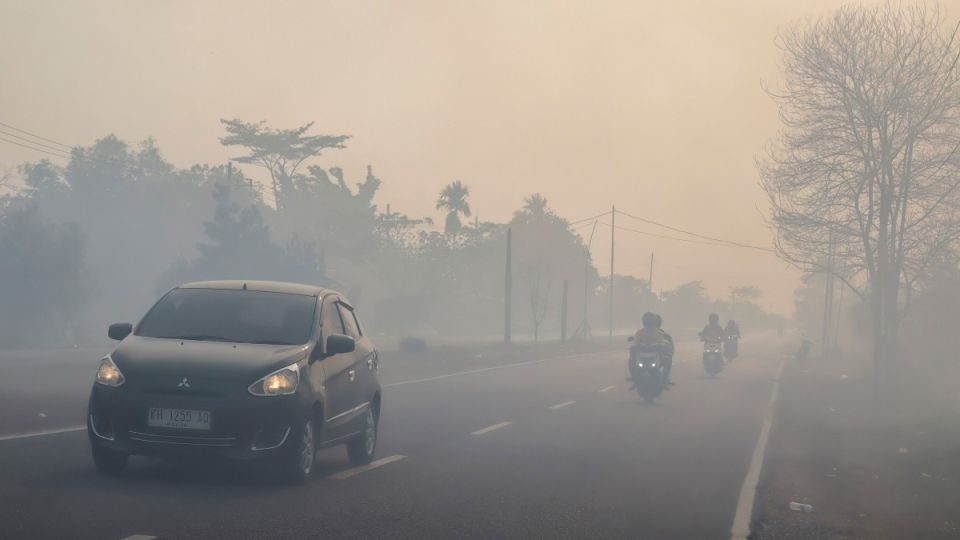
Arya News - More than 3 million people in 37 cities and regencies nationwide have been directly exposed to smoke from wildfires, according to the Health Ministry, with affected regions noting a significant jump in respiratory cases since late July.
JAKARTA – Thick haze from spreading wildfires has blanketed large swaths of Indonesia, sending respiratory cases soaring, disrupting daily life and forcing schools to close as worsening air quality raises health concerns for millions.
In Riau, thick haze has reduced visibility to around 500 meters in recent days, while PM2.5 levels have climbed to 235.7 micrograms (μg) per cubic meter, more than 15 times the World Health Organization’s recommended 24-hour limit of 15 μg.
PM2.5 refers to fine particles measuring 2.5 micrometers or less in diameter, which can penetrate deep into the lungs and pose health risks, particularly with prolonged exposure.
In provincial capital Pekanbaru, resident Styaningrum said the haze was thicker on Monday than previous days, with the strong smell of smoke hanging in the air.
“While I was going to a nearby shop this morning, the smell of smoke was so strong that it made it difficult to breathe and left me feeling dizzy,” she said.
Fine particles were also visible in the air and had settled on the terrace of her home, she observed.
“The dust floating in the air makes my eyes sting. When riding a motorcycle around my neighborhood, a mask is not enough. I have to wear a helmet with a visor to protect my eyes,” added Styaningrum, who has been avoiding spending time outdoors and venturing out only when absolutely necessary.
Andi Masrial, another Pekanbaru resident, said he was keeping his fifth-grade son indoors and preventing him from playing outside to limit exposure to the haze.
“My child has been coughing, so we have closed the windows and kept him in his room with the air conditioner on,” Andi said.
Other areas in Riau, including Pelalawan regency, have ordered schools to shift classes online as concerns grow over the health impacts of haze pollution on children.
Acting Riau governor S.F. Hariyanto said the provincial administration was distributing around 110,000 masks to residents affected by smoke from wildfires.
“The distribution of masks and other health assistance began on Monday. Besides masks, the [local] administration is also preparing medicines and other medical supplies for residents and firefighters who remain on the ground,” he said.
Health authorities have conducted screenings in affected communities, focusing particularly on children to identify potential health issues due to haze exposure.
Riau has recorded 237,835 cases of acute respiratory infection (ARI) since the start of the year.
Emergency services are battling seven wildfires across four regencies in the province as hot, dry weather and strong winds hamper firefighting efforts. Most are peatland fires, which can spread underground and therefore be difficult to extinguish completely.
The Riau Regional Disaster Management and Fire Agency said the fires had burned across 16,264 hectares of the province since January, with peatland comprising 92 percent of the affected area.
In South Sumatra, wildfire smoke has blanketed much of the provincial capital Palembang, where air pollution reached the “very unhealthy” level on Sunday. Visibility dropped to as little as 20 m at the height of the haze, according to local authorities.
Palembang resident Siti Fatimah, 45, said she had kept her daughter home from school since Friday after the girl developed a cough amid the worsening haze. Siti was also taking precautions to protect her toddler, whom she had been keeping indoors.
“Not only children are affected. Even adults feel it in their noses and eyes. The smoke gets thicker as the day goes on,” she said.
Wildfires have scorched more than 1,900 ha of land in South Sumatra this year, with authorities recording 1,723 fire incidents and nearly 13,000 hot spots.
The provincial capital has recorded more than 99,000 ARI cases this year to date, including 9,313 new cases in August alone. Local authorities have responded by distributing 16,500 free masks at several busy locations across the city amid the persisting haze.
In the territory of Kalimantan on Borneo, thick haze has disrupted air travel and driven a sharp rise in respiratory cases, with poor visibility prompting the cancellation of 43 flights from Jakarta to destinations across the island over the weekend.
Health facilities in West Kalimantan have recorded around 5,000 emergency room visits for respiratory infections each week since July, up tenfold from a weekly average of around 500 in the first half of the year.
Central Kalimantan has recorded around 70,400 total ARI cases this year, marked by a sharp rise since July.
Data from the Forestry Ministry’s wildfire monitoring system show that wildfires burned 57,081 ha across Kalimantan’s five provinces between January and June, well above the 55,717 ha burned across the territory throughout 2025.
The Health Ministry said more than 3 million people in 37 cities and regencies nationwide had been directly exposed to wildfire smoke.
The worsening fires have driven a surge in respiratory cases across the country, rising to around 400,000 a week since late last month and reaching more than 10.6 million total cases by early August.
Agus Jamaludin, head of the ministry’s Health Crisis Center, said 314 health workers had been deployed to respond to the surge in respiratory cases with a focus on Central and South Kalimantan, which are among the areas worst affected by the haze.
“The ministry has set up health posts and community health centers operating around the clock, including dedicated facilities to treat people suffering from acute respiratory infection,” Agus said on Friday, as quoted by state news agency Antara.
The ministry is also distributing medical masks, respiratory medicines and eye drops to communities affected by wildfire smoke.