Arya News - The government is turning increasingly to solar power to bolster the country`s energy security as climate change alters rainfall patterns, exposing the vulnerabilities of the hydropower sector.
PUNAKHA – The government is turning increasingly to solar power to bolster the country’s energy security as climate change alters rainfall patterns, exposing the vulnerabilities of the hydropower sector.
During the dry winter months, river flows decline affecting hydropower generation just as electricity demand rises. This seasonal mismatch forces the country to import electricity from India to meet domestic demand.
Solar power is now emerging as a critical part of the government’s strategy to diversify the country’s energy mix and reduce that dependence.
The Department of Energy (DoE) has assessed solar potential across the country, finding opportunities in every dzongkhag except Gasa.
The National Solar Energy Roadmap 2025–2040 has identified 310 potential sites, with a combined solar potential of 4,300MW concentrated in Bumthang, Wangdue, and Trongsa.
However, detailed feasibility studies and site assessments remain to be conducted. “Site suitability depends on a range of factors, including solar irradiation, slope, elevation, geological conditions, environmental considerations, access to roads and water, and proximity to transmission and distribution lines,” a DoE official said.
Private developers have selected potential solar sites in Paro, Thimphu, Wangdue, Trongsa, and Bumthang, while Druk Green Power Corporation (DGPC) has identified sites across the country, according to the DoE.
Officials said private developers’ choices could be influenced by several factors, including proximity to their offices and operations.
Projects identified by both public and private developers are expected to contribute to Bhutan’s goal of reaching 5,000MW of generation capacity by 2040.
Bhutan currently has about 3,576MW of installed hydropower capacity following the commissioning of the 1,020MW Punatsangchhu-II project and three smaller DGPC plants, mainly 18MW Suchhu, 32MW Yungichhu and 54MW Burgangchhu projects.
Achieving the 5,000MW target will require an estimated investment of USD 4.6 billion. The majority of projects are expected to be developed by DGPC with government support, while the remaining capacity would come from private investors and foreign direct investment, with financing from commercial institutions.
Preliminary assessments have been completed and potential sites identified under the renewable energy roadmap. Developers must follow established procedures covering feasibility, approvals, and project development.
The National Energy Policy 2025 positions solar primarily as a complement to hydropower rather than a replacement for it, providing electricity when hydropower production falls during the lean season.
The government expects additional renewable generation to gradually reduce the country’s dependence on electricity imports. Depending on how much planned capacity comes online, the DoE aims to cut imports by at least 10 percent by 2029–30 and ultimately eliminate the need for import by 2040.
The Renewable Energy Development Roadmap 2024 projects that Bhutan could stop importing electricity from India by 2035, if planned developments proceed as intended.
Bhutan’s solar ambitions are already beginning to move beyond roadmaps and feasibility studies.
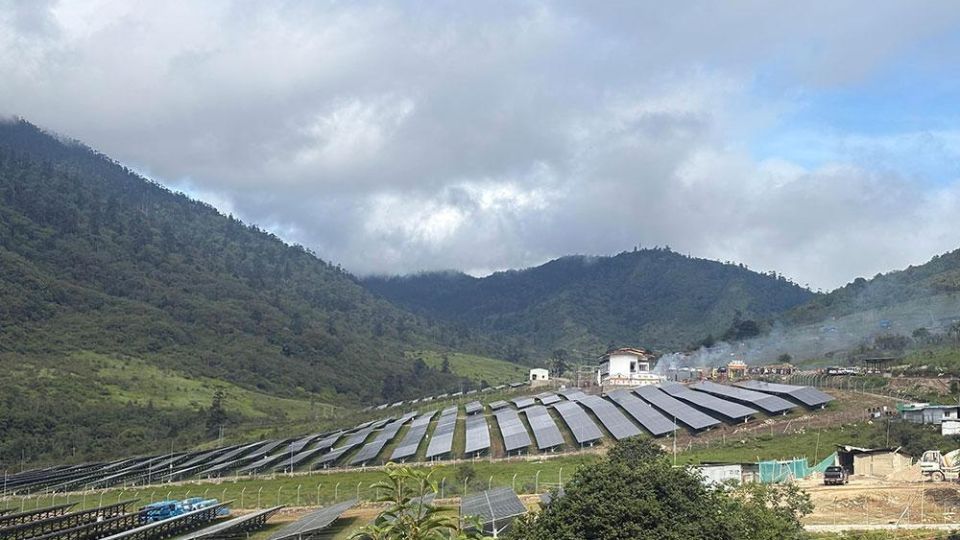
The country’s first utility-scale solar project, the 22.38MWp Sephu Solar Power Plant, has been commissioned. Since beginning operations in July 2025, the plant has generated about 29 million units of electricity and earned roughly Nu 113 million in revenue.
Several others projects are at different stages.
DGPC’s 120MWp Jamjee Solar Project is under construction, while its 120MWp Wobthang Solar Project in Bumthang is in the bidding stage.
The privately developed 146MWp Jungzhi Solar Project is expected to begin construction, while a smaller 200kWp Ecoluxe Solar Power Plant in Bumthang has already been commissioned.
The electricity generated from these solar plants is intended for the domestic market rather than export.
DoE officials said the Sephu project is providing an early test of how utility-scale solar can fit into Bhutan’s electricity system. With much of the country’s identified solar potential still untapped, the DoE sees scope for greater private-sector participation through public-private partnerships, independent power producer models, and foreign direct investment.
Land use, however, is likely to remain an important consideration as projects multiply.
The DoE said the projects identified so far are not intended to use agricultural, forest or community land.
Private developers could propose agri-voltaic projects, combining agricultural production with solar generation, but such developments would require the necessary regulatory and environmental clearances.