Arya News - Cambodia has pursued strict legal action against offenders, criminal networks and any officials involved in the activities, while developing a comprehensive cybercrime legal framework.
PHNOM PENH – No major online scam centres continue to operate in the Kingdom, thanks toa large-scale crackdown that cleared hundreds of suspected scam sites, according to the government’s Ad Hoc Commission for Combating Technology Crimes (ACT).
At the same time, it noted, Cambodia has pursued strict legal action against offenders, criminal networks and any officials involved in the activities, while developing a comprehensive cybercrime legal framework.
The government will host an international conference in September aimed at securing greater international cooperation and political commitment to tackling online scams worldwide.
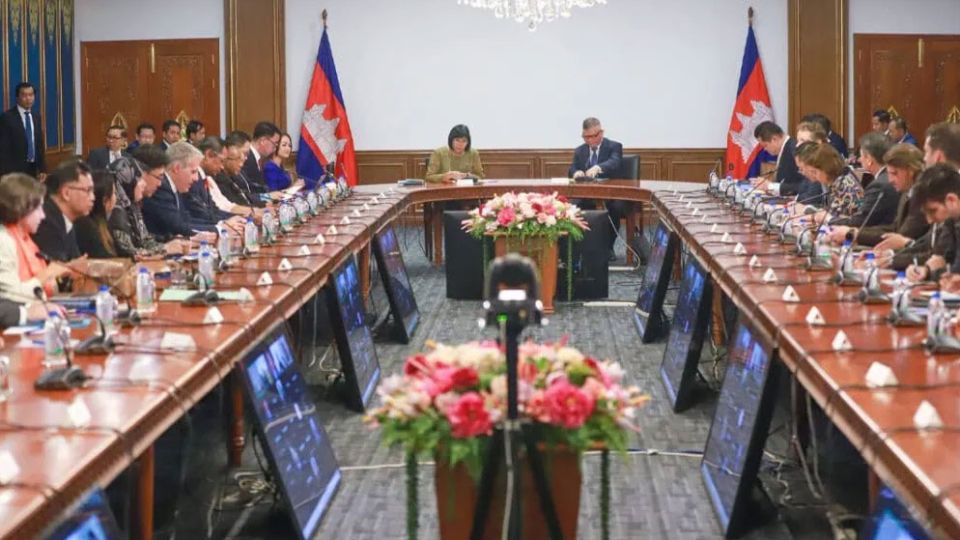
Speaking at a briefing for nearly 50 foreign diplomatic staff and international organisations in Phnom Penh on August 27, Chhay Sinarith, Minister attached to the Prime Minister and chairman of the ACT Secretariat, reported that Cambodian authorities had inspected 793 locations during operations conducted from July 2025 through August 20, 2026.
Of the sites, authorities had taken direct action against 624 locations, while nearly 30,000 suspects from 39 nationalities had been detained.
The meeting, held at the Ministry of Foreign Affairs and International Cooperation, included extensive questions from diplomatic representatives.
Sinarith said authorities had also seized evidence from another 169 suspected crime sites that had been abandoned by suspects who had fled.
He reported that Cambodian authorities have repatriated 58,266 foreign nationals, including 7,282 women. Of them, 22,045 people from 38 nationalities were identified as being directly linked to online scam activities.
Alongside deportations, legal proceedings have been pursued against key suspects, with authorities preparing and sending 408 cases to court.
Under judicial procedures, 3,477 suspects from 29 nationalities have been arrested and temporarily detained in prisons. They include nationals of China, Bangladesh, Vietnam, Myanmar, Cambodia, Laos, Malaysia, Pakistan, Indonesia, the Philippines, Nepal, Yemen, Switzerland, South Africa, Kenya, Cameroon, Morocco, Sri Lanka, Australia, Ukraine, France, Japan, South Korea, Singapore and Thailand, among others.
Authorities are continuing efforts to locate another 855 suspects who are wanted under court-issued warrants.
Sinarith acknowledged that online scam crime remains a complex global threat, with criminal networks rapidly shifting locations and changing the technology and methods they use to conduct fraud.
However, he said Cambodia had brought large-scale scam activity under control and that no major scam centres remained in the country following the crackdown.
“Major scam centres have been completely cleared, while strict legal measures have been taken against criminal suspects and officials involved,” he told the meeting.
He added that the Anti-Corruption Unit (ACU) had taken action in four major cases, arresting 15 suspects who were senior officials and law enforcement personnel. Those detained included deputy prosecutors, a deputy director-general of the Immigration Department, a deputy Phnom Penh police commissioner, a former director-general of the Ministry of Foreign Affairs, as well as police and military officials.
Despite the clearance of major sites, criminal networks have shifted their operations into smaller, more concealed locations, including guesthouses, condominiums, rented houses, vehicles and coffee shops.
Cambodian authorities are continuing to investigate and crack down on such operations, with officials saying there will be no exemptions.
The Commercial Gambling Management Commission (CGMC) has also been active, revoking the licences of 18 casinos and suspending the licences of another nine.
Authorities are also continuing inspections and legal action against casinos involved in online gambling and betting, including online sports betting.
Sinarith noted that alongside implementation of the law on combating technology-based fraud, Cambodia was accelerating the development of additional legislation, including a draft Cybersecurity Law, a draft Information Technology Offences Law and regulations governing virtual assets.
“The development and strengthening of this comprehensive legal framework demonstrates Cambodia’s political will and proactive approach to eliminating and preventing these crimes from taking place in Cambodia, in order to ensure socio-economic security,” he said.
International conference planned
Cambodia will host an International Conference on Combating Technology-Based Fraud on September 23-24.
Themed theme “Together Towards Breaking the Chain and Ending Technology-Based Fraud”, the conference will bring together government representatives, international organisations, law enforcement agencies, financial institutions, technology companies, research institutions and other stakeholders to share experiences and best practices and strengthen cooperation against the global threat.
Sinarith called on all parties to participate in the fight against these global crimes, adding that it requires practical international cooperation and that failure by any party to act would demonstrate a lack of political will to address the shared problem.
“Cambodia remains open to all international cooperation to prevent online scam crimes from returning and to strengthen Cambodia’s role in contributing more actively to efforts to combat technology-based fraud regionally and globally,” he said.
Read More:
Cambodia declares ‘large scam compounds’ eliminated as criminal networks shift into homes, cafés