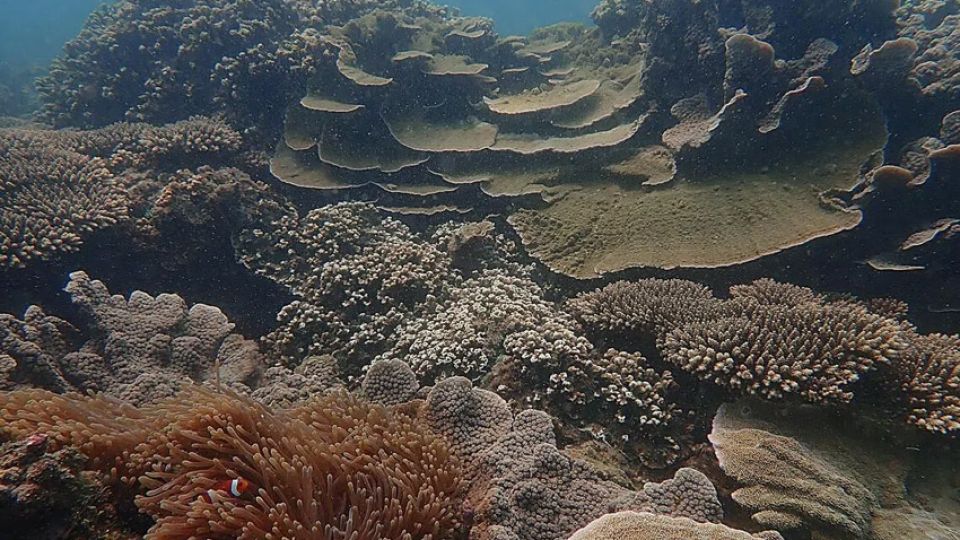
Arya News - The East Asian Seas are home to the Coral Triangle, one of the world’s richest marine biodiversity hotspots located around Indonesia, Malaysia, Papua New Guinea, the Philippines, the Solomon Islands, and Timor-Leste. About 30 per cent of the world’s coral reef area is found in this area.
SINGAPORE – Coral reefs around the world are in decline, with many reef areas shrinking as increasingly frequent marine heatwaves leave them less time to recover in between.
But a new report has found that reefs in the East Asian Seas, which includes Singapore, Malaysia, Indonesia and other parts of South-east Asia, are bucking the global trend, with coral cover holding steady over the past four decades.
The Aug 31 report by the Global Coral Reef Monitoring Network, an international network of scientists, managers and organisations, also showed that there has not been any documented increase in macroalgae, or seaweed, in this region.
This is another encouraging sign of reef health in the East Asian Seas, as macroalgae is known to hinder reef recovery by competing with corals for space to grow.
The East Asian Seas is home to the Coral Triangle, one of the world’s richest marine biodiversity hot spots located around Indonesia, Malaysia, Papua New Guinea, Philippines, Solomon Islands and Timor-Leste. About 30 per cent of the world’s coral reef area is found here.
Experts here told The Straits Times that the findings show that reefs in the region could have certain traits that make them more tolerant of hotter temperatures.
For instance, they may have heat-tolerant genetic traits, or could have microorganisms living in them that confer the coral with greater heat resilience.
Marine biologist Huang Danwei, deputy head of NUS’ Lee Kong Chian Natural History Museum, said corals which thrive even in harsh environments, such as those that live in the murky waters around Singapore, often have a higher degree of tolerance against marine heatwaves.
Such corals could produce offspring that are naturally resilient to warmer sea surface temperatures. When these coral babies disperse and settle in neighbouring reefs, it could confer them greater resilience against heat waves, he added.
Huang, as well as Karenne Tun, group director of National Parks Board’s (NParks) National Biodiversity Centre, are among the Singapore-based authors who contributed to the global report.
Called Status of Coral Reefs of the World: 2025, the 296-page report was based on more than 40 years of data from 36,886 sites across 124 countries and territories. The last time a similar report was published was in 2021.
Corals support about one-quarter of marine life, including thousands of fish species. About a billion people depend on coral reefs, directly or indirectly, from the ecosystem services they provide.
But the report noted that coral reefs are experiencing bleaching events so frequently that they no longer have time to recover before the next one strikes.
Bleaching happens when corals – which get their vibrant colours from microscopic algae that live in their tissues – expel the algae when they are stressed by rising sea temperatures, turning them ashen white.
The algae supply the corals with nutrients, so when bleaching occurs, the corals become vulnerable to disease. The corals may eventually die if the bleaching event is prolonged, as they are deprived of a key source of nutrition.
Global coral bleaching events occurred in 1998, 2010, 2016 and 2024, with Singapore also experiencing mass bleaching during those years.
All four global bleaching events followed El Nino events – a climate phenomenon that warms sea surface temperatures and lifts global temperatures.
Scientists have warned that another coral bleaching event may be on the cards in 2026, as the world is in the grips of a severe El Nino event that could extend to 2027.
The report showed that the average global hard coral cover dropped from 30.2 per cent in 1980 to 27.3 per cent in 2024.
Hard coral cover refers to the proportion of the coastal habitat that is covered by hard coral.
In comparison, coral reef cover in the East Asian Seas region remained stable between 1980 and 2009, with an average hard coral cover of about 30 per cent. This dipped to 27 per cent after the 2010 bleaching event, but recovered to close to 1980 levels between 2010 and 2020.
The report’s lead author Manuel Gonzalez Rivero said that the gap between bleaching events once stretched for decades, but now averages just five or six years. For instance, prior to the 1998 global bleaching event, the first widespread mass bleaching occurred during the 1982-83 El Nino, according to the National Oceanic and Atmospheric Administration.
And while the report showed that reefs in this region have shown a “remarkable stability” in hard coral cover over the past four decades, Huang said that climate-driven ocean warming remains the greatest threat to coral reefs even in the East Asian Seas region.
Moreover, reefs in the region face other stressors that could impact their health. “The other main threats to East Asian reefs include nutrient pollution that causes macroalgae to overgrow corals, marine plastics, overfishing, increased sedimentation and water turbidity, coastal development and land reclamation,” he said.
NParks’ Tun said that the apparent stability of East Asian reefs could also be because any decline in one part of the region is balanced out by an increase in coral cover somewhere else.
For example, declines in Southern Java and Sunda and parts of the Northern Coral Triangle were offset by gains in the Central Coral Triangle and Kuroshio, according to the report. This suggests that apparent regional stability may mask important local variability and vulnerability, it said, noting that resolving such patterns will require consistent data collection at the local level.
Data collection at the local level could also help scientists keep an eye on other aspects of reef health beyond coral cover.
For instance, Tun noted that while coral cover may remain stable, the types of species found in an area could change. Such shifts in coral communities can affect how reefs function and the ecosystem services they provide, she added.