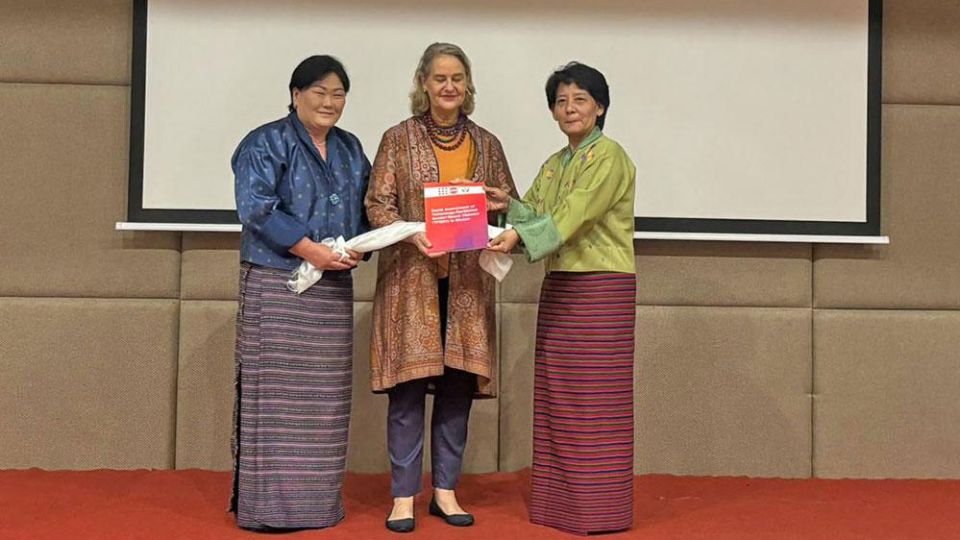
Arya News - The call was made on September 14 during a high-level advocacy event on ending TFGBV in Bhutan, organised by RENEW in collaboration with the United Nations Population Fund (UNFPA) Bhutan Country Office.
THIMPHU – Stakeholders have called for stronger and coordinated action to address technology-facilitated gender-based violence (TFGBV) as emerging forms of online abuse become a growing concern in Bhutan.
The call was made today during a high-level advocacy event on ending TFGBV in Bhutan, organised by RENEW in collaboration with the United Nations Population Fund (UNFPA) Bhutan Country Office.
The event also marked the release of a Rapid Assessment of Technology-Facilitated Gender-Based Violence in Bhutan, which provides an overview of emerging forms of online violence and gaps in the country’s response mechanisms.
The assessment identifies online harassment, cyberbullying, impersonation, anonymous online abuse, image-based abuse, circulation of intimate content, sextortion, and emerging forms of AI-generated deepfakes and digitally altered sexual imagery as key forms of TFGBV in Bhutan.
Although systematic national prevalence data on TFGBV remains limited, the assessment found growing concerns about the emotional, psychosocial and reputational impacts of online abuse, particularly on women, girls, children, young people and other vulnerable groups.
UNFPA India and Country Director, UNFPA Bhutan, Andrea M. Wongar, said that the harm inflicted in the digital realm carries profound and devastating real-world consequences for survivors.
“TFGBV is not merely a technological glitch. It is a direct continuation and amplification of offline gender inequalities, patriarchal norms and power imbalances,” the Country Director said.
She said Bhutan was not starting from an institutional vacuum and had shown proactive leadership on these issues.
“This existing momentum gives us real opportunities to strengthen prevention, awareness, coordination, reporting pathways, survivor support and institutional preparedness,” she said.
“Many countries in the region are now looking to Bhutan as a model for its comprehensive approach to addressing technology-facilitated gender-based violence,” said the Country Director of UNFPA Bhutan.
Cabinet Secretary and Chairperson of the National Commission for Women and Children (NCWC), Kesang Deki, said technology had not created these harms but had amplified and accelerated them, while in some ways making them harder to see and more difficult for victims to escape.
“We lack a comprehensive law addressing gender-based violence in totality, one that covers emerging issues like online harassment and deepfakes,” she said. “We do not yet have the formal channels needed to hold global platforms accountable.”
The Cabinet Secretary said the Government would use the report’s findings to finalise the National Protocol for Responding to Technology-Facilitated Gender-Based Violence, which was committed to under the 2024–2028 strategy, in partnership with GovTech and the Royal Bhutan Police.
She said the Government would also ensure that the protocol reaches frontline case managers and counsellors who are often the first to meet survivors.
The assessment found that survivors often face barriers to reporting because of shame, fear of reputational damage, victim-blaming, confidentiality concerns and limited awareness of available support and reporting mechanisms.
It noted that TFGBV should not be treated solely as a cybercrime or technology issue, as online violence can reflect and amplify existing gender inequalities, harmful social norms, stigma and discrimination.
The assessment found that Bhutan already has several legal, institutional and service-delivery mechanisms that can contribute to addressing TFGBV, including criminal law provisions, ICT and media regulations, child protection and cybersecurity initiatives, gender-based violence frameworks, and psychosocial support services.
However, gaps remain in inter-agency coordination, technical and investigative capacity, reporting and data systems, institutional preparedness, and the ability of existing frameworks to respond to rapidly evolving forms of technology-enabled abuse.
The assessment recommends strengthening existing systems rather than creating parallel mechanisms.
It calls for revised GBV Standard Operating Procedures to include specific provisions on TFGBV, clearer referral pathways and institutional responsibilities, stronger inter-agency coordination, improved digital investigation and reporting systems, and survivor-centred and trauma-informed support.
It also recommends greater digital literacy and awareness, stronger prevention measures, improved data collection and research, and continued review and adaptation of legal and regulatory frameworks to address emerging forms of online abuse, including AI-enabled violence.
A panel discussion on “From Evidence to Action: A Collective Response to TFGBV in Bhutan” followed the launch, bringing together stakeholders to discuss prevention, response and accountability.
Participants stressed the need for coordinated action among government agencies, law enforcement, regulators, civil society, service providers, development partners, communities and technology users.
With internet access, smartphone use and social media engagement increasing, stakeholders said that ensuring safer digital spaces would require both stronger institutional responses and greater awareness among users.
The assessment emphasises that addressing TFGBV requires a collective response that protects survivors, strengthens accountability and ensures that digital spaces remain safe and inclusive.