Arya News - Cambodian Mine Action Centre (CMAC) director-general Heng Ratana said the estimate covered the direct cost of surveying and clearing newly contaminated areas.
PHNOM PENH – Clearing the unexploded ordnance (UXOs) left by the 2025 Cambodia–Thailand border clashes could cost approximately $1 billion and take more than a decade, according to a preliminary estimate by the Cambodian Mine Action Centre (CMAC). The cleanup places new financial and humanitarian pressure on a country still dealing with contamination from past wars, it noted.
CMAC director-general Heng Ratana said the estimate covered the direct cost of surveying and clearing newly contaminated areas.
The work would have to be conducted alongside existing operations to remove landmines, cluster munitions, aerial bombs and other unexploded ordnance left from decades of conflict.
“For the clearance of these explosive remnants of war (ERWs), we may need around $1 billion, and it could take more than 10 years,” he said following a September 11 presentation at the Techno Peace Museum.
Ratana stressed that the timeframe depended on available funding, access to affected areas, security conditions and operational capacity.
“If sufficient resources are available, we may be able to complete the work in a little more than 10 years,” he said, adding that the estimate did not mean all ERWs from previous conflicts would also be eliminated during that period.
He argued that responsibility for the cost should not fall solely on Cambodia.
“This is also a question of responsibility. Those who violated our country must be held responsible,” he said.
New contamination forces strategic rethink
Cambodia had already established targets for reducing the impact of anti-personnel mines by 2030 and other explosive remnants of war by 2035.
However, Ratana said those strategies were developed before the contamination arising from the 2025 clashes.
“The problem is that, when those plans were prepared, they did not yet include the new explosive remnants that entered our country in 2025,” he said.
“This will require us to revise our strategy,” he added.
Ratana explained that Cambodia’s 2030 target applied primarily to known areas contaminated by anti-personnel mines, and should not be interpreted as a commitment to remove every bomb or unexploded munition throughout the country.
Cambodia submitted information covering approximately 524 square kilometres of known mine-contaminated land to the international community in November 2025, he said.
However, data from 11 districts in border provinces had not yet been fully included because the clashes interrupted CMAC’s survey operations.
Those districts could add more than 200 square kilometres, bringing the known anti-personnel mine challenge to over 700 square kilometres.
That figure is separate from areas affected by aerial bombs, cluster munitions and other unexploded ordnance from earlier wars, as well as the contamination attributed to the latest fighting.
Ratana distinguished between the technical terms “mine-free” and “impact-free”, noting that complete removal of every explosive item would be extremely difficult to measure or achieve.
An impact-free country, he explained, could still contain mines in remote and unused locations, but they would no longer present a significant threat to communities or socioeconomic development.
Nearly 386,000 hectares identified
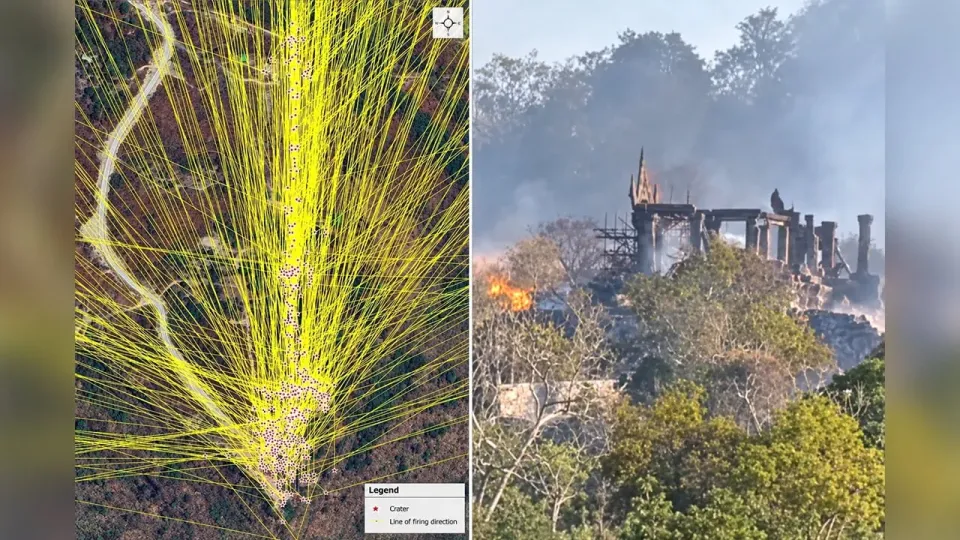
CMAC’s preliminary field investigation following the clashes identified more than 16,000 items or locations considered physical evidence of explosive contamination, according to Ratana.
Survey teams used impact sites, craters, fragments and unexploded weapons to map affected areas and analyse apparent firing directions.
The evidence was consolidated into approximately 5,400 contaminated polygons covering an estimated 386,000 hectares.
Within this broader area, CMAC estimated that cluster-munition contamination affected approximately 295,000 hectares across 335 villages.
Another 14 affected villages had not yet been fully surveyed clearance teams could not safely access them, Ratana noted.
CMAC estimates that between six million and seven million individual cluster submunitions may have been dispersed.
Ratana cautioned that this was an operational estimate based on the area affected, the capacity of the delivery systems and evidence collected on the ground, rather than a final verified count.
Cluster munitions can disperse dozens of smaller explosive devices over a wide area.
Submunitions that fail to detonate remain dangerous and may explode when touched, moved or struck during farming and construction.
Ratana said CMAC teams had encountered M42, M46 and M85 submunitions in fields, villages, houses and schools. Some were found underground, while others were caught in trees, bamboo or on rooftops, complicating clearance operations.
Based on field experience, he estimated that 30 to 40 per cent of some submunitions may have failed to explode, with potentially higher failure rates for those buried in the ground.
The precise number remains uncertain because surveys have not been completed in all frontline and inaccessible areas.
Cost extends beyond clearance
Ratana said the projected $1 billion represented the direct cost of technical survey, clearance and disposal.
It did not include the wider economic losses caused by contaminated land remaining unusable for years.
“If land cannot be used for 10 years, and it could have generated $500 or $1,000 a year, how much income will be lost?” he asked.
More than 92,000 families, or almost 400,000 people, were affected, across 22 districts, 60 communes and 349 villages along the border, according to figures presented by CMAC.
Contamination has restricted access to homes, farmland, schools, health centres, roads, wells and ponds. Ratana warned that families unable to cultivate their land or return safely to their houses would require continued government assistance.
He described the contamination as a potentially long-term socioeconomic crisis rather than solely a technical demining problem.
“If people cannot return, cannot use their land, cannot produce crops and cannot live safely in their homes, this becomes a serious challenge for the government,” he said.
Emergency clearance prioritises civilian areas
CMAC divided affected locations into three operational categories following the fighting.
Blue areas were considered sufficiently safe for residents to return after emergency interventions.
Orange areas remained accessible but were close to locations presenting continuing risks. Red areas could not yet be entered because of security conditions or the presence of unexploded ordnance.
Initial operations prioritised residential areas and essential routes, including access to wells, ponds and public services. Clearance later expanded to farmland and other sites necessary for restoring livelihoods.
During approximately six to seven months of emergency operations, CMAC cleared or released more than 100 square kilometres of land and found or destroyed nearly 10,000 explosive items, Ratana said.
Teams had supported the safe return or access of more than 6,000 households and conducted clearance at 89 schools and 20 health centres.
CMAC also carried out approximately 5,500 explosive-risk education sessions, reaching about 230,000 people.
Nevertheless, Ratana said these achievements represented only the emergency phase.
Full clearance would require a longer-term strategy, sustained government funding and increased international support.
“The immediate work is like emergency treatment for a seriously injured person,” he said.
“We still need a longer-term solution that establishes priorities and ensures sustainable development for affected communities,” he added.
CMAC has already received support from international partners, including Japan, the US, Germany, China, UN agencies, the World Bank and mine-action organisations.
But Ratana indicated that the unprecedented scale of the new contamination would require greater resources and continued cooperation.
Cambodia has spent more than three decades clearing mines and unexploded ordnance.
CMAC alone has removed approximately 3.2 million explosive items during the past three decades, accounting for an estimated 72 to 73 per cent of all items cleared nationwide, according to Ratana.
Annual mine and unexploded-ordnance casualties have fallen from nearly 1,500 in 1999 to fewer than 50 in recent years.
However, the new contamination threatens to slow Cambodia’s progress and prolong the danger to border communities.
CMAC has not yet published a final nationwide technical assessment detailing the complete clearance cost, contaminated area or implementation schedule.
Ratana said further surveys would be necessary before a definitive figure and operational plan could be established.
Read More:
Cambodia’s UN ambassador: ‘Fighting crime can never justify territorial violations’
Cambodia challenges Thailand to explain troops, weapons at Tamone Thom
Myanmar leader backs Cambodia’s peaceful, law-based’ stance on Thai border dispute