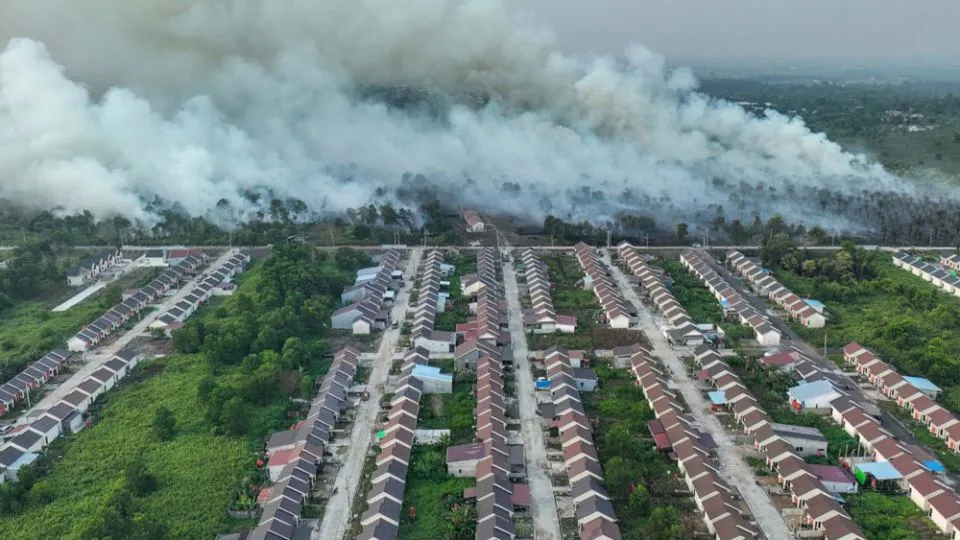
Arya News - The Independent Housing Stimulus Assistance (BSPS), which helps homeowners renovate their houses, had reached only 32.5 percent of its 400,000-unit target for 2026 as of Sept. 17.
JAKARTA – The government is struggling to meet President Prabowo Subianto’s target of building 3 million homes a year, with data showing that key supporting programs are falling behind their milestones. While potential assistance from countries such as China could help bridge the gap, analysts warn that financially constrained homebuyers, coupled with regulatory and ownership uncertainties, could make the ambitious target increasingly difficult to achieve.
The target is supposed to be fulfilled through multiple programs, including subsidized housing, home renovations and easier access to housing credit. However, with less than four months left in 2026, Public Housing and Settlements Minister Maruarar “Ara” Sirait said several regions still need to improve the implementation of their programs.
The Independent Housing Stimulus Assistance (BSPS) program, which helps homeowners renovate their houses, had reached only 32.5 percent of its 400,000-unit target for 2026 as of Sept. 17. The government plans to increase the target fivefold to 2 million units in 2027.
Meanwhile, the Housing Financing Liquidity Facility (FLPP) had provided Rp 18.75 trillion (US$1.05 billion) in financing for 150,750 homes as of Sept. 16, reaching only 43.1 percent of this year’s 350,000-unit target.
The government has pledged to improve implementation by easing BSPS eligibility requirements, including reducing the required occupancy period for uninhabitable homes, shortening the waiting period between aid disbursements and simplifying proof of land ownership.
On financing, the Housing Credit Program (KPP) ceiling has been raised from Rp 36 trillion to Rp 50 trillion, along with incentives for low-income households, including waivers of land and building acquisition duties and building permit fees in regions that have adopted the policies.
Inviting foreign helps
The government is opening the door to partnerships with companies from China and other countries to accelerate housing development.
“We need [Chinese] technology because it can make housing construction faster, but I need it to be safe and, if possible, not expensive and affordable. I also want technology transfer. And goods from local micro, small and medium enterprises (MSMEs) should be used. Don’t make Indonesia [only] a market,” Minister Ara told reporters on Wednesday.
He said the government had held discussions with China’s housing minister and the Chinese ambassador while preparing land and regulations for potential projects at 10 locations.
“For entrepreneurs, what is important is legal certainty. Don’t let permits take too long as long as they comply with the rules, and there should be no illegal levies,” Maruarar said, acknowledging the problems that hamper the program.
The government is also discussing a housing cooperation scheme with Qatar, with land and regulations being prepared, Maruarar said, adding that the projects’ legal framework was being reviewed with law enforcement and audit institutions.
Previously, Deputy Public Housing and Settlements Minister Fahri Hamzah said Qatar-based Al Qilaa Group had delayed its investment commitment under the 3-million-home program pending legal certainty over the land for its planned transit-oriented development (TOD) housing project in Kampung Bandan, Jakarta, on land under the right to manage (HPL) held by state railway operator PT Kereta Api Indonesia (KAI), as reported by Bisnis.
The investor wants assurances that the land is free from potential future disputes, Fahri said, adding that negotiations over its status were ongoing.
Real Estate Indonesia (REI) deputy chairman Bambang Ekajaya said cooperation with China on construction technology could help accelerate housing development, particularly vertical housing.
China’s advanced prefabricated construction technology could shorten construction times for high-rise projects and make more efficient use of limited land in Jakarta and other major cities, he said.
“Cooperation with foreign parties, for example, China, usually they come as a package. The project is not the only thing they handle, but they may also bring financing from there to accelerate development, which is still lacking here and is still needed, because we are still far from the actual need,” Bambang said to The Jakarta Post on Thursday.
However, Bambang said the cooperation would need clearer regulations, particularly on foreign workers, land, ownership, investment and financing.
“That also needs to be handled carefully. We should not let the good objective then create social or political problems.”
Arief Rahardjo, head of strategic consulting at Cushman & Wakefield, said that construction technology could help improve cost and time efficiency, particularly for large-scale projects, but it would not be enough on its own to determine investment decisions.
“Technology is not the only factor, because ultimately, investors will still look at overall project viability, including demand preferences, affordability and land costs,” Arief said to the Post on Thursday.
Indonesia’s housing sector, he noted, continued to have strong underlying demand, particularly because most buyers were end-users.
However, investors and developers were becoming more selective as demand remained price-sensitive, while land and construction costs continued to weigh on project feasibility.
“The more predictable the processes and regulations are, the easier it is for investors to calculate risks and returns,” Arief said.