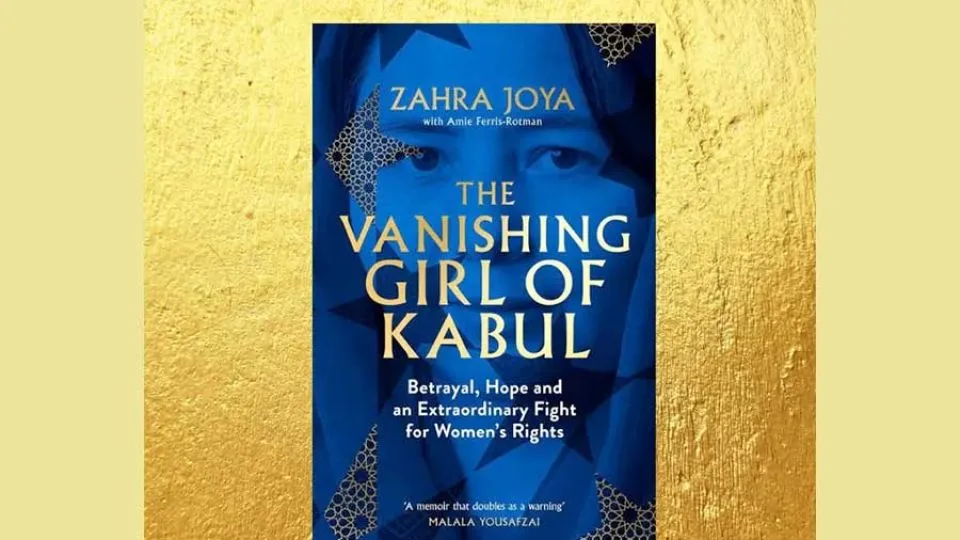
Arya News - Zahra Joya and Amie Ferris-Rotman combine memoir with journalism to examine the systematic erasure of women under the Taliban.
ISLAMABAD – There is a moment in The Vanishing Girl of Kabul when Zahra Joya is trying to work out what she will need to report on the Taliban’s return. She isn’t just thinking like a journalist, she’s thinking like someone who has already lived through one Taliban regime and knows what its return could mean.
The danger is therefore both professional and personal. Her notebook is also a record of what might happen to her, her colleagues and the women whose stories she is determined to tell. This tension gives the book its particular force. Published in this July and co-written with British-American journalist Amie Ferris-Rotman, The Vanishing Girl of Kabul combines the intimacy of memoir with the discipline and urgency of investigative journalism.
Joya’s story begins with a deceptively simple need: she wants to go to school. During the Taliban’s first rule in the 1990s, that meant becoming someone else. Her family allowed her to live for years as a “bacha posh”, a girl dressed and treated as a boy. She became Mohammed so that she could move through a world in which education was available to boys but forbidden to girls.
This transformation is not presented as a clever childhood adventure. It is an early lesson in the absurdity of a society that makes basic freedom dependent on gender.
When Joya eventually returns to school as Zahra, the emotional cost of that earlier life becomes clear. Boys still call her Mohammed. Girls recognise her as Zahra. She remembers wanting to “escape, disappear in a cloud of magical smoke”. The image is striking because disappearance will become one of the book’s central ideas. Joya spends her childhood hiding in order to exist, and later watches millions of Afghan women being pushed towards a different kind of disappearance, from schools, workplaces, streets and public life.
Yet the book refuses to turn Afghanistan into a story of unbroken darkness. That is one of its most important strengths. After the fall of the first Taliban government and the US-led intervention, Joya experiences education and professional opportunity on a scale that had previously seemed impossible.
She becomes the first woman in her family to attend university and eventually becomes a journalist determined to expose corruption and abuses against women. For her and many other Afghan women, those years represented real possibilities, whatever the failures and contradictions of the foreign intervention.
This history matters because the book is not simply arguing that Afghanistan was once free and then became unfree. It is asking what happens when people are encouraged to build lives around the promise of progress and then watch that progress disappear. The Taliban’s return in 2021 therefore becomes more than a political event. It becomes a personal rupture.
Joya had built a professional identity that was almost unimaginable during her childhood. Now she was forced into hiding and eventually exile.
Her journalism gives the memoir another dimension. Joya’s encounter with Sahar Speaks, the initiative founded by Ferris-Rotman, is especially significant. Ferris-Rotman had noticed a glaring problem in international coverage of Afghanistan — foreign journalists were regularly writing about Afghan women, often presenting Afghanistan as one of the world’s worst places to be female, while Afghan women themselves were largely absent from the foreign press corps.
Joya arrived at Sahar Speaks with limited English and asked simply, “Could I sit in a corner? I won’t bother you, I just want to learn.” She had crossed Kabul to get there.
That encounter eventually leads to Rukhshana Media, the women-led organisation Joya founded to report on Afghan women and girls. Its significance becomes even clearer after the Taliban takeover. The work is no longer simply about giving women a place in journalism. It becomes a way of documenting what power wants hidden.
Some of the book’s most disturbing passages come from these investigations. Joya and her colleagues documented dozens of cases of women who were killed or disappeared after the Taliban returned.
Among them was Khatera, a teacher found strangled with her own scarf, whose death was dismissed by the Taliban as an armed robbery. In Mazar-i-Sharif, the murders of two teenage girls sent a chilling message to other young women about the price of pursuing an education. Frozan Safi, a 29-year-old economics lecturer and activist, was eventually identified in a morgue by the clothes she was wearing.
These episodes demonstrate why The Vanishing Girl of Kabul should not be read only as a memoir. Joya is not simply remembering what happened to her. She is investigating what is happening to others. Her personal experience gives her access to the emotional reality of repression, while her journalistic training makes her attentive to names, evidence, patterns and omissions. The two forms strengthen each other.
The book is also unusually clear about the limits of Western narratives. Joya challenges the idea that Afghan women who fled simply abandoned the struggle. When a Western commentator suggests that Kabul feminists should have stayed and fought, Joya responds with the reality of what Afghan women were already doing under extraordinary pressure.
She came from the provinces, built a media organisation and continued to report when doing so could put her life at risk. Her anger is directed not only at the Taliban but also at the Western governments that negotiated with them and then failed to reckon with the consequences.
The writing itself is strongest when it moves between the intimate and the political without forcing either one to dominate. A suicide bombing is not merely another statistic because Joya’s body has learned its rhythm. The 2016 attack on a Tolo TV bus, which killed seven staff members and injured more than 20, becomes part of her understanding of what it means to work as a journalist in Afghanistan.
Later, watching footage of 17-year-old Zaki Anwari falling from an American evacuation aircraft turns the chaotic withdrawal into something painfully human: a young life, and all the possibilities attached to it, disappearing before the world.
Exile does not provide an uncomplicated ending. In London, Joya and her family initially live in a hotel before making a home in North London. They arrive with one shared backpack and diapers, and gradually acquire books, clothes and suitcases. “Without meaning to, we made a life again!” she writes. The sentence captures both relief and loss. Making a new life is possible, but it does not mean recovering the old one.
That is ultimately what makes the book significant now. The Vanishing Girl of Kabul is not a story in which rescue arrives from outside. Its central achievement is to place Afghan women inside the narrative as witnesses, journalists, investigators and political actors. Joya does not ask readers to pity Afghan women. She asks them to listen to them.
The title suggests disappearance, but the book works against it. The girls who are denied classrooms, the women who are silenced, the journalists who are threatened and the families forced into exile are all at risk of being reduced to statistics. Joya’s answer is to record their names and circumstances, to investigate what happened and to insist that their lives remain part of the historical record.
That is the quiet power of this memoir. It does not pretend that journalism can immediately defeat repression, nor does it offer easy optimism. Instead, it shows that recording the truth is itself a form of resistance. The Taliban may try to make Afghan women vanish from public life. Joya’s work makes disappearance harder. She writes so that the world cannot say it did not know.